
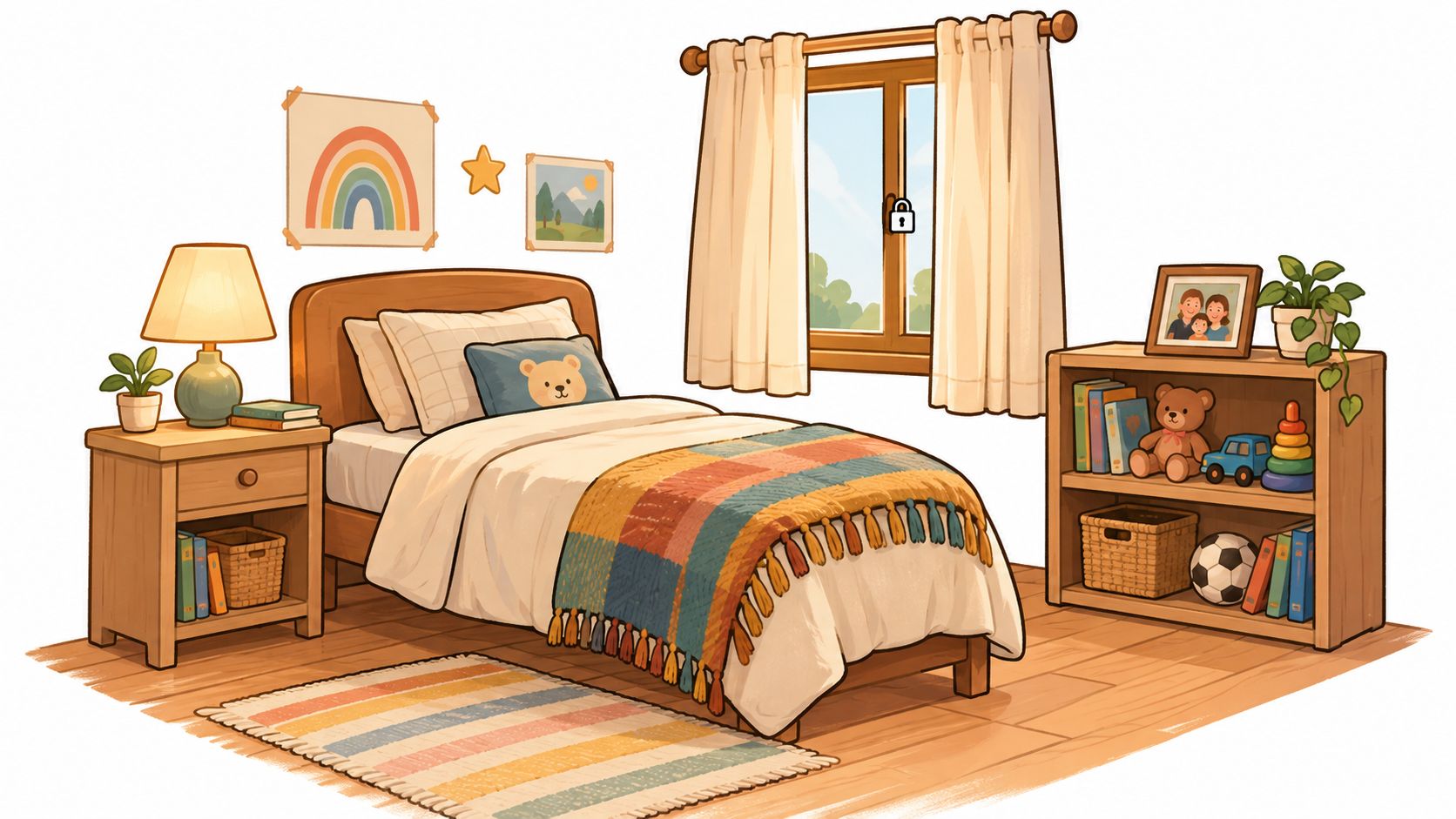
Standing in a spare room on a Saturday morning, most households have the same thought. The walls look fine, the floor is clean, the bed can go there, but is this really a foster care bedroom that could welcome a child safely and well?
That question matters. In England, the bedroom is not treated as a casual decorating choice. It sits inside safeguarding, privacy, placement matching and long-term stability, which means the room has to work on four levels at once, legally, physically, emotionally and financially.
Table of Contents
- Standing in Your Spare Room and Wondering If It's Enough
- What UK Fostering Standards Actually Require of a Bedroom
- Walking Through the Room for Safety, Privacy and Practical Use
- Furnishing and Personalising the Room for a Real Child
- Sharing, Matching and the Child Who Actually Comes
- Keeping the Room Ready Between Placements
- Putting It Together and Taking the Next Step
Standing in Your Spare Room and Wondering If It's Enough
The first mistake people make is judging the room by whether it looks tidy. Tidiness helps, but fostering approval depends on whether the room can hold a child's life with dignity, safety and privacy. A spare room that feels fine for storage can still be wrong for fostering if it lacks space, warmth, or the right layout.
Start with the right mindset
The room is not being assessed as a showroom. It is being assessed as part of a home where a child may arrive carrying a lot of change, uncertainty and, sometimes, distress. That means the room needs to feel ready without being overdone.
Practical rule: A good fostering room says, “you have a proper place here,” not “this was only ever a guest room.”
A sensible way to think about the space is to test four things in order. First, does it fit the legal and policy expectations in England? Second, is it physically safe and private? Third, does it feel personal rather than temporary? Fourth, can the household keep it available without creating financial strain?
That order matters because a child's bedroom is part of the placement, not something to sort out after approval. The room needs to support the matching decision social workers make before a child arrives. If the room is not ready, the placement conversation gets harder, slower and less certain.
Preparation also sends a message. A room that has been thought through tells a child that they were expected, not squeezed in at the last minute. That quiet message is one of the most important things a foster home can offer.
What UK Fostering Standards Actually Require of a Bedroom
England's national fostering standards are direct about the bedroom. Under Standard 10.6, each child over the age of three should have their own bedroom in the foster home, and if sharing is unavoidable, the responsible authority has to agree to that arrangement for each child, with every child given their own area in the shared room. The decision and the reasons for it must be recorded in writing, and the provider has to consider bullying, abuse history, abusive behaviour, the children's wishes and other relevant circumstances before asking for agreement. The related accommodation standard also requires the home to comfortably accommodate everyone, including any aids or adaptations needed for a disabled child. Those requirements are set out in the National Minimum Standards for Fostering Services published by the government, and they make the room a safeguarding issue, not a housing preference, as the standard wording shows in the official document on fostering services standards.
What “suitable” really means
Suitability is not just about owning a spare room. Government guidance for England says applicants will usually need one, but they do not have to own their home. Manchester City Council says a spare bedroom is ideally available, but not essential in every circumstance, including some baby care and flexi-carer arrangements, and it discusses individual circumstances at enquiry rather than ruling people out online.
That flexibility should not be misunderstood. It does not cancel the national expectation that children over three normally need their own room. It means a household without a permanently unused room is not automatically dead in the water before a proper conversation has even happened.
For a foster assessment, “suitable” means the home can be matched to a child's needs with defensible reasoning. It covers privacy, safety, accessibility and the child's circumstances, not just square footage. It also means the agency or local authority can explain why the arrangement works and can stand behind that decision in writing.
The safest interpretation is simple. A spare room helps, but a defensible matching decision is what really matters.
If the household wants to understand the wider assessment process, the questions usually begin well before anyone talks about décor. A useful place to start is these fostering assessment questions, because the bedroom is only one part of the wider approval picture.
Walking Through the Room for Safety, Privacy and Practical Use
A strong room starts with the basics, but the basics need to be tested properly. The door should close securely, windows should be safe, and the child should be able to move around without bumping into furniture or squeezing past clutter. If the room becomes a thoroughfare, or if the layout makes it hard to get out in an emergency, it stops being a good fostering room.
Check the structure before the soft furnishings
Heating matters because a child needs a room that feels settled, not drafty or unevenly warm. Lighting matters too, especially a practical bedside light for reading, night-time reassurance or winding down. Ventilation should be decent, because a closed, stale room does not feel healthy or comfortable for everyday use.
Storage is not an afterthought. Clothes, books, toys and small personal items need a clear place so the child can own the room instead of just sleeping in it. A small desk or at least a workable surface for homework, colouring, writing or a laptop makes the room more usable for school-age children and teenagers.
For the door and lock, caution beats guesswork. If the household is changing or fitting door furniture, it helps to avoid common lock installation mistakes, because a poor fit can create noise, sticking, or weak security. A simple practical guide like avoid common lock installation mistakes is useful when the aim is privacy that works rather than privacy in name only.
Privacy is built, not wished for
Privacy is visible in the details. Curtains or blinds should cover the window properly. Sightlines from the landing should be thought through. The child should be able to close the door at night and feel that the room is theirs for rest, not a space that feels constantly exposed.
Useful standard to hold in mind: if the room feels too open for a child to change clothes, sleep, study or keep belongings private, it is not ready yet.
The room should also be clean, uncluttered and easy to keep that way. A bin with a lid, a mirror at a sensible height and simple bedside storage all make a difference. None of those are glamorous, but all of them help a child settle into a home with less friction.
Anyone preparing the physical room should also think ahead to the support side of fostering. A supervising social worker's advice can be valuable here, especially when the room needs to work for a child's specific needs or for a future placement type. A practical overview of that support sits in what foster care social workers do, and it's worth reading before making expensive decisions.
Furnishing and Personalising the Room for a Real Child
A foster care bedroom should look ready for a child, not locked into one child's age, taste or gender. That means starting with neutral basics that can be layered later, then leaving room for the child's own things once they arrive. A bed, mattress, wardrobe, bedding and a place for books or possessions are the obvious starting points, but the room should still feel flexible enough to adapt.
Build in flexibility from the start
A household waiting for approval doesn't know whether the first placement will be a baby, a primary-aged child or a teenager. Babies may need a very different sleep setup from older children, while teenagers need more privacy, more storage and often more control over how the room feels. A one-theme room can become a problem if it signals the wrong age or personality.
The safest choice is usually a calm base with room for change. Plain bedding, simple storage and neutral walls make it easier to add a child's own belongings later. That approach also avoids sending the message that the home has already decided who the child should be.
For families thinking through room furniture, a practical guide like the guide for parents on kids' furniture can help with layout ideas, but the true test is whether the furniture leaves enough space for the child's movement, privacy and storage.
Let the child's identity fit the room
A child's room should make space for culture, faith, language and personal identity. That means there should be room for photographs, books, keepsakes, prayer items, cultural objects or anything else the child may want around them. The point is not to decorate around a child before they arrive. The point is to make sure their own sense of self can enter the room without being edited out.
Practical items help too. A spare set of bedding means the room is easier to manage on laundry day. A nightlight option can make settling easier for some children. A lockable drawer can be useful for older children who want a private place for personal items, provided the arrangement fits the child's age and the household's safeguarding approach.
For teenagers, the room needs even more respect. They often want less childish décor, more storage and more say over how their space looks. A useful perspective on that age group sits in teens in foster care, because a teenager's bedroom is often the difference between feeling tolerated and feeling welcomed.
Sharing, Matching and the Child Who Actually Comes
Bedroom sharing in fostering is decided through matching, not enthusiasm. The room has to suit the child who is coming, so the age, gender, relationship, background and wishes of the children all need to be checked before anyone sleeps there. The arrangement should be written down before it starts.
Sharing is a safeguarding decision
Sibling sharing is not automatic permission. Some local authorities allow it only up to a certain age, while others are stricter or more flexible depending on the situation. The agency has to check the responsible authority's policy before assuming a shared room is acceptable.
A baby under six months may sleep in the carer's room in some circumstances, but older children generally need a suitable private space. Mixed-age and mixed-need sharing needs closer attention, especially where there is a history of abuse, abusive behaviour, bullying or emotional volatility. The sleeping arrangement has to protect both children, not just fit the floor plan.
Bedroom sharing should never be treated as a quick fix for lack of space. It has to survive a safeguarding conversation.
If a child has mobility or sensory needs, a downstairs bedroom or accessible bathroom may be a better fit than a larger upstairs room. The issue is not one feature on its own, but whether the whole home supports the child safely and comfortably. The room decision should sit alongside the wider home layout.
Trafford Council's matching checklist is a good example of how seriously this gets treated. It requires the age and gender of the children, the background of everyone who may share, the views of the other child, and consultation with the other child's social worker if that child is also looked after. It also requires the outcome to be recorded on both files, which makes the arrangement part of placement matching rather than a casual household choice. The same general principle appears in how placement matches work, because the bedroom is only one part of a child's placement story.
For households trying to make a shared room workable, it helps to create a playful children's bedroom that still leaves room for privacy and individual space. That means separate storage, clear sleeping areas and enough personal territory for each child to feel settled, even when the room is shared.
Before any shared arrangement begins, write down who sleeps where, why the arrangement is safe, and what each child keeps private, then make sure the record appears on both files.
Keeping the Room Ready Between Placements
The hardest part of a foster care bedroom is often the empty period between children. The room still has to be kept ready, even when nobody is sleeping there, and that has housing and budget consequences. Many households underestimate the commitment there.
The room has to stay available
UK Universal Credit housing rules recognise an additional-room condition for foster parents, including approved foster parents who currently have no child placed, provided the relevant period since approval or the last placement does not exceed 12 months. That matters because the empty room still has a purpose, and the system can recognise that purpose if the paperwork and housing position are handled properly. The legal detail sits in the Universal Credit housing rules for an additional room.
That does not solve everything. Households still need to think about evidence, local housing policy, and what happens when a placement ends but the room remains reserved. A council tax or housing policy question is not the same as fostering approval, and the two should not be confused.
The practical issue is simple. If a room is turned into a home office, guest room or storage space, it may stop functioning as the always-ready child's room that fostering requires. Families should be very cautious about redesignating it in a way that makes a future placement harder.
Budget for vacancy, not just for occupancy
A bedroom that sits empty still costs money. Bedding wears out, furniture needs replacing over time and utilities do not disappear just because the room is between placements. Households that ignore this often discover too late that they can physically foster but can't comfortably keep the room available.
The wider context is clear enough. England and Wales have a large pool of spare rooms, yet the care system still needs more foster carers. That gap suggests the barrier is not only physical space. Confidence, housing policy and the cost of leaving a room open all matter just as much.
A sensible household plans for both states of the room, occupied and vacant. That means keeping it functional, financially manageable and ready to welcome a child again without a rushed reset.
Putting It Together and Taking the Next Step

A strong foster care bedroom is not just a spare room with a bed in it. It is a safeguarding decision, a private and safe space, a welcome that feels personal, and a room that can stay ready when placements change. The biggest mistakes are usually the obvious ones, treating sharing as automatic, overlooking privacy, or forgetting the cost of keeping the room available.
If a spare room is already sitting in the house, the next step is not to guess. Organic Fostering can talk through what a foster care bedroom needs to look like in practice, how matching works, and what the household should expect from assessment and support. Visit Organic Fostering for an informal, no-obligation conversation about becoming a foster carer or transferring from another agency.