

In England, most applications to become a foster carer take roughly six to eight months from application to approval, with eight months as a maximum planning benchmark rather than a guaranteed completion date. Some applications finish sooner, while others take longer.
But when an agency describes its timetable, does that mean the assessment alone, the time until panel, or the whole journey from first enquiry to formal approval?
That distinction matters for households planning work, family commitments and a future fostering role. Understanding how long it takes to become a foster carer means separating the published benchmark from the practical steps that determine an individual application's progress.
Table of Contents
- Typical Timescales from Enquiry to Approval
- What the Eight-Month Benchmark Really Means
- Checks and Paperwork That Shape the Timeline
- Common Delays and Who Can Control Them
- What to Expect from Organic Fostering in Manchester
- Frequently Asked Questions About Fostering Timescales
- Practical Steps and Questions to Ask Before You Commit
Typical Timescales from Enquiry to Approval
The route into fostering includes several connected activities, not a queue of completely separate appointments. Checks, preparation training and conversations with a social worker may overlap, so adding every activity together can give a misleading total.
Stage 1 covers initial suitability evidence, including identity, household information, health and statutory checks. Stage 2 is the fuller assessment of parenting capacity, relationships, experience, support networks and the proposed fostering role.
Indicative timescales for each stage of becoming a foster carer in England
| Stage | What happens | Indicative timing |
|---|---|---|
| Enquiry and first conversation | Questions about fostering, an initial conversation and an optional home visit | Agency appointment availability sets the starting date |
| Application and Stage 1 checks | Forms, identity, health and statutory checks | Decision on completion within 10 working days of receiving all required information, under the statutory assessment guidance |
| Preparation training | Pre-approval learning about fostering and children's needs | Provider course dates and attendance requirements set the schedule |
| Stage 2 assessment | Social worker interviews, references and home visits | Several months of assessment work, potentially alongside initial checks |
| Panel recommendation | Panel considers the assessment and recommends whether the applicant is suitable | Within eight months of the application to be assessed |
| Final decision and approval | The decision-maker considers the recommendation and final minutes | Within seven working days of receiving the recommendation and final panel minutes |
| Whole process | Application through to formal approval | Commonly six to eight months, without a guaranteed completion date |
The panel and decision-maker timings above come from the Fostering Services National Minimum Standards, which distinguish the panel's recommendation within eight months from the considered decision within seven working days after receipt of the recommendation and final minutes.
A positive panel recommendation isn't the final approval decision. Applicants still need the fostering service's formal decision and notification. The explanation of panel and approvals helps clarify that distinction.
Building a personal timeline
Applicants can record an expected date beside each stage, then ask which activities can happen together. Government analysis of mainstream fostering households approved in 2022–23 found that 76% completed both assessment stages concurrently, including 85% through independent fostering agencies and 65% through local authorities, according to the Department for Education's recruitment and retention analysis.
For example, a household might attend preparation training while references are being gathered. The useful planning question is therefore whether any outstanding task prevents the next activity from starting, rather than whether every check has already finished.
What the Eight-Month Benchmark Really Means
How should you use a published timescale when your own assessment may take a different amount of time? Treat it as a planning reference, like an expected house-sale completion date: useful for setting expectations, but affected by the evidence and decisions still outstanding.
Fostering decisions require enough information to consider whether an applicant can meet children's needs safely. A late reference, for example, can hold up the evidence needed for a decision, even if other parts of the assessment are progressing.
A benchmark, not a fixed timetable
The GOV.UK guide to applying to become a foster carer describes a process that can take up to eight months. It includes household checks, social-work assessment, panel consideration and a final decision. This gives applicants a public framework for planning, while individual completion times depend on how the stages and evidence come together.
National monitoring also compares approvals completed within 180 days, approximately six months, with those taking 240 days, approximately eight months. The Department for Education's fostering reform consultation reports these timings by provider type:
Approval timing by provider type in England
| Provider type | Approved within six months | Took eight months or more |
|---|---|---|
| Local authority | 41% | 29% |
| Independent fostering agency | 61% | 18% |
These figures describe groups of approvals. They cannot predict an individual household's timescale or show that one particular agency will be faster. Use them to understand the range in reported timings, not as a personal deadline.

Approval and matching are different decisions
Applicants can discuss the ages, needs and types of fostering they feel prepared to consider. The government application guide explains that applicants cannot choose a particular child from a group or have a trial placement. Assessment considers an applicant's suitability, including preparation for children's everyday lives, learning and relationships. After approval, matching considers whether the household can meet a particular child's needs, including their identity, relationships and daily care.
Useful comparison: An agency's current average is more helpful when it states where the clock starts and ends and explains how longer applications are counted.
Before using an advertised timescale to plan, ask how the agency measures it and what stages it includes. The guide to fostering assessments can help you understand what the assessment involves and identify which parts of your own timetable may need confirmation.
Checks and Paperwork That Shape the Timeline
A social worker may finish an interview before a reference or medical report arrives. That doesn't mean the assessment can immediately move to a decision: the service needs the supporting evidence as well as the conversations.
Checks help assess safeguarding, household stability and the practical ability to care for a child. They should build a rounded picture, rather than treat a person's health, employment history or relationships as isolated facts.
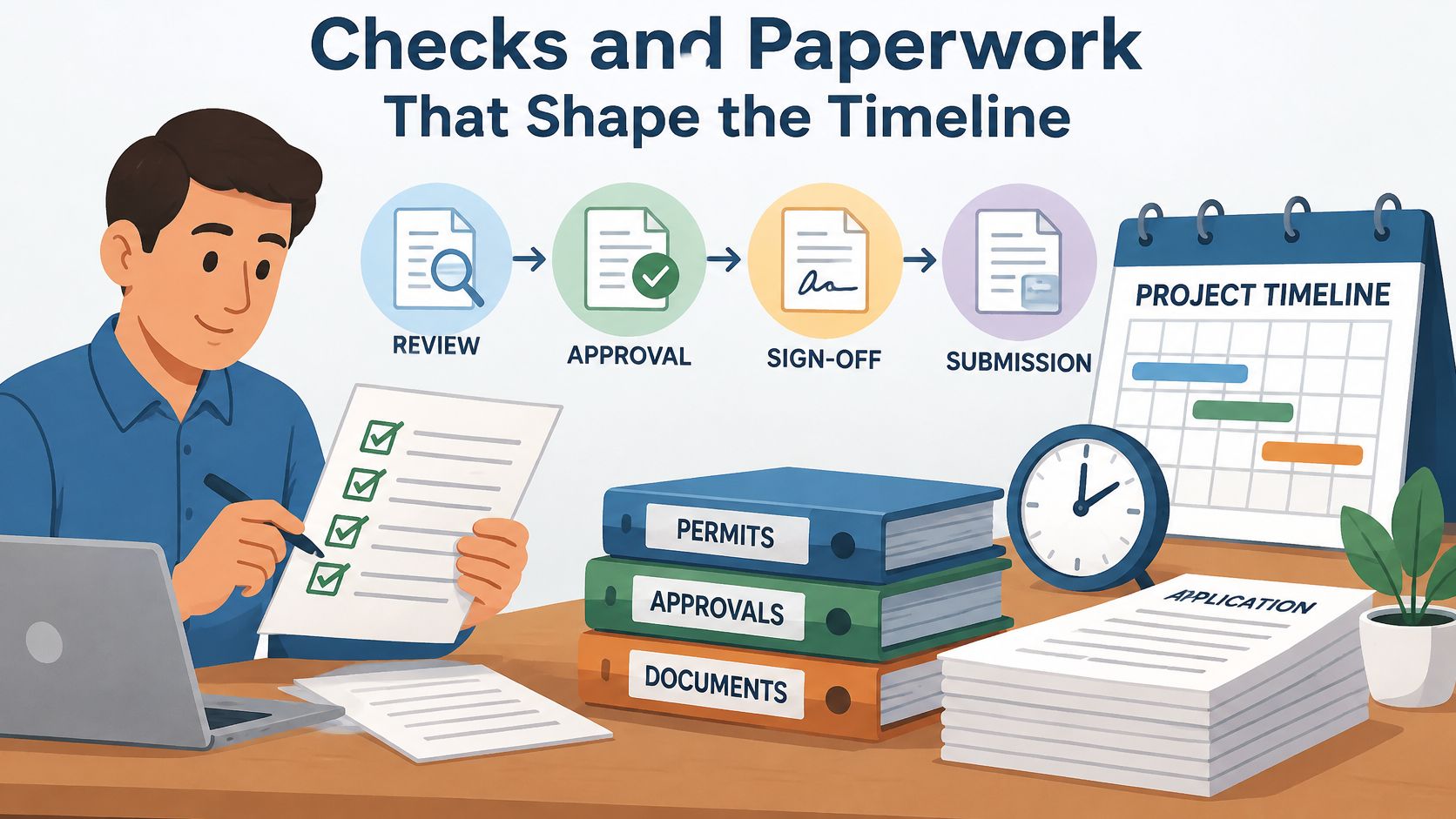
Checks and references in the fostering assessment
| Check or reference | What it covers | Why it matters for children |
|---|---|---|
| Enhanced DBS | Criminal-record information for the applicant and every adult living in the household | Supports safeguarding and suitability decisions |
| GP medical | Health information from the applicant's GP | Helps assess capacity for the caring role and support needs |
| Probation checks | Relevant involvement with probation services | Informs risk assessment |
| Personal references | Accounts from people who know the applicant well | Provides an independent view of character and relationships |
| Ex-partner reference | Relevant information about previous relationships | Helps establish a fuller personal and family history |
| Current partner checks | Relevant checks concerning a current partner | Considers significant adults around the child |
| Education references | Information concerning the applicant's children | Helps assess how existing children's needs are met |
| Employment references | Work history and explanations for employment gaps | Checks the accuracy and completeness of the applicant's history |
| Finances and housing | Financial information, credit history and landlord information where applicable | Helps assess household stability and practical readiness |
| Home safety | The home environment, including pets | Identifies hazards and necessary safety measures |
Why course length isn't the whole timetable
As a local example, Medway Council's fostering process requires a three-day Skills to Foster course and describes its Form F assessment as taking around three to four months. Those are details of that council's process, not national course-length or assessment guarantees.
Form F is an assessment report used to bring together information about an applicant's suitability to foster. Completing training doesn't mean that references, home visits or the assessment report are also complete.
Each provider sets out its detailed evidence requirements, so the table is a guide rather than an exhaustive checklist. Applicants can use the background checks overview to prepare questions about documents, consent forms and relevant personal history.
Common Delays and Who Can Control Them
The Department for Education's fostering statistics report that England received 8,290 applications in 2024–25, with 5,370 completed during the year and 2,925 still in progress at 31 March 2025. These figures show why a household's assessment may cross a reporting year. The published totals describe activity during a set period, while each application depends on its own outstanding tasks.
For your own timeline, identify what is still needed and who can take the next step. Applicants can influence some waits directly, while others depend on referees, agencies or checking bodies. The table shows where each party can act.
Common delays and who usually controls them
| Delay | Typical cause | Who holds most control |
|---|---|---|
| Late or missing references | Slow responses or incomplete contact details | Applicant can check details and prompt referees; referees control replies |
| Checks taking longer than expected | Records needed from previous addresses or services | Shared between the applicant, agency and checking bodies |
| Delayed medical information | GP report has not arrived | Applicant can arrange appointments and follow up; the GP controls reporting |
| Household members unavailable | Adults cannot attend interviews or visits | Applicant and household |
| Panel date not aligned | Report completion does not match the panel timetable | Agency |
| Requests for more information | Gaps or questions emerge during assessment | Shared |
| Training places full | Limited course dates or capacity | Agency |
| Changes in circumstances | A house move, relationship change or health issue | Applicant controls prompt disclosure, not necessarily the event |
| Unclear next steps | Responsibilities or updates have not been explained | Agency |
Influence without pressure
A prompt from an applicant can move one part of the process along, but it cannot set another person's response time. For example, if a referee has not replied, the applicant can check that the agency sent the request to the correct address and remind the referee to respond. The agency then decides whether the reference meets its requirements or whether another referee is appropriate.
A GP report can create a similar pause. The applicant can arrange any requested appointment, confirm that the report request has been received and ask the agency whether anything else is needed. The GP controls when the report is prepared, so regular, clear follow-up is more useful than assuming the assessment has stopped.
A wait by itself says little about suitability. Ask which evidence remains outstanding, who is responsible for the next action and when to expect an update. Those details turn an uncertain pause into a task that can be tracked.
If you are preparing for assessment conversations, the fostering assessment questions guide can help you plan what to ask. Clear questions about responsibilities and next steps make it easier to follow your own timeline without expecting every stage to move at the same pace.
What to Expect from Organic Fostering in Manchester
What should a household in Greater Manchester check beyond a headline timetable? Organic Fostering is an Ofsted-registered independent agency supporting foster families across Manchester and the North West. Its route to approval includes an enquiry, home visit, application, preparation training, assessment, panel and approval, with the pace shaped by how these stages fit the household's circumstances.
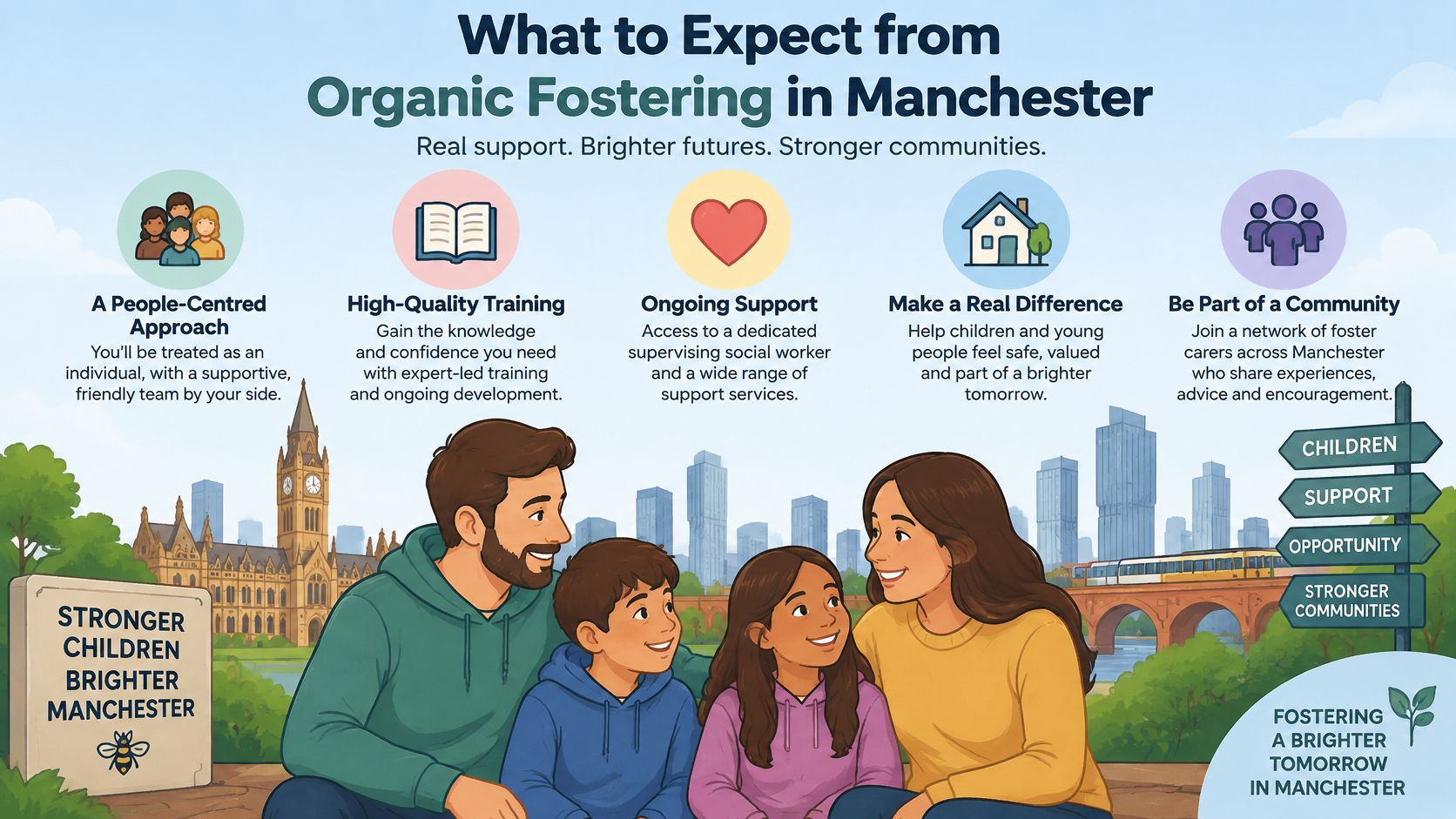
Checking the current offer
The published information describes a supervising social worker for each household, out-of-hours advice, allowance details, an online estimate tool and support for experienced carers considering a transfer. These details can help families understand what support may be available, but current arrangements should be confirmed before they shape a budget or plan.
Read the payment policy to understand the distinction between money for a child's care and any carer fee. Check the Statement of Purpose for how the service operates, then consult the latest Ofsted report and current register information rather than relying on older descriptions. This gives a clearer picture of both the agency's approach and its current standing.
Planning for a transfer
Experienced carers should have a separate discussion about transferring. A new applicant's timetable is not a reliable forecast for a transfer, especially if a child already lives with the household. In that situation, planning must account for continuity of care as well as the assessment and approval process. The family can ask for a clear outline of the transfer steps and how they will be coordinated, then plan around that specific route instead of applying a general benchmark.
Frequently Asked Questions About Fostering Timescales
Can payment or pressure speed up approval?
Payment cannot shorten the safeguarding checks or assessment. Applicants can influence some parts of the timetable by returning complete documents, replying promptly and attending agreed appointments. The agency still needs time to complete its assessment and decision-making.
Does approval mean a child will arrive straight away?
No. Approval and placement are separate stages, as explained in What the Eight-Month Benchmark Really Means. A household should avoid arranging an arrival around an expected approval date, since matching also considers existing household members and the support a placement requires.
Can a single person become a foster carer?
Being single does not, by itself, determine an application's outcome. The assessment considers the person's circumstances, availability, relationships and support network. Before applying, ask the agency for its published eligibility criteria and check how they apply to your situation.
Does a longer assessment mean the application is going badly?
A longer timetable alone does not show how an application will be decided. Ask the agency what stage remains and what action is needed from you. Clarify whether the outstanding task is a record, an appointment, an additional assessment conversation or a suitability matter that needs discussion. Each calls for a different next step.
What happens if an applicant withdraws?
Tell the fostering service directly that you want to withdraw, then ask how it will record the decision, what happens to information already collected and whether anything must be completed. If you might apply again, ask what the agency would need to review in a future application. Where you are unsure rather than ready to withdraw, request a conversation about the remaining steps and any concerns you want addressed.
Practical Steps and Questions to Ask Before You Commit
What would help your household decide whether fostering fits your circumstances? Start by asking how the agency will guide you through preparation, assessment and approval, then consider the practical commitments alongside your family discussions and work arrangements.
A simple tracker can make progress easier to follow without turning assessment into a race. For example, record “medical form,” the date it was requested, who is responsible, and the next action. If the agreed update date passes, contact the named person to ask whether anything is needed from you and when to check again.
Questions for an initial conversation
- Current timings: What stages does the agency expect, and how can the timing vary for an individual household?
- Communication: Who will be your named contact, and how will you receive progress updates?
- Assessment: What will the assessment ask you to reflect on about your household, relationships and readiness?
- Decision-making: What happens after panel, and how will the final outcome be communicated?
- Preparation: What does training cover, and when are places available? Read the foster parent training guide to learn more about preparation.
- Support and allowances: What support continues after approval, and where can you read the written policies on payments and responsibilities?
- Transfers: If you are moving from another agency, how will the agencies coordinate the transfer and maintain continuity for a child already placed?
Before and during the process, keep submitted documents organised, respond to requests as you are able, and tell your contact if your circumstances change. These steps help the agency work with accurate information. They do not remove the need for time to reflect on fostering and the needs of a child who may join your household.
Organic Fostering offers prospective carers across Manchester and the North West an informal, no-obligation conversation about assessment, preparation and the practical commitments of fostering. Adults considering fostering or transferring agencies can visit Organic Fostering to discuss their circumstances and ask for current stage-by-stage timings. A conversation can clarify possible next steps, but it cannot guarantee approval or a fixed completion date.