

A woman in her fifties in Salford has a spare bedroom, grown children of her own, and a shoplifting conviction from when she was nineteen. She has thought about fostering for years, yet keeps putting off the enquiry because she assumes that one mistake settled the question decades ago. Her situation is common, and the honest answer is more layered than a plain yes or no.
Answering it properly means separating three different questions. What must an applicant disclose? Everything, spent or unspent. What might an enhanced DBS check show? Potentially cautions and spent convictions alongside anything unspent. The check works like an X-ray: it reveals what is on the record, and the assessment then decides what it means. Which offences normally prevent approval? A defined list covers the most serious matters.
The assessment also looks beyond the person who enquires. A partner or adult child in the household is checked too, and the type of fostering being considered, such as caring for teenagers or taking short-notice placements, can shape how a past offence is weighed. Fostering means caring for children who cannot live with their birth families, so each judgement comes back to whether a home can offer safe, stable care.
The need is real. In the year ending 31 March 2024, 83,630 children were looked after by local authorities in England, 56,390 of them, or 67 per cent, lived in foster placements, 24 per cent of foster placements were with a relative or friend (up from 20 per cent in 2020), and 10 per cent of looked-after children experienced three or more placements during the year, according to the official 2024 statistics. Later official releases show fostering household numbers continuing to grow, while children still wait for safe, stable homes.

For a wider introduction to eligibility, prospective carers can read five questions about who can foster. What matters in the end is suitability and children's safety, judged from the detail of each case rather than the phrase "criminal record" alone.
Table of Contents
- Can You Foster with a Criminal Record
- DBS Checks, Cautions and What to Disclose
- When a Household Member Has a Record
- What Different Criminal Records Can Mean
- How Organic Fostering Assesses Past Convictions
- What to Do Before You Enquire
Can You Foster with a Criminal Record
The short answer to can you foster with a criminal record is yes, in some circumstances. In England, the agency must consider the individual case, but particular offences normally prevent approval. A historic minor conviction may be assessed differently from a recent serious offence, yet nobody can assume they'll be approved without a full assessment.
That assessment looks beyond the name of an offence. The agency will need to understand what happened, the person's age at the time, the sentence or other outcome, how long ago it was, whether there's a pattern, and what evidence shows about rehabilitation and current circumstances. It also considers whether the history creates a risk to a child in the home.
The legal test is about suitability
Under regulation 26 of the Fostering Services (England) Regulations 2011, a fostering service may assess an applicant it considers may be suitable. The regulation doesn't impose a blanket ban on every conviction. It does, however, set out mandatory exclusions for specified offences.
An applicant, or an adult household member aged 18 or over, is generally not suitable if convicted as an adult of an offence listed in Part 2 of Schedule 4, or given a police caution for such an offence after admitting it. The framework also refers to certain categories linked to Schedule 4, including some where the original offences have since been repealed. The exact offence and the person's age when it occurred matter.
In plain language, the specified categories concern serious harm, including offences against children, sexual offences and serious violence, cruelty or neglect. A narrow exception may allow approval for a particular named child if that child's welfare requires it, often where there's an existing family relationship or the adult is already caring for that child. This is not general permission to foster any child.
Practical rule: Ask about the exact offence and the relevant legal category, rather than relying on a broad label such as “spent conviction” or “minor offence”.
Local authorities and independent agencies in Manchester and the wider North West work within the same England-wide framework. Before an application goes to a fostering panel, the agency must consider the circumstances and the child's welfare. The precise Schedule 4 wording should be checked against the current regulations when advice is being prepared for publication. Prospective carers can find out more about becoming a foster carer.
DBS Checks, Cautions and What to Disclose
The legal test and the paperwork are related, but they aren't the same thing. Fostering in England involves an enhanced DBS check with a children's barred-list check. The assessment also considers information such as convictions, cautions and relevant police information, alongside references and the wider circumstances of the household.
A conviction follows a court finding. A caution is a formal police outcome following an admission, and a caution for a specified offence can have serious implications. Neither should be treated as a minor paperwork detail just because it isn't a conviction.
Filtering isn't permission to conceal
Some older records may be filtered from a DBS certificate if they meet the applicable conditions. Adult convictions can generally be filtered after 11 years, or after 5.5 years if the person was under 18, provided the offence wasn't specified as serious and didn't result in custody. Adult cautions can generally be filtered after six years. Custodial convictions and specified serious offences aren't filtered. These rules concern what may appear on a certificate; they don't mean a relevant matter should be kept from the fostering agency.
A spent conviction under rehabilitation rules is also not a reason to withhold relevant information during a fostering assessment. Be direct at the first conversation, and ask the agency how it wants the details recorded. The distinction matters because what an applicant should disclose, what appears on a DBS certificate and what other information an enhanced check may reveal aren't necessarily identical.
| Situation | What it usually means | What to do |
|---|---|---|
| A past conviction or caution | The agency needs enough detail to assess the offence and its relevance, even if it's spent. | Give an accurate account and provide the court or police outcome. |
| A record that may be filtered | Some qualifying records may not appear on the certificate, but filtering doesn't settle suitability. | Don't assume filtering means there's nothing to discuss; ask the agency directly. |
| An enhanced check | It can include relevant police information as well as certificate information. | Be open about known history and respond honestly to questions. |
A useful preparation document is a short, factual chronology: what happened, the person's age, the outcome and sentence, how much time has passed, and what has changed since. Evidence of rehabilitation can help an assessor understand the account. Concealing a relevant matter can damage trust; an old, unrelated offence explained can be considered in its full context.
For more on the process, see background checks for fostering.
When a Household Member Has a Record
The applicant isn't the only person whose history can matter. Regulation 26 addresses the applicant and each household member aged 18 or over in relation to specified offences. Local-authority guidance commonly expects enhanced DBS checks for applicants and household members aged 16 or over. A partner, adult child, lodger or other adult living in the home may therefore be relevant even if the prospective carer has no convictions.
Government guidance allows for enhanced DBS checks with a children's barred-list check for adults living in a foster household. Named respite or backup carers may also need checks if they're part of the approved fostering arrangement. The agency needs to understand who will have contact with a child, not only who will be the main carer.
Think about the household and the placement together
A household hoping to care for teenagers may have different supervision needs from one considering emergency placements or keeping siblings together. Respite care also involves agreed arrangements about who will be present and responsible. These differences don't automatically determine suitability, but they can affect how an agency assesses access, boundaries and any remaining risk.
The same care is needed when relatives or community members may provide regular support. Cultural, faith or language matching can make trusted relationships important to a child's sense of belonging, but regular access still needs to be discussed openly. A household member's record, living arrangements or unsupervised contact may affect the assessment or the placement plan.
Salford's official fostering guidance says convictions and cautions are considered individually, while offences against children or serious offences may prevent assessment (Salford fostering eligibility guidance). This local example reflects the need to discuss the facts rather than assume that every record has the same effect.
Before beginning a full assessment, make a list of adults who live in the home and anyone expected to provide backup care. Note who might be alone with a child and whether a proposed support arrangement could be changed. Clear boundaries or a different support plan may help an agency understand how a household would manage risk, but they can't guarantee approval.
What Different Criminal Records Can Mean
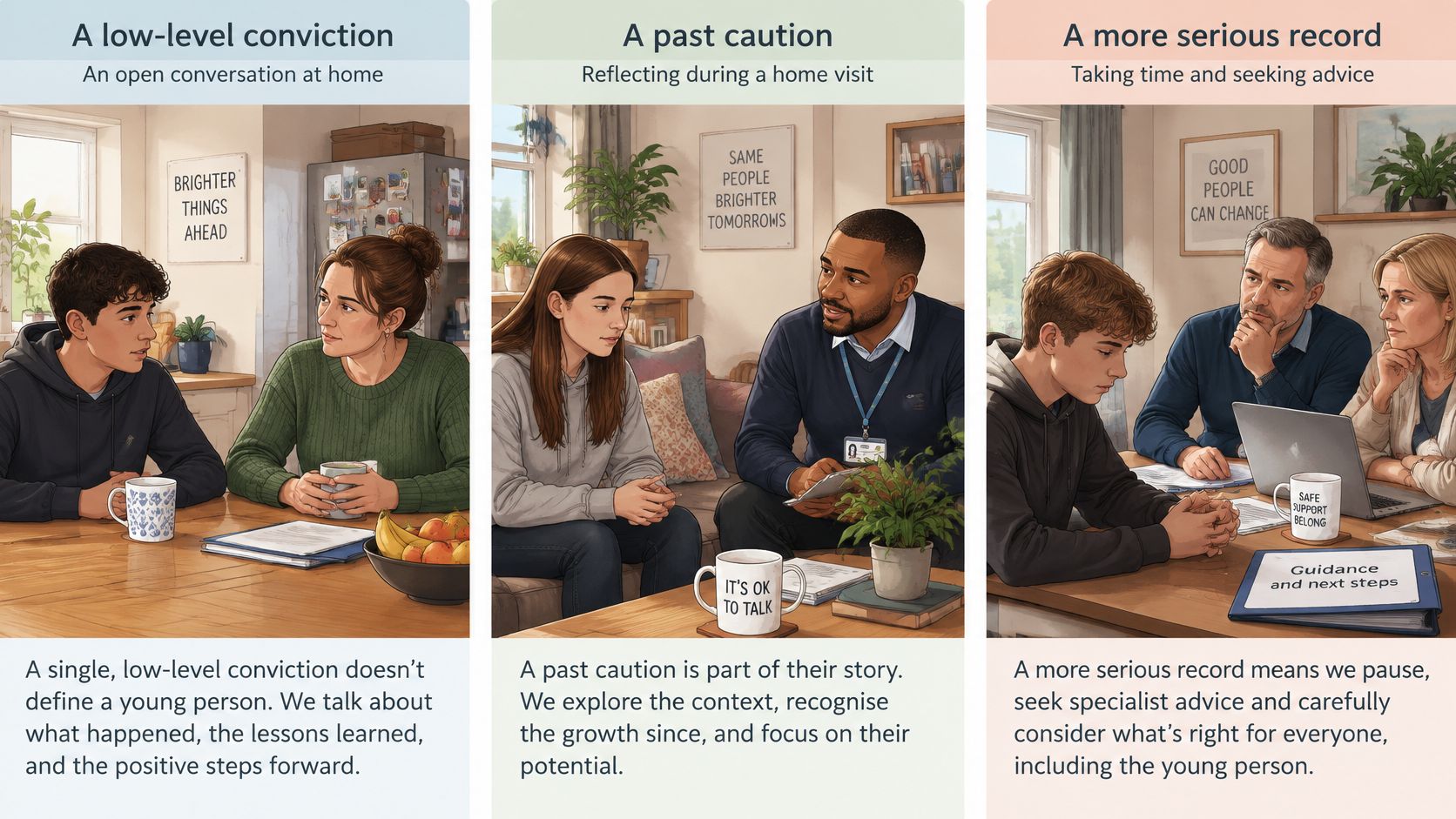
Consider a prospective carer with an old, minor adult conviction unrelated to children, followed by a stable period of life. An assessor may consider that history differently from a recent offence or one that led to custody, but age alone doesn't settle the question. The offence, sentence, pattern, rehabilitation evidence and possible impact on a child all matter.
A historic offence committed when someone was under 18 also needs to be understood in context. It isn't automatically judged as though the person had offended as an adult, but the agency still needs the facts, including the outcome and what has changed since. The person should avoid relying on a general time limit as proof of suitability.
Five situations that need different questions
- An old minor conviction: The assessor can examine its relevance to caring for children, the sentence, whether it was repeated and evidence of rehabilitation. An unrelated offence may raise different questions from one involving harm or risk to a child.
- A youth offence: The person's age at the time matters, as do the offence, outcome and pattern. A long period since the event may be relevant but doesn't, by itself, determine approval.
- A caution for a specified serious offence: A caution isn't automatically a lesser concern. Where the prescribed exclusion applies to a caution given after an admission, the person shouldn't treat it as ordinary paperwork.
- Non-conviction police information: This isn't a conviction, but it shouldn't be dismissed without discussion. The assessor may consider its relevance, whether it forms part of a pattern, and whether it indicates any current risk.
- A household member's record: A clear record for the applicant doesn't remove the need to assess an adult who lives in the home or will have a regular caring role. The agency will consider that person's history and their access to children.
A careful account can acknowledge past behaviour without defining a person by it. The assessment still has to put the child's safety first.
There's a narrow route for approval in relation to a particular named child when that child's welfare requires it, often in a family relationship or existing care arrangement. It doesn't provide a general route to fostering any child. For every other situation, no time limit on its own approves a carer. Prepare a truthful account of the offence, age, sentence, timing, any repetition and evidence of change, then let the agency assess the full circumstances.
How Organic Fostering Assesses Past Convictions
A search result can't decide whether a household is suitable. An agency needs to understand the person's motivation, stability, health, home conditions, references and capacity to care, as well as relevant history. Only after a completed assessment can the fostering panel consider whether approval is appropriate, with the child's safety and welfare at the centre.
Organic Fostering is an Ofsted-registered independent fostering agency based in Manchester, supporting foster families across the North West. Its published route includes an informal first conversation, a home visit, application guidance, preparation and training, checks and references, assessment, panel and approval. Any published timescales are indicative, not a promise of how long an individual assessment will take.
A staged assessment, not a yes-or-no search result
The first conversation gives a prospective carer an opportunity to raise a conviction or caution early and ask how it may be considered. The agency can explain the next steps and whether a full assessment appears realistic, but it can't guarantee approval in advance. Applicants can read about fostering assessments and check the current route from enquiry to panel.
Approved households have a supervising social worker, and approved carers can access out-of-hours advice. Matching considers a child's needs, culture, faith, language, identity and existing relationships. That can be especially relevant if a household member's history affects who can safely share the home or provide support.
The placement being considered matters too. Organic Fostering's published placement types include short-term, long-term, emergency and respite care, keeping siblings together, and caring for teenagers. A household may need to consider how its history and support arrangements relate to the particular child and plan. That doesn't mean a record will be compatible with one placement and unsuitable for another in every case; the agency has to assess the actual circumstances.
Experienced foster carers considering a move can ask about structured transfer support, with the child's continuity of care in mind. A transfer doesn't avoid the checks or replace assessment. Published information about the agency's process and support is the right place to confirm current details.

What to Do Before You Enquire
A little preparation can make an initial conversation clearer. It doesn't decide the outcome, but it helps the agency understand the history and identify what information may be needed.
Prepare a clear, factual account
Write a short chronology in your own words. Include the offence or caution, your age at the time, the date, the court or police outcome, any sentence and what has changed since. Keep the account factual, and don't include identifying or sensitive details about any child.
Gather rehabilitation evidence you already have, such as completed requirements, steady work or caring responsibilities. Note who may be able to provide a reference. You don't need to create a polished case for yourself; the aim is to give an accurate starting point.
Then list every adult in the home and anyone who may provide regular backup care. Make a note of who might have unsupervised contact with a child. Think about the fostering role you're exploring, whether short-term, long-term, sibling, teenager or respite care, without treating that preference as approval.
Before speaking to an agency, review current England guidance and its own eligibility information. You can also read questions often raised in a fostering assessment. Ask how checks work, what information the agency needs and whether it seems realistic to proceed to a full assessment.
Guidance should be reviewed before publication by someone familiar with fostering. For an applicant, the decision belongs to the completed assessment and panel, not an online answer or an early conversation.
Organic Fostering offers an informal, no-obligation conversation for people considering fostering in Manchester and the North West, including those with a past conviction or caution. Contact Organic Fostering to discuss your circumstances early, ask how the checks work and explore whether a full assessment may be realistic.