

If keeping brothers and sisters together matters, why isn't a home with enough bedrooms always the right placement? For siblings in foster care, the answer depends on more than space. A suitable arrangement must protect each child, support their relationship and make everyday care manageable.
For prospective and current foster carers across Manchester and the North West, that means considering the whole household alongside each child's needs. Sometimes the strongest option is a shared home. Sometimes children need separate homes, with careful arrangements to keep a valued relationship going.
Table of Contents
- Why Siblings in Foster Care Matter
- Understanding the Legal and Welfare Priority
- Comparing Sibling Placement Options
- Matching the Right Foster Family
- Meeting Everyday Sibling Care Needs
- Sibling-Friendly Arrangement Examples
- Making Separation Decisions Responsibly
- Explore Fostering with Organic Fostering
Why Siblings in Foster Care Matter
Consider a hypothetical placement decision involving younger siblings who share a bedtime story, familiar food and a particular way of making each other laugh. A shared foster home could preserve those small connections while much else changes. Separate placements would require adults to make deliberate arrangements for the children to remain involved in each other's lives.
Those everyday details matter. A sibling may recognise a family expression, understand a home language or remember how a birthday was celebrated without needing an explanation. Maintaining those connections can offer continuity without asking children to leave their family identity behind.
The Children's Commissioner for England estimated that around 20,000 children, approximately 37% of children in care who had at least one sibling, were separated from a sibling in their initial placement, according to its analysis of siblings in care.
Familiar relationships, individual children
Siblings shouldn't be treated as an interchangeable group. Children who share a family history may understand that history differently, need different kinds of reassurance or have different feelings about living together.
A useful starting point is to distinguish between what children share and what belongs to each child:
- Shared connections: Language, traditions, memories, familiar routines and relationships with relatives.
- Individual needs: Privacy, education, health, communication, friendships and emotional safety.
- Relationship dynamics: Affection, rivalry, dependence, conflict and any responsibilities a child has taken on.
Practical rule: Preserving a sibling relationship means understanding it, not assuming that living together answers every question.
For households considering fostering in Greater Manchester or elsewhere in the North West, willingness to welcome siblings is valuable. It isn't, by itself, evidence that a particular placement is suitable. The decision must consider whether the household can care for each child as an individual while supporting their connection.
Understanding the Legal and Welfare Priority
England's framework gives a strong priority to placing siblings together, rather than an absolute rule that overrides welfare. The Children and Young Persons Act 2008 requires local authorities to accommodate siblings together where reasonably practicable and consistent with welfare considerations, as discussed in the Oxford review of sibling placement and contact.
A local authority is the council responsible for arranging a looked-after child's care. A looked-after child is a child in the council's care. Professionals must consider the needs of each child, not just whether a placement keeps the group under the same roof.
A house with several bedrooms offers a useful analogy. Having enough rooms answers a question about physical capacity. It doesn't establish whether the adults can manage competing needs, protect privacy or respond safely to a difficult relationship.
Distinguishing the reasons for separation
A welfare decision and a shortage of suitable homes aren't the same thing. Carers should seek a clear explanation of what professionals have assessed and what remains unresolved.
- Shared living meets assessed needs: The household can support the relationship while providing appropriate care for each child.
- Shared living raises welfare concerns: Professionals identify a risk or relationship difficulty requiring a different arrangement.
- A suitable shared household isn't available: The obstacle concerns placement capacity rather than a conclusion that separation is better.
A placement shortage shouldn't be described as though it proves that siblings would be better apart.
Legal references also need geographical care. The Regulation 5A instrument concerning shared or nearby placements is a Scottish instrument, not the legal basis for an English placement decision. For Manchester and North West placements, carers should seek an explanation grounded in England's framework.
Nearby homes may be a practical option when shared living isn't appropriate, but distance alone doesn't establish suitability. Professionals still need to explain how the arrangement meets each child's welfare needs and supports their relationship. Carers shouldn't have to infer the reasons from a referral's wording or the bedrooms available.
Comparing Sibling Placement Options
Placement options serve different purposes, and some overlap. Relatives who are approved foster carers might care for siblings together, while separate foster homes might also be near one another. The important comparison is what each arrangement enables adults to do for the children.
A care plan sets out how a child's needs should be met. Government analysis reported that approximately 1,400 siblings were not placed in accordance with their care plan during 2019–20, representing 13% of all siblings in care, in its children's social care market study. These historical figures illustrate why the intended arrangement and the placement available need separate scrutiny.
Sibling placement options at a glance
| Placement option | Relationship purpose | Main considerations | Safeguarding question |
|---|---|---|---|
| Shared foster-carer home | Preserve everyday involvement and shared experiences | Individual attention, household capacity, privacy and relationship dynamics | Can every child feel safe and receive suitable care? |
| Relatives or friends who are approved foster carers | Maintain existing family or community connections | Existing relationships, boundaries and capacity to meet assessed needs | Can familiar adults provide protective care without overlooking concerns? |
| Separate homes with planned sibling contact | Sustain a relationship where shared living isn't suitable or available | Reliable arrangements, children's wishes and cooperation between households | What contact is safe and meaningful for each child? |
| Nearby placements | Make practical involvement easier without sharing a home | Actual travel arrangements, household cooperation and professional oversight | Does proximity support welfare rather than simply look convenient? |
A shared address allows spontaneous interaction, such as chatting after school or playing before dinner. Separate homes require adults to organise opportunities that might otherwise happen naturally. Neither arrangement should be judged only by its label.
Placement purpose and placement duration
Short-term, long-term, emergency and respite fostering describe different care arrangements, rather than different levels of commitment to sibling relationships. The guide to types of foster care provides context for those distinctions.
For a prospective carer, useful questions include:
- Purpose: What does the proposed arrangement need to achieve for these children?
- Preparation: What information is available before a decision is needed?
- Continuity: Which existing relationships and routines can realistically continue?
- Review: What would prompt professionals to reconsider the arrangement?
An emergency need shouldn't remove those questions. It makes clarity about immediate arrangements and subsequent review particularly important.
Matching the Right Foster Family
Matching means deciding whether a particular household can meet particular children's needs. A spare bedroom and willingness to foster are starting points, not a complete assessment.
The Children's Commissioner's analysis found that separation was associated with sibling-group size: approximately 26% of children with one sibling in care were separated, compared with 43% of those with two siblings, 57% with three siblings and 64% with five siblings, according to its detailed sibling separation report. These figures describe a placement challenge, not a reason to assume that larger groups belong apart.
Start with each child's needs
Prospective carers can prepare by considering practical questions. Professionals remain responsible for assessing the children's circumstances and the proposed match.
- Age and development: Are routines based on each child's abilities rather than age alone?
- Birth order and responsibilities: Has an older child become accustomed to parenting younger siblings?
- Health and disability: What appointments, adaptations or communication support might be needed?
- Trauma and behaviour: What situations cause distress, and what responses have helped?
- Conflict and safety: What is ordinary disagreement, and what requires a safeguarding response?
- Identity: How will culture, faith, language and meaningful traditions be supported?
- Family relationships: What involvement with birth relatives is planned?
- Individual attention: Can adults spend protected time with each child?
Matching also involves the existing household. Resident children, working patterns, travel commitments and adults' availability all deserve consideration. A family's confidence with younger children, for example, doesn't automatically establish readiness for a group with widely differing developmental needs.
Turn willingness into an informed discussion
The explanation of how foster placement matches work can help prospective carers prepare for conversations about referrals and suitability.
Those exploring eligibility can ask how accommodation, time, household circumstances, checks, references, preparation and training will be assessed. They should distinguish general enquiry information from the professional assessment of a particular sibling placement.
Financial planning belongs in the same discussion. Carers should request a clear explanation of fostering allowances, any fee, what payments cover and how placement-related expenses are handled. No household should plan sibling care around an assumed payment or an unconfirmed arrangement.
Before accepting a match: Unanswered questions should be identified openly, with responsibility for obtaining the missing information agreed.
A thoughtful decision may be to proceed, seek further information or conclude that the household isn't suitable for that particular group. Honesty protects children better than an overstretched commitment.
Meeting Everyday Sibling Care Needs
Daily care turns placement planning into something children can experience. A labelled drawer, a predictable breakfast routine or an agreed quiet space can make expectations clearer without requiring children to adapt to everything at once.

The Oxford review linked earlier found that joint placements were generally at least as stable as separated placements, with evidence of better educational outcomes and, in particular circumstances, improved mental-health outcomes. That finding supports careful consideration of shared placements, not a promise about an individual child's experience.
Make space personal and routines workable
Bedroom arrangements need explicit agreement during assessment and placement planning. Carers shouldn't assume siblings will share just because they previously did. The guidance on bedroom considerations for foster care offers a starting point for that discussion.
Daily planning can address practical pressure points:
- Possessions and privacy: Identify personal belongings, storage and boundaries around borrowing.
- School preparation: Agree who helps with clothing, bags, homework and different departure times.
- Food and familiarity: Ask about preferences, cultural needs and established mealtime habits.
- Appointments: Plan how a child can attend an appointment without every sibling losing their usual activities.
- Play and downtime: Offer shared activities without requiring constant togetherness.
Fairness doesn't always mean identical treatment. A teenager's bedtime, a younger child's reassurance needs and a sibling's accessibility requirements may call for different arrangements. Adults can explain differences respectfully without sharing private information or comparing children.
Protect childhood and seek help early
An older sibling who automatically checks homework or settles a younger child may need reassurance that adults will take responsibility. Carers can acknowledge the relationship without allowing the older child to carry the household's caring role.
Protected individual attention needn't be elaborate. Reading together, preparing food or walking to school can offer space for a child to speak without a sibling answering first.
Carers should record patterns rather than labels: what happened, what preceded it, how adults responded and whether anyone felt unsafe. Persistent fear or coercion shouldn't be dismissed as ordinary sibling rivalry.
Professional support needs practical definition. Carers can ask what their supervising social worker will help coordinate, how out-of-hours advice is accessed and who will communicate with education and health professionals. Preparation and ongoing training should address the household's actual needs, including conflict, safeguarding and relationships with birth family.
Short-term or respite arrangements still need clear handovers about routines, privacy and safety. Longer-term care requires adults to revisit arrangements as children's needs change.
Sibling-Friendly Arrangement Examples
The following hypothetical composite scenarios illustrate planning questions. They aren't accounts of actual children, testimonials or placements made by an agency.
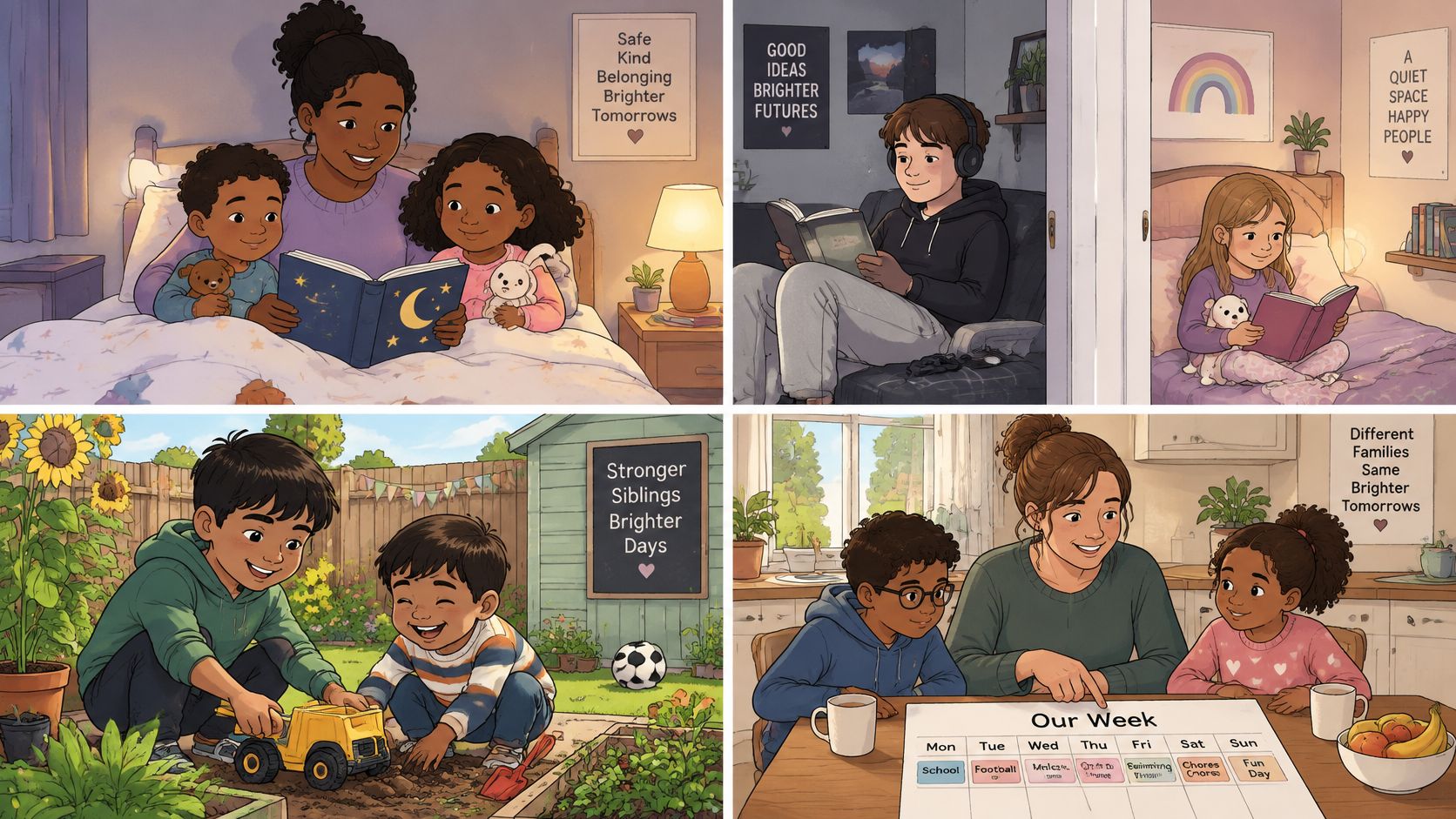
Younger siblings and a familiar routine
Younger siblings might seek reassurance through the same evening story and familiar morning sequence. A shared home could preserve those routines, provided adults also notice differences in sleep, communication and comfort.
The question isn't whether children appear close during an introduction. Professionals and carers need to understand whether the proposed routine works for each child, including when one needs attention separately.
An older sibling and a younger child
A teenager might want private time while a younger sibling repeatedly seeks their help. Sharing a home could remain suitable if adults take responsibility for care and establish boundaries without making either child feel rejected.
A useful plan would consider privacy, separate activities and how adults respond when the younger child turns first to the teenager. The older child shouldn't have to choose between maintaining affection and having an independent life.
A larger group with shared language or culture
A larger sibling group might share a home language, religious practices or strong community connections. Assessment should explore how a household could sustain those connections while meeting different educational and developmental needs.
Matching should go beyond a cultural label. Adults need to ask what matters to these children, what practical knowledge is required and where support is needed. The foster-home stories resource can provide a separate route into reading about fostering, while these examples remain illustrative.
Separate homes with a protected relationship
Where professionals assess shared living as unsafe, separate placements may be necessary. A relationship plan could explore supported meetings or other appropriate communication, subject to individual assessment.
- Central question: What form of contact can each child safely manage?
- Practical test: Can the responsible adults deliver the agreed arrangements?
- Review trigger: What changes in the children's wishes or responses require reconsideration?
The preferred arrangement follows assessed needs, not assumptions based on age, group size or apparent closeness.
Making Separation Decisions Responsibly
More bedrooms don't resolve an assessed safeguarding concern. Equally, separate addresses don't remove the responsibility to consider a sibling relationship.
Government guidance explains that, where siblings cannot live together, maintaining meaningful relationships should be a significant consideration when matching children with foster carers, in its guidance on matching in foster care. The practical task is to turn that consideration into arrangements adults can deliver.
Build a workable contact plan
A sibling-contact plan should be specific enough that carers don't have to negotiate essential details after a visit has already fallen through.
| Planning area | Questions to resolve |
|---|---|
| Children's wishes | How will each child express preferences, including through supported communication? |
| Format and frequency | What meetings, calls, messages or shared activities are appropriate? |
| Transport | Who arranges journeys, accompanies children and manages delays? |
| Costs | Who authorises and pays agreed expenses? |
| Safety | What supervision, boundaries or professional involvement are needed? |
| Information-sharing | What should households exchange, through which agreed route? |
| Review | Who checks whether arrangements remain suitable, and what prompts an earlier review? |
Age-appropriate contact isn't just a matter of choosing between a visit and a video call. Adults should consider attention, communication needs, privacy and how children feel before and afterwards. Virtual contact may complement face-to-face time where appropriate, but it shouldn't be assumed to meet every need.
Keep responsibility visible
Maintaining a relationship across homes resembles maintaining a bridge: adults need to organise access, notice difficulties and make repairs. Living nearby won't achieve that without cooperation.
The explanation of social workers' roles in foster care can help carers identify where professional coordination is needed, particularly when different local authorities are involved.
A written contact plan is only useful when named adults understand their responsibilities and children can influence its review.
If contact causes distress, carers should record observations and seek advice rather than independently abandoning arrangements or insisting they continue unchanged. A plan supports professional judgement; it doesn't replace assessment or guarantee that a particular relationship can safely continue in the same form.
Explore Fostering with Organic Fostering
At 31 March 2025, England had 42,190 fostering households, down from 42,615 the previous year, according to Ofsted's fostering statistics for England. Those figures provide national context, not a reason for any household to accept an unsuitable placement.

For individuals, couples and families exploring fostering in Manchester and the North West, the next useful step is an informed conversation. Existing carers considering transfer can also ask how continuity for children would be protected.
Prepare for an initial conversation
Useful topics include:
- Household suitability: Accommodation, availability and the needs of existing household members.
- Preparation: Recruitment, assessment and training for sibling care.
- Practical support: Supervision, advice, allowances and coordination with other professionals.
- Matching: Culture, faith, language, identity and existing relationships.
- Transfer planning: How any proposed move would be managed around children's welfare.
A suitable sibling placement brings together household readiness, individual care and realistic relationship support. An enquiry can clarify those issues without committing a family to proceed.
As an Ofsted-registered independent fostering agency based in Manchester, Organic Fostering recruits, prepares and supports foster families across the North West, with matching that considers children's needs, culture, faith, language and relationships. Prospective carers and approved carers considering a transfer can visit the website to enquire about an informal, no-obligation conversation about sibling fostering, assessment and practical support.