

NEW ARTICLE
Title
Form F Assessor Training: A Practical Guide for 2026
Suggested slug
form-f-assessor-training
Meta description
Learn how Form F assessor training prepares social workers to gather evidence, assess applicants and write a defensible report for fostering panel in England.
Primary search phrase
Form F assessor training
A new assessor may open a Form F report and see pages of questions, while the applicant is waiting for an explanation of what happens next. The useful starting point is to treat the assessment as a structured decision record, not a form to fill in. Form F assessor training should show how to gather, test and analyse evidence so a fostering panel can consider whether an applicant can meet children's needs.
Table of Contents
- Title
- Suggested slug
- Meta description
- Primary search phrase
- What Form F Assessor Training Must Cover
- Statutory Framework and Checks Assessors Must Know
- How to Run a Form F Assessment From Allocation to Panel
- Interview and Triangulation Techniques
- Writing a Defensible Report and Catching Quality Gaps
- Checking a Form F Training Course Before You Enrol
What Form F Assessor Training Must Cover
In England, Form F is the written assessment that brings together information about an applicant and analyses their suitability to foster. It informs panel consideration, so each conclusion needs a clear evidence trail. The assessment covers an applicant's background, household, relationships, health, experience, support, checks, references, strengths and suitability.
The Enfield fostering statement of purpose describes assessment areas including an applicant's childhood, relationships, health, employment, parenting capacity, resilience, teamwork and commitment to development. It also includes religion, ethnicity, culture and language, including whether applicants can care for children whose background differs from their own. Use those areas as a reference in every interview, rather than treating them as separate boxes to complete.
| Assessment area | What the assessor must establish | Main evidence source |
|---|---|---|
| Childhood and experience of being parented | How the applicant was parented and what they took from it | Home-based interviews |
| Relationships past and present | Stability, conflict and the support networks available | Interviews and references |
| Health, education and employment | Current health, learning needs and working pattern | Health information and employment history |
| Childcare and parenting capacity | Direct experience and the ability to meet a child's needs | Childcare history and references |
| Resilience under stress | How the applicant sustains relationships under pressure | Interviews and household observation |
| Teamwork and working with professionals | Willingness to share information and accept supervision | Professional references |
| Commitment to training and development | Engagement with preparation and ongoing learning | Training record and interview |
| Religion, ethnicity, culture and language | Ability to meet a child's identity needs, including where these differ from the applicant's own | Interviews, cultural history and household views |
For each area, identify the source before drawing a conclusion. An interview may explore how an applicant understands their own childhood; a reference can add an independent perspective on relationships or reliability; health information and employment history help clarify practical circumstances. No single source answers every question.
The Ofsted annual fostering data collection provides a national picture of fostering recruitment and assessment. For an assessor, the practical lesson is that clear communication about evidence and expectations is part of assessment quality. Applicants should understand what information is being gathered and why.
Before the first home visit, write each assessment area on a preparation sheet and add the evidence source that could help explore it. That simple exercise makes gaps visible early and keeps the discussion focused on the applicant's capacity to care for children.
Statutory Framework and Checks Assessors Must Know
Form F assessment in England sits inside a statutory and professional framework. The National Minimum Standards for fostering services operate alongside the Fostering Services (England) Regulations 2011. The standards describe what good looks like; the regulations set out what must happen. Between them they shape how fostering services recruit, assess, approve, train and support foster carers. These are England's requirements. Scotland, Wales and Northern Ireland have their own frameworks, so an assessor working across borders must check which rules apply before writing a word of the report.
An assessment is carried out by a qualified social worker registered with Social Work England. That registration matters because the report is not a record of conversations. It is a decision record that panel members read in order to reach a judgement about a child's future home, and every conclusion in it has to survive questioning by people who were never in the room. Lawful information gathering, confidentiality and reasoning you can explain out loud are the three habits that keep it defensible. An evidence trail that points from each statement to the check, reference or interview it came from lets panel follow your thinking without hunting through the file.
Checks and local procedures
The checks commonly include medical information, Disclosure and Barring Service checks, household safety checks and references. Recruitment and assessment may also involve identity, date of birth, address history, and criminal-record and barred-list information. For a plain-language overview of the checks involved in fostering, see Organic Fostering's background checks guidance.
Local procedures can add requirements on top of the national ones. Some local authority fostering services, for example, ask for more references than the national baseline, including personal-professional referees, and expect preparation training to be completed before a report reaches panel. Treat that as local variation rather than universal rule: one service's sequence is not another's. Confirm what your own agency requires, then keep a dated record of what was requested, what came back and what you made of it. Panel will ask.
Before the first assessment visit, check that:
- Registration is current: confirm the assessing social worker's registration with Social Work England.
- The agency's checks are clear: identify the checks, references and preparation required under its procedure.
- Completion is recorded: note the date each check was requested, received and reviewed.
How to Run a Form F Assessment From Allocation to Panel
Allocation is the point at which an assessment file starts collecting the reasoning that panel will later read. From that moment on, every visit note, check and conversation either adds to a traceable evidence trail or leaves a gap that somebody else has to explain.
| Stage | Typical timing | Assessor action |
|---|---|---|
| Allocation and assessment agreement | Start of assessment | Agree visits, information sources, responsibilities and panel date |
| Stage 1 evidence | Complete before Stage 2 begins | Check all information received |
| Decision not to proceed | Within 10 days of receiving all Stage 1 information | Record reasons in writing |
| Home visits | Six or seven over about five months in Southwark's published example | Repeat interviews and test strengths against observed behaviour |
| Presentation to panel | Within six months of allocation in the same published example | Submit a reasoned recommendation |
The staged process sits behind that timetable. The 2025 Form F additional FAQs describe Stage 1 being completed and checked before the decision to proceed to Stage 2, and set a 10-day period for a decision not to proceed once all Stage 1 information has been received. Read the stages as a series of decisions, not a series of forms to fill in.
Confirm the framework before contact. Check registration and read the current England Form F guidance. Working from a 2018 template tends to leave analysis missing or mislabelled, and panel reads that as an assessment that was not thought through.
Agree how the assessment will run. Set out visits, information sources, responsibilities and the intended panel timetable. This agreement gives the applicant a clear picture of what is expected and gives the assessor a shared reference point if plans change. Put actual proposed dates in it, not an intention to visit regularly.
Complete Stage 1 before Stage 2 begins. Stage 1 behaves like a gate: identity, references and checks are in place before interviews begin. Starting interviews early leaves gaps that become harder to close later, because the ground has already been covered once and the follow-up questions arrive out of sequence.
Record a decision not to proceed in writing. If Stage 1 evidence does not support moving forward, make the decision within the stated period and explain the reasons. A decision without a written rationale cannot be reviewed by anyone else, and the applicant is entitled to know what was weighed.
Build Stage 2 evidence from different sources. Complete statutory and safeguarding checks and carry out repeated home-based interviews. Training and assessment can overlap, so the timetable is rarely one task finishing neatly before the next starts. Note in the file what each source added and when it arrived.
Analyse as the work progresses. Interpretation left to the final draft tends to flatten into description. Record what the evidence suggests, what remains uncertain and what follow-up is needed while each discussion is fresh.
Southwark Council's published process shows the shape of a straightforward case: repeat visits at home, spaced so that trust has time to build, and a report ready for panel within the same assessment window. Those timings are indicative and do not set a national timetable. Missing references, checks that take longer, or applicants who need more time all push the panel date back, and the file should show which of those applied.
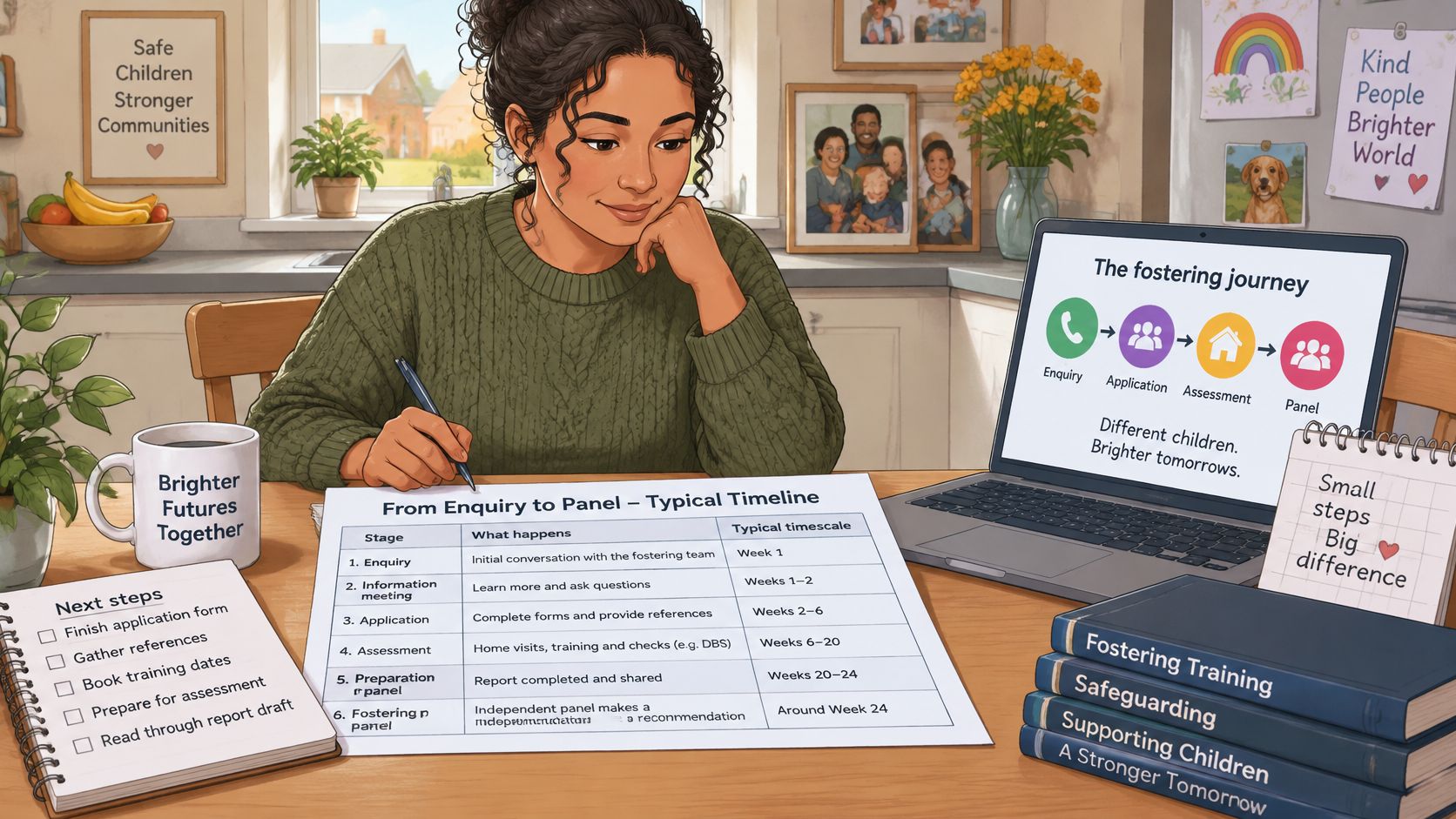
Plan visit dates at allocation, while keeping the Stage 1 decision window in view. A well-run file shows every stage and decision date, explains why each decision was made, and names an owner and a next action for every open question. Panel reads the report as a chain of judgements rather than a diary of visits, so a section that lists what happened without saying what it means for a child's care has stopped short of the job. Approval also marks the start of a carer's development rather than the finish line, which is why the assessment should name what still needs to be learned and reviewed afterwards. Information about fostering panel and approvals can help applicants understand how the assessment report feeds into panel consideration.
Interview and Triangulation Techniques
Triangulation is how an assessor turns a set of conversations into a decision record that panel can follow. A room can be located from two windows: each view is partial, but together they show the shape of the space and where the views disagree. In a Form F assessment, those views come from the applicant, referees, household members, observed interactions and documentary checks. The assessor's task is to trace each material claim to more than one source and explain what the combined evidence shows, so the evidence trail is calibrated to the question panel must decide.
Repeated home-based interviews let you see how applicants respond over time and in their own setting. Vary the time of day where useful. Watch household interactions, but treat any single moment as one observation, not a settled pattern. Make room to hear from household members, including children where their age allows. Their views are evidence in their own right and belong in the record alongside the applicant's account. Triangulation is not collecting more of the same. Two references that echo the applicant's phrasing add volume, not independent evidence. Seek sources with different perspectives on the same question.
Ask for examples, not just assurances
Warmth and motivation matter. They do not by themselves demonstrate parenting capacity. Ask about a specific hard day, a disagreement or a moment when a child was distressed. Explore what the applicant noticed, what they did, how they understood the child's perspective and what they might change next time.
A practical question pattern to rehearse is: What happened? What did you do? What did you learn? What would you do differently? It moves an interview from broad claims towards examples that can be tested against the needs of children. When an answer stays general, return to the same incident and ask for the missing detail. Panel members need detail they can weigh.
If an applicant discloses trauma or domestic abuse, stay calm, listen without rushing to interpret and record what was said accurately. Follow the agency's safeguarding procedure and seek guidance when required. The assessor's role is to understand the relevance of the information to fostering suitability and support needs. Investigation beyond that role belongs elsewhere.
For a sense of the topics applicants may be asked about, common fostering assessment questions offers related guidance. The assessor's task is to use questions to produce evidence that can be analysed and cited.
A strong interview leaves the assessor with evidence to cite, not an impression they can only describe.
Writing a Defensible Report and Catching Quality Gaps
A frequent drafting failure is a conclusion that repeats an applicant's account without showing how it was tested. A defensible judgement makes four moves: state the evidence, explain what it means, identify the relevant risk or protective factor, and give the recommendation that follows. It should also distinguish capacity already demonstrated from support that would still be needed.
The CoramBAAF fostering practice guidance recommends practical tools such as trigger questions, worksheets, assessment tracking, safer-caring checklists, ecomaps and health-and-safety checks. Use them to organise the work, not as substitutes for analysis. Complete a home safety check before panel submission and note what was checked, any concern found and how it was addressed.
| Symptom in the draft | Likely cause | Fix before panel |
|---|---|---|
| Conclusion rests on one account | Narrative not corroborated | Add a second source and record any contradiction with an action plan |
| Warmth treated as parenting capacity | Motivation confused with capacity | Ask for specific examples and assess them against the child's needs |
| Household views missing | Interviews focused on the applicant | Interview each household member and record their views |
| Outdated 2018 terminology | Old template or notes reused | Work from the current 2025 form wording |
| Culture and faith listed but not applied | Description without analysis | Link identity to matching and safer-caring implications |
Before submission, conduct a bias-and-risk review and arrange moderation by an experienced practitioner. Record contradictions that remain unresolved, along with an action plan and named responsibility. A strengths-based report can recognise what an applicant brings without minimising uncertainty or risk.
Apply the child-needs test
Ask whether the report shows, with specific evidence, how this household could respond to trauma, separation, family contact, identity and safeguarding demands. The 2025 framework gives children's needs a dedicated focus and aims to retain strengths-based, trauma-informed analysis while streamlining the assessment. A clearer form won't automatically produce more rigorous decisions; assessors still need calibration and quality assurance.
Approval and matching decisions require formal assessment and professional decision-making. Organic Fostering's fostering assessment information describes the assessment process, while the report itself must show the reasoning behind its conclusions in full.
Checking a Form F Training Course Before You Enrol
A training certificate records attendance. The harder test is what an assessor can do when the evidence in a Form F is thin and panel needs a clear recommendation. A suitable course should teach the current 2025 England Form F and how its evidence builds a panel-ready decision record. It should develop critical thinking, reflective practice, practical assessment tools and evidence-based report writing. The CoramBAAF best-practice course listing describes training needs that include analysis and practice in conducting assessments.
Check whether the course prepares assessors to explore safeguarding and child protection, safer caring and risk, trauma, attachment and child development, recording, confidentiality, equality and anti-discriminatory practice. Depending on the assessment, useful learning can also include first aid and medication, education, online safety and exploitation, family time and working with birth families, preparing young people for independence, and specialist subjects linked to a child's needs. Training should show how these topics inform assessment of applicants' capacity, and assessors should know the limits of their own expertise.
Check how competence is assessed
Ask how the course teaches assessors to maintain independence when an applicant is pressing for a particular outcome, handle sensitive disclosures, and escalate safeguarding or panel concerns. Find out how supervision and sign-off are recorded, and what marking criteria apply to practice tasks. Ask each provider to set out its own supervision and sign-off arrangements.
One UK online Form F assessor course advertises 20 hours of CPD across 15 interactive modules, according to its course listing. Hours and module counts describe course structure; teaching quality and quality assurance need separate evidence.
Use a practical decision rule: enrol only if the course includes marked practice, supervision and a clear sign-off route. If those details aren't available, ask the provider for its marking criteria and supervision arrangements before paying. Prospective carers can also read guidance on foster parent training to see how preparation and ongoing learning fit together.
Form F assessor training is most useful when it builds judgement as well as familiarity with the form. The strongest courses treat the Form F as a decision record for panel. They teach assessors to build an evidence trail that panel can follow, calibrate judgements against the framework, and name gaps instead of filling them with assumption. Organic Fostering recruits, assesses and supports foster carers across the North West, and explains likely timescales for assessment and training for each applicant's circumstances. Practitioners and people considering fostering can visit Organic Fostering to learn more and start a conversation.