

Matching a Muslim child with Muslim carers isn't, by itself, a complete care plan. Muslim foster care means children's fostering that makes practical provision for a child's Islamic faith, culture, language and important relationships, without assuming what that child believes or how they practise. The useful question is whether a household can provide safe care and sustain the particular things that help that child feel understood.
Table of Contents
- What Muslim Foster Care Means in England
- Faith Food Language and Daily Routines
- An Illustrative Week in a Foster Home
- How Matching Works When Faith Differs
- Who Can Apply and What Assessment Asks
- Common Questions About Muslim Foster Care
- Start a Conversation About Fostering or Transferring
What Muslim Foster Care Means in England
Muslim foster care is ordinary children's fostering with explicit attention to faith and identity. The term describes how care is delivered: a child lives under the same legal framework as every other looked-after child, while the adults around them plan deliberately for their religious and cultural life.
A placement is the home arrangement made for a child in care. At 31 March 2025, England had 54,820 children living in foster placements, representing 67% of all children looked after, while 24% of foster placements were with a relative or friend who had become an approved foster carer, according to the Department for Education's children looked after statistics.
That kinship figure shows one recognised fostering route: a relative or friend who already knows the child can go through assessment and become their approved carer, bringing an existing relationship into the formal system.

Faith belongs within the whole care plan
A child's care plan sets out how their needs will be met. Faith-sensitive planning belongs inside that plan from the start, woven through safety, health, education, family relationships and emotional support.
In practice, that means two things carrying the weight: a household's recorded capabilities and the child's own wishes. An academic review of Muslim families and care law identifies a measurement problem at the heart of the topic: England's central children-in-care return records ethnicity, but not religion.
There is no definitive official national count of Muslim children in care. Ethnicity cannot stand in for religion, and a name cannot reliably establish a child's beliefs.
What the available figures can establish
The Muslim Fostering Project report received usable responses from 22 fostering services, identifying 267 Muslim children; its authors cautioned that the sample wasn't statistically representative while estimating that Muslim children might account for roughly 5% of children in care.
None of these figures is a Greater Manchester or North West total. For families living in those areas, national estimates shouldn't be treated as a precise measure of local placement demand.
Different types of children's foster care can involve faith-sensitive planning, whether a child needs a temporary home or a longer-term arrangement.
Practical rule: A suitable home may be Muslim or non-Muslim. The matching section below explains how faith is weighed alongside everything else a child needs.
Faith Food Language and Daily Routines
| Area of life | What to record | How a carer can respond |
|---|---|---|
| Child's own wishes | Preferences, doubts, mixed heritage and views that may change | Follow the child's lead and review arrangements as identity develops |
| Halal food | Dietary rules and what the family expects | Plan meals, shopping and eating out without assuming every child observes the same rules |
| Ramadan | Whether this child fasts, plus age and health | Keep school, sleep and meals flexible and never pressure a child who doesn't fast |
| Prayer and worship | Prayer, mosque and any clothing practice the child wants | Offer time and a quiet space only where the child chooses them |
| Eid and community | Which celebrations and networks matter to this child | Mark Eid and keep agreed community links in the care plan |
| Language | Home language alongside the language used at school | Keep words, stories and relatives' language in everyday life |
| Family contact | Trusted Muslim relatives where contact is safe | Support only the contact set out in the care plan |
| Modesty and personal care | Clothing and personal-care preferences | Agree culturally appropriate care with the child rather than imposing a dress code |
These faith and culture practices to record in a placement turn broad intentions into daily care. A useful entry identifies the child's preference, the agreed response and who will help make it happen.
A qualitative study based on 28 semi-structured interviews, described in Coventry University's publication on the salience of Islam, found that religion influenced Muslim-heritage children's understanding of identity, family relationships and wellbeing, even where personal religious practice differed.
Make familiar routines possible
Entering care can separate a child from familiar people, meals, words and surroundings. Preserving an ordinary routine, such as a familiar breakfast or a bedtime conversation in a home language, can help the household feel less unfamiliar.
For halal food, the practical discussion should cover shopping, preparation, school meals and eating away from home. A carer shouldn't guess that a vegetarian option resolves every question, or that a child's current preference necessarily matches the expectations recorded by their family.
For Ramadan, planning should bring together the young person's wishes, school commitments and any relevant health advice. The aim isn't to measure commitment through fasting, but to support safe, considered arrangements.
Separate culture from religious observance
Cultural familiarity and religious practice aren't interchangeable. A child might value Eid, family recipes and Muslim relatives while choosing not to pray. Another might want regular worship but have little interest in a particular cultural celebration.
Mosque attendance therefore isn't a reliable stand-alone test of whether a child's identity needs are being met. Nor should Arabic automatically be treated as the child's home language.
When faith is uncertain, carers should record what is known and distinguish it from assumptions. Age-appropriate questions can begin with familiar experiences, such as foods the child likes, celebrations they remember or people they miss, rather than demanding a declaration of belief.
A child shouldn't have to perform religious observance to have their background respected.
Carers should also notice situations where privacy matters. A young person may prefer to discuss clothing or personal care away from siblings, visitors or other members of the household.
These arrangements belong within everyday foster carer roles and responsibilities, not just preparations for religious festivals. The table should be revisited at each review, especially as an adolescent develops greater independence and expresses different wishes.
An Illustrative Week in a Foster Home
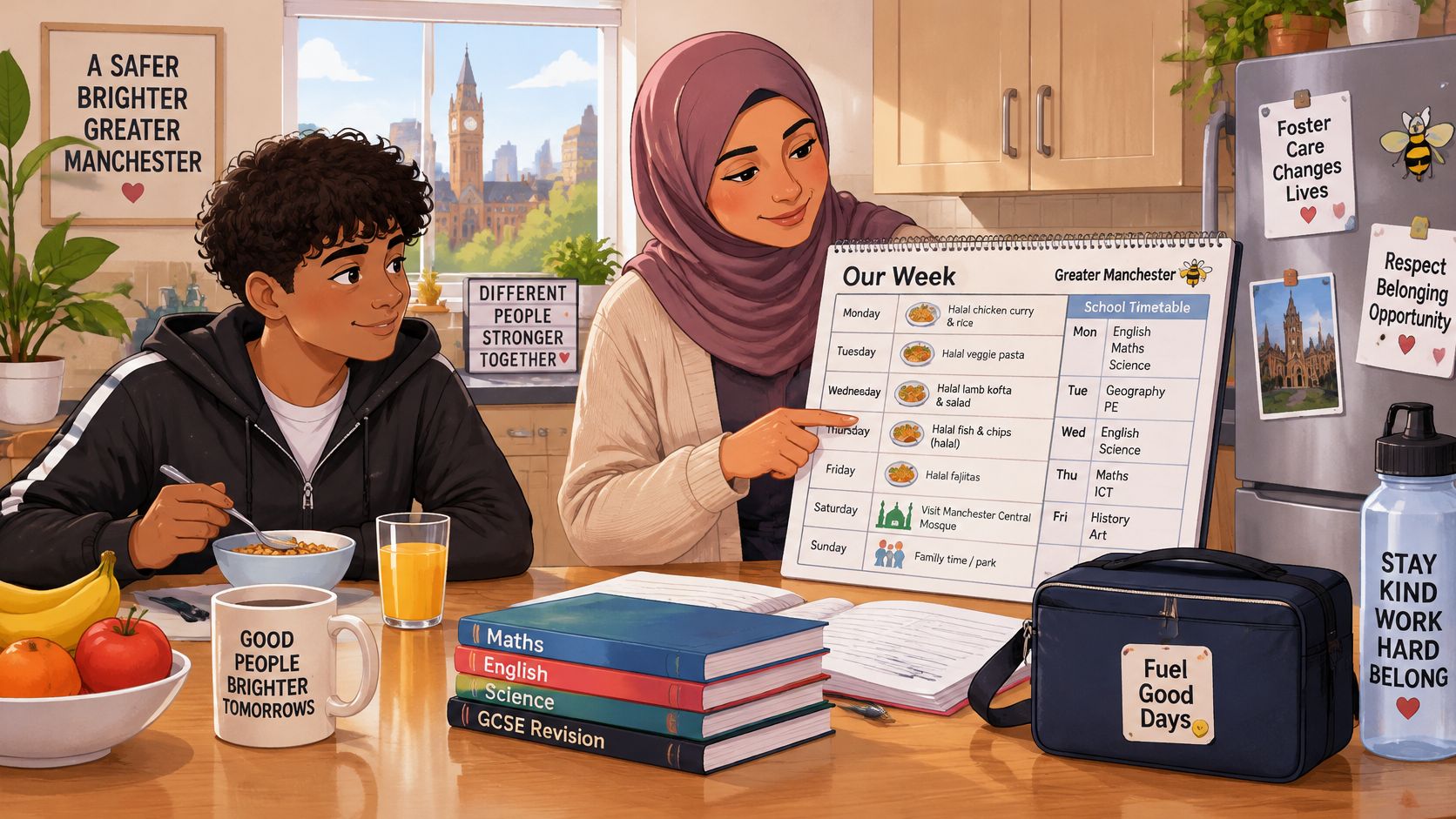
This is a hypothetical example, not an Organic Fostering family or an account of an identifiable child. A Greater Manchester household is caring for a teenager whose placement arrangements include halal meals, an optional prayer space and agreed weekend contact with a trusted aunt.
On Monday, the carer checks the school timetable and prepares a calm evening meal. Conversation includes homework and food preferences, rather than turning the teenager's arrival into an interview about religion.
Responding to a difficult evening
Midweek, the teenager sharply refuses the agreed bedtime routine. The carer keeps the boundary while considering whether the response reflects worry, frustration, unfamiliar expectations or something that happened earlier.
At a visit from the supervising social worker, the carer describes what happened before and after the disagreement, rather than labelling the teenager difficult. Together, they consider what might help the next evening feel more predictable.
Organic Fostering helps carers look beyond a child's immediate behaviour, remain curious about its meaning and respond with safety, boundaries and empathy. That approach doesn't remove expectations, but it changes how an adult explains and maintains them.
Keeping the week workable
On Thursday, the carer checks a proposed Ramadan arrangement with school. In this illustration, the teenager is considering fasting, so the discussion addresses exams, rest and relevant health advice without treating fasting as compulsory.
Friday's meal includes a familiar dish chosen by the teenager. There's time and space for prayer, but no requirement to use it.
At the weekend, the agreed contact with the aunt takes place. A home-language phone conversation is treated as ordinary family communication, not a special cultural exercise.
The support around such a week matters:
- Supervision and learning: Organic Fostering carers have a supervising social worker, preparation and ongoing learning.
- Advice and peer contact: Approved carers can access advice outside normal hours and opportunities to connect with other foster carers.
- Joined-up care: Carers receive help navigating education and health needs and work with social workers, schools, health professionals and birth families where appropriate.
If the teenager says mosque attendance or fasting is no longer wanted, the carer records that change and raises it with the child's social worker. Worship arrangements, school communications and meal planning can then be reconsidered. The plan changes without making the relationship conditional on religious participation.
How Matching Works When Faith Differs
Coventry University's research on Muslim-heritage children's care experiences reports that more than half spend time with non-Muslim families, and that permanent homes are harder to find where children are older, disabled, part of a sibling group, of mixed or multiple heritage, or have complex needs. England's national children-in-care statistics do not record religion, so matching rests on what is recorded and known about each child rather than on category counts. What a child needs is a carer who can sustain the religious, cultural and linguistic connections that already matter to them, and a shared faith still leaves capability, availability and the care plan to be weighed.
The tension is practical. A child needs stability and safety, while carers need the knowledge, capacity and support to maintain the connections that matter to that particular child.
A decision order for a possible placement
- Record the child's wishes. Include uncertainty, disagreement and changes of view, rather than presenting identity as settled.
- Confirm safeguarding and the care plan. Establish what the household must provide and any restrictions that affect daily arrangements.
- Identify valued relationships. Consider family and community connections and whether safe, agreed contact is possible.
- Assess capability against need. Compare language, diet, worship and education requirements with what the carer can sustain.
- Set dated review points. Name who will check the arrangements and how the child can raise a concern between reviews.
Capability shows up in specifics. A carer should be able to explain how an agreed food requirement will be met during school holidays, or which worship setting or family contact is realistic from their address. A general statement that all religions are welcome tells a social worker very little.
Preparation training can test these practical responses before a placement. Assessment records should distinguish existing skills from learning still needed, and placement actions should be specific enough for a social worker to check.
Allow room for differences within a shared background
Some children are secular, some belong to different Muslim traditions and others are unsure of their beliefs. Some unaccompanied young people need specialist language and trauma support alongside religious familiarity, a complexity explored in scholarship on Muslim-background fostering and adoption.
Teenagers need meaningful involvement in decisions about independence and personal identity. Siblings also need individual attention: a shared family background does not mean every child wants identical worship, clothing or community arrangements.
Matching safeguard: A household label is a starting point for questions, not evidence that every need can be met.
Matching at Organic Fostering weighs a child's care plan and known needs against a carer's approval, household, experience and ability to provide safe care. The agency's explanation of how placement matches work shows what that weighing looks like in practice.
Who Can Apply and What Assessment Asks
People of any faith or none can foster, including single people. Being Muslim isn't an entry test, and religious identity doesn't replace assessment of the household's ability to care safely.
The GOV.UK fostering assessment guide explains that assessment covers religious beliefs, ethnicity, cultural background and languages, including whether an applicant is willing and able to care for a child whose background differs from their own. It can involve home visits, calls and meetings, and considers the property, family relationships, employment history, standard of living, experience with children and relevant skills.
Questions about belief are questions about care
Muslim applicants should expect to discuss how religious practice fits into family life. The purpose is to understand daily routines and responses to difference, not to conduct a test of piety.
A useful discussion might explore how shared spaces would work if a young person wanted privacy, or how a household would respond if a child didn't share its beliefs. Honest answers are more useful than promises that nothing would ever be difficult.
The agency also needs to understand what support the applicant would use when a child's needs exceed their current knowledge. Preparation involves recognising limits as well as identifying strengths.
The whole household matters
Organic Fostering normally requires:
- Suitable accommodation: A suitable spare bedroom for a child.
- Practical availability: Time and flexibility to meet a child's needs.
- Readiness for the process: The right to work in the UK and willingness to complete assessment, checks and training.
Recruitment and assessment can include identity, date of birth, address history, references, and criminal-record and barred-list information. These checks sit alongside conversations about relationships, judgement and the practical realities of family life.
Couples are assessed together. Where children already live in the home, their views, ages and needs, and the possible effect of fostering on them, form part of the assessment.
Applicants can prepare by considering specific fostering assessment questions, including examples of handling disagreement, supporting a child through distress and asking for help. There's no advantage in presenting an idealised household that the assessment cannot meaningfully understand.
Common Questions About Muslim Foster Care
Is fluency in the child's home language necessary?
Fluency is not a precondition for a suitable match. Communication needs still have to be assessed. A care plan can include learning key words, keeping familiar stories available and supporting agreed calls with relatives. For significant meetings or sensitive discussions, carers should establish what interpreting support the local authority will arrange rather than relying on informal translation.
What information should be discussed before a placement?
The carer should receive the information needed to understand and safely meet the child's known needs. Questions should address faith, diet, language, health, education, family contact and any gaps in what has been recorded. Where a question goes unanswered, that gap should be stated plainly in the plan rather than filled with assumptions about a child's background.
What should a carer record before asking for help?
A useful record covers the immediate concern, what the child has said they want, when it happened and what has already been tried. Writing this down first makes a conversation with the supervising social worker faster and more productive, and it helps show whether a difficulty is a one-off or part of a pattern that needs a different response. Carers should not wait for a routine meeting when an issue affects safety or prevents agreed care being provided.
Start a Conversation About Fostering or Transferring
Faith-sensitive fostering rests on recorded capabilities and the child's own wishes. Because national children-in-care data does not record religion, that evidence has to be built child by child: diet, prayer, language, family contact, identity and the daily routines that make care feel safe.
A first conversation works like a survey before building work. It maps the household, tests likely pressure points and shows where preparation is needed before anything is decided. The eligibility basics covered earlier still apply; this stage is about how they translate into everyday care.
Organic Fostering is an Ofsted-registered independent fostering agency supporting foster families across Manchester and the North West. An initial discussion can address how a household's beliefs, routines and existing commitments might fit with fostering, including areas where preparation would be needed.
The route into fostering
- Start a conversation. Discuss motivation, household circumstances and questions about caring across differences.
- An initial home visit. Explore the home and practical arrangements in more detail.
- Apply and train. Begin the application and preparation process.
- Assessment. Consider the household's capacity, complete checks and explore the care it could provide.
- Panel and approval. Complete the formal consideration of suitability.
These stages organise the evidence. Approval follows only when assessment shows safe, sustainable care, and a willingness to support Muslim children is weighed alongside the household's capacity and the needs of any proposed child.
For carers considering a transfer
An already-approved carer may want to discuss supervision, cultural understanding or help with a particular aspect of care. The agency can explain transferring from another fostering agency and discuss continuity for children already in the household, whose welfare comes first.
Financial questions deserve clear answers before a decision is made. Prospective or transferring carers should request the agency's current allowance and tax guidance, separating the costs of caring for a child from any professional fee and the tax arrangements that apply to fostering income.
Organic Fostering prepares and supports carers to provide safe family care, including thoughtful responses to children's faith, language and identity. Prospective carers and those considering a transfer can visit Organic Fostering to start a conversation about their household and the support needed to care for a Muslim child.