

An English foster carer provides day-to-day family care inside a multi-agency plan, not accommodation alone. Commitment includes keeping records, attending meetings, advocating for the child and knowing when a concern needs professional action.
The familiar advice that fostering starts with a spare bedroom misses the harder question: who takes responsibility for what happens inside that home? Understanding foster carer roles and responsibilities means recognising both the carer's parenting role and the limits of their authority. Good intentions matter, but they aren't a substitute for skilled care, clear agreements and timely support.
Table of Contents
- What Foster Carers Are Responsible For
- Who Decides What in a Child's Care
- The Day to Day Parenting Role
- Records, Meetings and Safeguarding
- Training, Supervision and the Annual Review
- How Duties Change with the Placement
- Expectations Before and After Approval
What Foster Carers Are Responsible For
A foster household works like the engine room of a wider ship. The carer keeps the daily routine running: school runs, meals, bedtime and the small negotiations that help a child feel settled. Around that, the child's social worker, school and health staff steer the plan. In England, fostering is a team role, and the team can include the local authority, the school, health professionals and the child's birth family.
The duties attached to the role are wider than most applicants expect: keeping records, writing reports, attending meetings, advocating for the child, helping with behaviour and feelings, and completing training. The government's guide to becoming a foster carer reports that in 2024 England had 83,630 looked-after children, equivalent to 70 per 10,000 children, with 56,390 children, or 67%, living in foster placements, and that 99% of children living in foster care said they felt safe always or most of the time over the previous three years. Feeling safe is built from ordinary moments: an adult arriving when expected, responding calmly and taking a worry seriously.
Family care with professional responsibilities
A looked-after child is a child in the care of a local authority. Their foster carer offers ordinary family experiences, and the professional tasks sit inside that ordinary life. Preparing for a meeting is part of caring, because it shows whether the child is sleeping, settling at school, enjoying friendships or struggling after family contact.
The boundary that puzzles new carers usually appears in small moments. A child comes back from contact upset and slams a bedroom door. The carer decides how that evening goes: a calm conversation, tea, an early night, a note for the morning. Whether contact happens more or less often belongs to the child's social worker and the care plan. Both halves matter, and only one of them is the carer's to decide.

Practical rule: The home and the paperwork are the same job. A carer writing a clear report is doing the same work as one who makes tea at the right moment.
Different kinds of expectations
Prospective carers meet three layers of expectation:
- Law and statutory guidance set the framework within which children's services and fostering services operate.
- National standards describe the knowledge, skills and development expected of carers.
- Agency arrangements explain how the household records information, accesses support and follows its agreed fostering practice.
None of these layers hands a carer authority over every decision about a child. A placement label shifts the emphasis of the work while the professional duties stay in place. Each of the types of foster care keeps the carer inside the same accountability.
Who Decides What in a Child's Care
Who decides common fostering matters in England
| Area | Carer usually does | Needs agreement or escalation | Who leads |
|---|---|---|---|
| Daily home life | Meals, bedtime, clothes, pocket money within the plan, homework support | Major care-plan changes or substantial changes to agreed household arrangements after an incident | Carer within delegated authority; child's social worker for the plan |
| Education | Attendance, uniform, homework and telling school about a difficult morning | Change of school, managed move or exclusion planning | Child's social worker with education services; carer contributes observations |
| Health | Routine GP, dentist, optician and first aid within agreed arrangements | Surgery, significant treatment or stopping agreed medication | Health professionals and those with authority to consent; carer follows the plan |
| Family contact | Preparing the child, agreed transport and noting how the child was before and after | Frequency, venue, supervision level or stopping contact | Child's social worker through the care plan and any relevant court arrangements |
| Overnight stays and holidays | Local activities and stays already covered by delegated authority | Arrangements outside that authority, including travel abroad requiring permission | Placement plan and child's social worker |
| Safer caring at home | Age-appropriate supervision and agreed household boundaries | Revising the safer-caring plan after a new risk | Carer with supervising social worker |
| Safeguarding incident | Immediate safety, factual recording and prompt reporting | Strategy discussion, allegation or missing-child response | Placing authority with relevant agencies, including out-of-hours services |
| Placement move | Honest feedback and support with a planned goodbye | Decision to end or move the placement | Placing local authority, with the child's welfare first |
Delegated authority means agreed permission
Delegated authority means permission to make specified decisions on the child's behalf. The placement plan should make those permissions clear, so ordinary childhood experiences don't become unnecessary administrative hurdles.
The table describes a working starting point, not blanket permission. A carer should know what's agreed for that particular child, who can consent to significant decisions and which contact number applies outside office hours.
Organic Fostering carers work with social workers, schools, health professionals and birth families where appropriate. Understanding the different fostering social worker roles helps distinguish support for the household from responsibility for the child's wider plan.
How the boundary works in practice
Illustrative scenario: A child wants to stay overnight with a school friend. The carer checks the delegated arrangements and considers the child's needs and safety. An overnight stay already covered by those arrangements needn't automatically require fresh permission, but an arrangement outside them needs agreement.
A medical appointment creates a different question. Booking a routine dental check may sit comfortably within delegated authority; consenting to significant treatment requires the appropriate consent route. A carer shouldn't assume that taking the child to the appointment gives permission for every procedure.
Family contact can also produce difficult moments. A child may become upset before a planned visit, but the carer shouldn't privately rewrite future arrangements. Their role is to hear the child, address immediate safety, communicate the concern and seek a decision through the agreed route.
Commitment doesn't mean solving every problem alone. Recognising a decision beyond the carer's authority is part of responsible parenting.
If a child is injured, missing or makes a disclosure, immediate protection comes first. Emergency help should be sought where necessary, alongside prompt notification through the safeguarding arrangements, including out of hours. An allegation must follow the appropriate local authority process, not an informal agreement between the adults concerned.
The Day to Day Parenting Role
An illustrative weekday might begin with breakfast, a missing school jumper and a child who won't leave their bedroom. The carer's task is to get the morning moving while staying alert to what the reluctance might mean. Some mornings that takes five minutes. Others swallow the whole hour, and the school run happens late with a conversation to follow later that day.
The practical duties are ordinary: school readiness, any medication already agreed in the care plan, a packed lunch, a proportionate handover to school. Proportionate is the word that matters. A teacher may need to know the child slept badly and is likely to be fragile by lunchtime. They don't need unrelated private details about the child's family.
Behaviour needs a response, not a label
After school, the carer reads the child as closely as the routine. Is the child hungry, withdrawn, unusually energetic, worried about a friendship? Homework matters. So does noticing that a snack and a quiet twenty minutes will make homework possible at all.
Behaviour works like a message sent in a language the child may not yet have words for. Organic Fostering helps carers look beyond a child's immediate behaviour, stay curious about its meaning and respond with safety, boundaries and empathy. Curiosity of that kind is disciplined. The carer follows the agreed approach, keeps the boundary where it was agreed, and asks what support the child needs, even before the reason for the behaviour is clear.

A thrown school bag calls for a safe boundary and a calm response. The carer addresses the action, then makes space to understand what came before it, treating "ungrateful" as a label that explains nothing about the morning.
Identity belongs in ordinary routines
Belonging is built through practical choices:
- Food and personal care: familiar meals and suitable hair-care products make everyday life more comfortable.
- Faith and language: agreed religious practices, the pronunciation of names and chances to use a familiar language all deserve attention.
- Relationships: planned family contact needs emotional preparation as well as transport, plus respectful support afterwards.
The child's own preferences matter here. A carer shouldn't assume a child wants a particular food, celebration or routine because of their background. Ask, then adjust.
The rest of the household is part of the picture too. Partners and birth children need room to express their views, and supporting siblings in foster care means attending to each child's place in family life rather than treating one placement as the whole story.
Whether a foster carer can also work depends on the child's needs and the carer's actual availability. Appointments, meetings, contact arrangements and unexpected difficulties all need space in the week, and those rarely arrange themselves around school hours.
A good day is one where the child felt safe, was fed and was heard, and where the carer passed on anything the professional team needed to know.
Records, Meetings and Safeguarding
A carer's notes are the handover between everyday life and the professional network. They show what happened between appointments and meetings, and they can shape decisions about education, health, family contact and safety. Clear, specific, calm recording gives the child's day a voice in rooms they are not in.
Fostering responsibilities include keeping records, writing reports, attending meetings and advocating for children. Those duties work together: a well-kept record gives the carer a reliable basis for speaking up.
Record observations before interpretations
Observable facts describe what the carer saw or heard. Interpretation describes what the carer thinks those facts might mean. Both can be useful, and the record should make clear which is which.
A useful log entry records the date and time, who was present and the child's exact words where relevant. It describes any injury or concern in neutral language, notes a relevant school event or contact arrangement, and explains what the carer did and who was informed.
A recording check:
- What happened: Describe actions and events without assigning motives.
- What the child communicated: Distinguish their words from an adult's account.
- What followed: Record immediate care, advice received and agreed action.
- What remains outstanding: Identify a response, appointment or decision still needed.
Consider a child who returns from contact subdued. The note records what the carer saw and heard, the child's exact words if shared, what the carer did and who was told. The question of whether contact caused distress belongs in a professional discussion, where the team can weigh it alongside other information. The carer's record informs that discussion; it does not settle it.
Recording habit: Write the note while events are fresh. A safeguarding concern needs prompt action through the agreed route. It should not wait for tomorrow's notes.
Use records to contribute to decisions
Carers should expect to contribute to the child's looked-after review, education planning and placement meetings. Preparation means identifying progress, worries, the child's views and any decision that needs clarification.
A carer can support a proposal in principle and still explain, professionally and specifically, why a suggested arrangement may be difficult for the child and what alternative deserves consideration.
At Organic Fostering, the supervising social worker uses those records when discussing progress, so the quality of the note shapes the quality of the conversation.
Confidentiality means sharing relevant information only with those who need it. A child's history stays out of conversations with friends and off social media. Safer-caring arrangements also need attention when circumstances change, including visitors, bedroom arrangements and online activity. Notes should be completed promptly, and safety concerns must never wait for routine supervision.
Training, Supervision and the Annual Review
In England, mainstream foster carers are expected to complete the Training, Support and Development Standards workbook within 12 months of approval, according to the Government's support guidance for foster carers. The standards describe what carers should know, understand and be able to do. They work like a map of good care. Supervision lets a carer check the route against this particular child.
Training continues after an approval panel has considered an application. Fostering services are expected to provide preparation, induction, continuing development and supervision, with learning connected to the needs of children placed.
A useful first-year learning pattern starts with safeguarding, safer caring and accurate recording, then develops around the child living in the household. That pattern follows the placement as it unfolds and avoids pretending a single national course timetable fits every child.
A new health need, difficulty around family contact or unfamiliar behaviour should prompt a focused discussion. What matters is whether the carer can apply an appropriate response to the child's needs.
Consider a child who becomes tearful before contact. Supervision can turn that observation into a plan: what to record, what to try, who to ask, and when to seek specialist advice. The carer stays close to the child's experience; the professional network helps decide what the plan should be.
A workable learning process is:
- Identify the gap. Describe the situation that the carer feels less prepared to manage.
- Agree the support. Decide whether training, specialist advice, practical guidance or a combination is needed.
- Apply the learning. Use the agreed approach consistently and avoid introducing conflicting strategies.
- Review the effect. Record what helped, what didn't and what needs adjustment.
Organic Fostering's foster parent training guidance can help prospective carers see learning as part of the role and plan for it in the weekly rhythm of the household.
Keep evidence that shows development
The training portfolio is the organised record of that development. It can include certificates, completed learning, development plans, supervision records and examples of how learning changed practice. Required preparation should be distinguished from additional development chosen to strengthen particular skills. Carers should keep a live learning log, identify child-specific gaps when a placement starts and request support before a difficulty becomes a crisis.
The annual review is the formal checkpoint where continuing suitability and development are considered. It reads the portfolio, supervision notes and the child's progress together. Evidence should reflect the household's actual fostering work, with certificates as supporting evidence.
The service remains responsible for providing necessary support, advice, information and training in children's interests. The carer remains responsible for applying agreed strategies and reporting their impact. Both sides must act on the plan for it to work.
How Duties Change with the Placement
A child arriving for one emergency night and a teenager settled for years can sit under the same approval, yet they ask different things of the household. Safeguarding, recording and work inside the child's plan stay constant; the immediate purpose of the care decides where the carer's energy goes first.
Settling, belonging and handing over
Short-term fostering often means helping a child settle while professionals consider next steps, including a possible return home. The carer gives warmth, routine and honest reassurance, then leaves decisions about duration and destination to the people authorised to make them.
Long-term fostering is a defined route that builds belonging over time while education, health and care planning continue. On 31 March 2025, 19,870 children were recorded in long-term fostering placements in England, according to the Department for Education's looked-after children methodology.
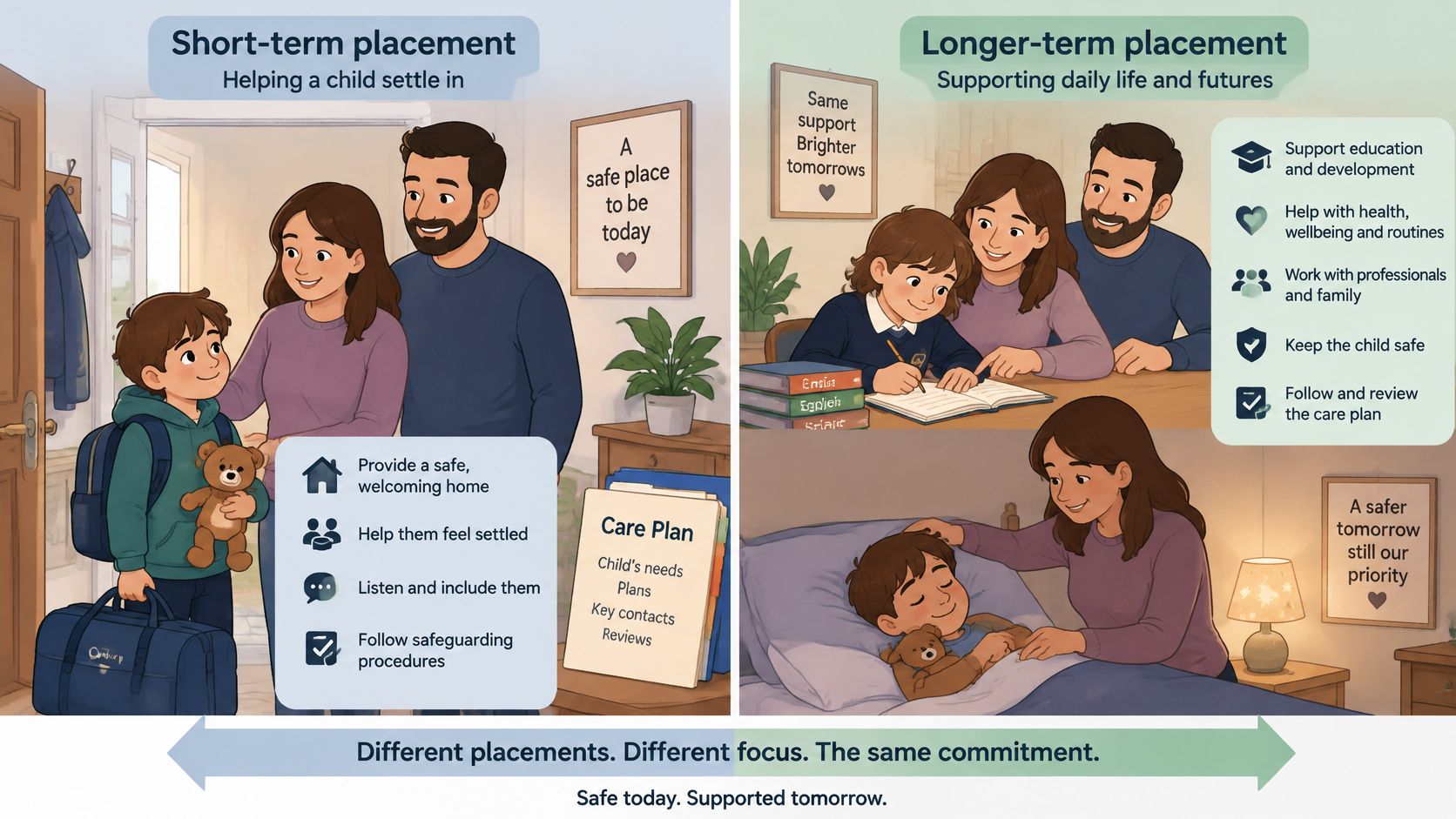
Other arrangements shift the first priorities:
- Emergency placements: when information is thin, safety, a calm welcome, medication or allergy checks and one trusted adult matter before anything else.
- Respite placements: a short, agreed stay needs continuity of routines, medication arrangements and a clear handover.
- Sibling placements: brothers and sisters may share a history and still need different bedtimes, school support, contact arrangements and boundaries.
- Teenage placements: independence, education or training, phone use and risks outside the home need explicit, realistic agreements.
Stability is a shared responsibility
England's 2025 stability figures found that 10% of looked-after children experienced three or more placements during the year, while 62% of eligible 18-year-olds who left care from a foster placement were still living with their former carers three months later under Staying Put, according to the Department for Education's stability measures.
Continuity is protected through early, specific signals rather than a final phone call: missed sleep, school refusal after contact, medication worries, rising tension between children, or a carer noticing their own patience thinning. Naming those signs in supervision gives the supervising social worker and local authority time to adjust support, review safeguarding and safer caring, and plan before strain becomes breakdown.
Organic Fostering matches a child's care plan and known needs against the carer's approval, household, experience and ability to provide safe care. Understanding how placement matches work helps carers weigh a referral, including culture, faith, language and existing relationships.
Before saying yes, the household tests the fit in plain terms: sleep, the school run, contact, health appointments, other children, work hours and the likely length of stay. When the answer is yes, the role becomes the steady middle ground: family life on the inside, professional decisions around it.
Expectations Before and After Approval
Expectations before and after approval in England
| Stage | What the carer does | What the service and professionals do |
|---|---|---|
| Before approval | Takes part in preparation, assessment and checks | Provides preparation and assesses suitability; approval isn't guaranteed |
| After approval | Follows the care plan, uses agreed strategies and keeps records and a learning log | Provides a supervising social worker, supervision, induction and continuing development |
| Training | Completes the standards workbook within the required post-approval timetable | Provides relevant learning and supports portfolio development |
| Payments and tax | Keeps placement records and registers as self-employed with HMRC | Explains placement-related payments without promising continuous placements or tax-free income |
| Moving agency | Shares approval history and details of any child currently placed | Assesses the carer again, with the child's welfare central to the transfer process |
A realistic route into the role
Organic Fostering describes five steps: start a conversation, initial/home visit, apply and train, assessment, and panel/approval. Household circumstances, available time and willingness to complete checks and learning all matter; completing the stages doesn't guarantee approval.
After approval, a supervising social worker focuses on the carer's development and the household's fostering practice. Payments meet the costs of care and may include a professional fee, but active placements aren't guaranteed.
For tax purposes, foster carers are generally treated as self-employed and should register and complete tax returns; HMRC's fostering tax guidance explains Qualifying Care Relief and why fostering income shouldn't automatically be assumed to be tax-free.
An approved carer moving agencies still undergoes Organic Fostering's assessment, informed where appropriate by existing reports, training and experience. If a child is already placed, the current service, new agency and child's local authority must prioritise their welfare and continuity.
Organic Fostering can explain the responsibilities, preparation and support involved in fostering, or discuss the transfer process and continuity for children already in a carer's care. Prospective and approved carers can visit Organic Fostering to start a conversation about their household, availability and questions about the role.