
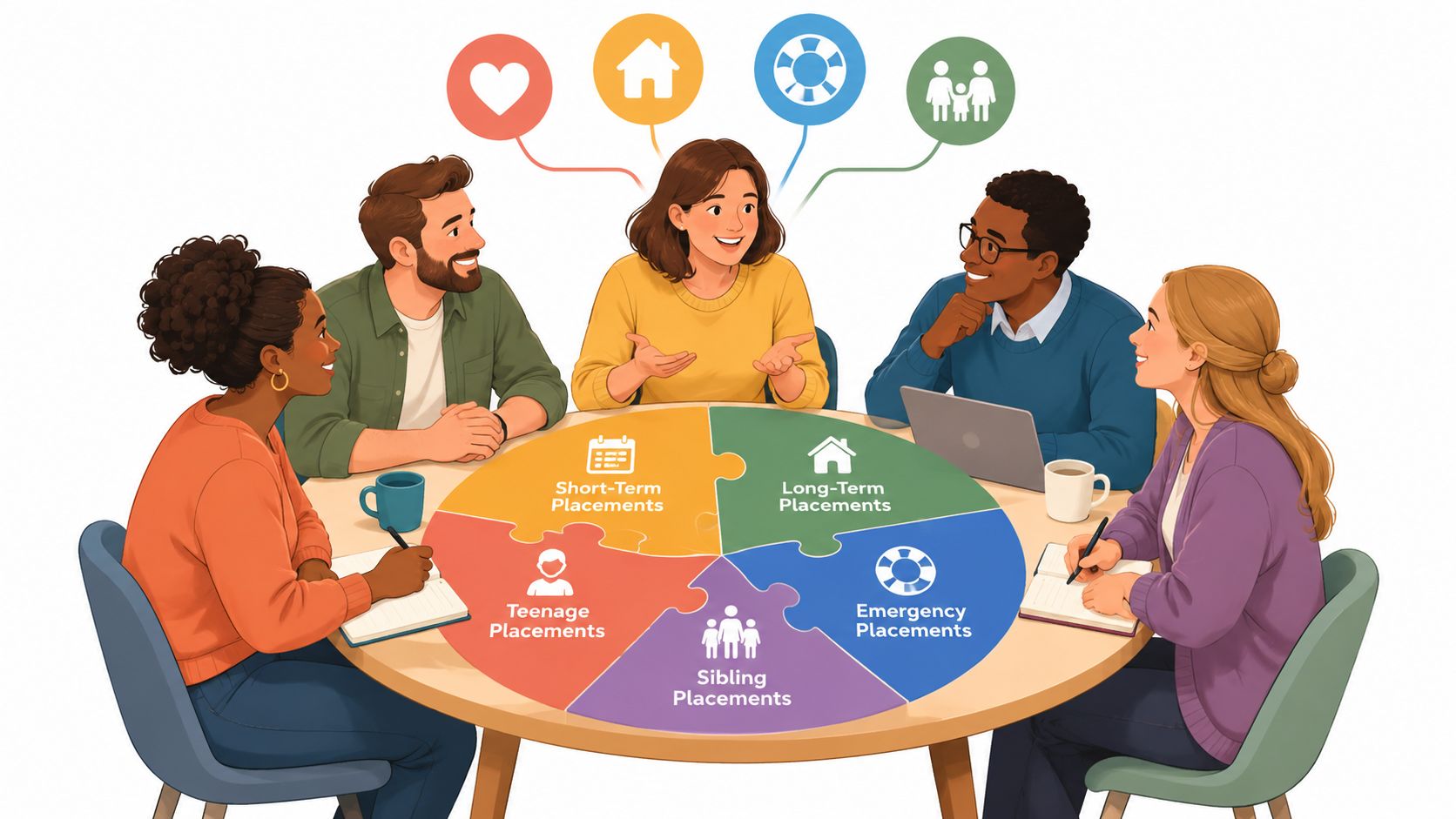
People often search for foster carers stories because official guidance can explain the process, but it can't fully answer what fostering feels like at home. Yet children's privacy, carers' confidentiality and safeguarding responsibilities mean unverified personal accounts shouldn't be invented or presented as authentic. A more responsible approach uses evidence-based narrative themes, including short-term, long-term, emergency, respite, sibling and teenage placements.
Those themes help prospective carers in Manchester and the North West understand the decisions behind a placement. They also show why matching, cultural identity, training, allowances, assessment and continuing support matter alongside warmth and commitment. General guidance for England must remain separate from Organic Fostering's current services, published requirements and support arrangements.
The route into fostering usually includes an enquiry, home visit, checks, training, assessment and a panel decision. Government guidance explains that applicants must be assessed on their ability to care for a child, while the National Careers Service overview of foster carer approval describes the assessment, training and panel stages. Allowances and tax arrangements also need careful explanation using current official information. Any finished article about fostering should receive review from someone familiar with fostering before publication.
Table of Contents
- 1. Transparency about limitations
- 2. Protection must come before inspiration
- 3. Unverified stories cannot establish lived experience
- 4. Fiction can blur the line between example and evidence
- 5. Safeguarding changes how stories should be told
- 6. Confidentiality protects children and families
- 7. Evidence can explain the pressures behind the stories
- 8. Readers need a route from curiosity to informed choice
- Foster Carer Stories, 8-Point Limitations, Quoted Instruction, Alternatives & Next Steps
- Turn These Themes Into Your Next Step
1. Transparency about limitations
A trustworthy account starts by explaining what can and cannot be verified. A personal story carries authority because readers assume that a real carer, child or family has lived through the events described. If the source, date, consent and context aren't known, that authority becomes misleading.
This matters particularly in fostering. A placement may involve health information, education arrangements, family relationships, court processes or experiences of trauma. Even a story with names removed can reveal a child's identity when combined with location, age, timing or unusual circumstances.
An evidence-based article can still be useful. It can explain how a short-term placement differs from a long-term placement, why emergency care may require flexibility, and how respite care can support continuity without implying that a particular household has experienced those events.

What careful readers should expect
Responsible foster carers stories should distinguish between:
- Verified accounts: Stories published with appropriate consent, approval and enough context to confirm their origin.
- Evidence-based themes: General patterns drawn from official guidance, research and professional practice.
- Illustrative scenarios: Clearly labelled examples that explain a decision without claiming that a real family experienced it.
Organic Fostering's fostering FAQs can sit alongside official guidance, but agency-specific eligibility, payment and support details should always be checked against the agency's current published information.
Practical rule: A story should protect the child first, inform the reader second and promote an agency only where the claim can be checked.
2. Protection must come before inspiration
Protection comes first because foster carers stories can reveal too much when they drift into invented detail. A warm article still needs to respect uncertainty, responsibility and support, so readers understand fostering without being misled by a polished but unverified account.
A made-up example might describe a household welcoming a teenager, keeping siblings together or helping a child settle into school. Those situations can happen, but a fictional version can blur the line between a helpful illustration and a real outcome. Readers may then assume that approval, relationships or settling-in always work in the same way.
The same care is needed with money. All foster carers in England receive an allowance, but the amount depends on location, the child's age, specific needs, and the carer's skills and experience. The current GOV.UK guidance on foster care allowances indicates that for the tax year 6 April 2026 to 5 April 2027 minimum weekly rates are published as £176 for ages 0 to 2 in the rest of England to £267 for ages 16 to 17. Check the current GOV.UK page before publication, as rates are updated annually.
A safer way to present a scenario
A safer example says that a household with a spare bedroom is weighing up whether it has the space, time and emotional capacity for a teenager. That kind of scenario helps readers in Manchester and the North West understand the questions a fostering service may ask, without pretending a real family reached a particular result.
Readers need honest preparation, not a script with a happy ending. A careful article can still explain that fostering may involve progress, setbacks, contact with birth family, professional meetings and endings, while keeping the dignity of everyone involved intact.

3. Unverified stories cannot establish lived experience
A web page can describe fostering in general, but it does not verify every story people share online. Readers need to know whether an account came from a current carer, a former carer, an approved publication, a professional interview, or an anonymous post. Without that context, the story cannot reliably stand in for fostering in Manchester, the wider North West, or England.
A verified account also needs boundaries. A real carer may be willing to discuss preparation, training, support, or the emotional strain of endings, but publication should follow a clear process that confirms permission and removes identifying details about children and birth families.
The questions readers ask are often practical. A person considering a short-term placement may want to know how routines change at home. Another may be weighing up sibling placements, care for a teenager, or the need to support a child's culture, faith, or language. Those are valid concerns, but an unverified online story cannot answer them for every household.

A better way to read any foster carer story is to ask what it can prove, and what it cannot. One account may show how an emergency placement changed household routines. Another may show the pressures of a sibling placement, or the support needed for a child with additional needs. These examples can help readers understand the shape of fostering, like looking at different road maps before choosing a route, but they are still examples, not promises.
A properly approved story would normally make its limits clear:
- Consent: The adult contributor understands where the account will appear and what it will discuss.
- Anonymisation: Details that could identify a child, family, or placement are removed or changed appropriately.
- Current context: Agency-specific services, eligibility, and payment information are checked against current pages.
- Balanced detail: The story includes practical pressure as well as progress.
Organic Fostering's foster caring stories page may be a useful place to see what the agency has chosen to publish. Readers should still treat each account as one perspective, not a universal template.
4. Fiction can blur the line between example and evidence
A fictional foster carer story can still be useful, but only if readers can see it for what it is: a teaching example, not proof. A made-up household might show the pressure of taking in a sibling group, managing contact, or supporting a child with additional needs. That can help readers understand the kinds of decisions foster carers face, yet it cannot show that the same outcome is typical or assured.
The risk grows when fiction is written to sound like a real testimonial. A polished story can feel reassuring, like a well-lit model room, but it may hide the harder questions behind approval, placement type and day-to-day support. Readers in Manchester and the North West need to know how different households are assessed, because fostering is shaped by capacity, relationships, identity and the needs of the child, not by a neat script.
Assessment is part of that picture. Applicants do not become approved carers because they resemble a character in an article. They complete checks, references, preparation and an assessment that looks at their home, household relationships, experience, and ability to meet a child's needs. The GOV.UK guidance on becoming a foster carer says applicants in England must have the right to work in the UK, be at least 18 and usually have a spare bedroom. Most fostering services require applicants to be at least 21, and approval follows a completed assessment.
A clearer article uses the fictional prompt to surface practical questions:
- Household capacity: Can adults manage routines, school travel, appointments and communication with professionals?
- Placement type: Would the home be suitable for emergency, respite, short-term or long-term care?
- Relationships: Can carers support safe links with birth family and siblings?
- Identity: Can the home respect culture, faith, language and personal identity?
The fostering assessment information from Organic Fostering can sit alongside national guidance, but agency details should always be checked directly. The goal is not to turn fiction into proof. It is to show readers the questions that shape a real fostering journey.
5. Safeguarding changes how stories should be told
Safeguarding isn't a footnote to fostering content. It determines which details can be shared, who can give consent and whether a story could affect a child's safety, relationships or sense of identity. A seemingly harmless detail about a school, hobby, placement date or family connection may become identifying when combined with other information.
The same principle applies to descriptions of behaviour. A child shouldn't be reduced to trauma, diagnosis, age or a placement challenge. A sensitive account describes the support adults provide, the professional advice they follow and the child's right to dignity. It avoids sensational descriptions and doesn't invite readers to judge birth families.
A practical narrative theme might involve a household learning how to respond when a child needs predictable routines. The article can discuss preparation, supervision, recording concerns and seeking advice without describing a real child's behaviour or claiming a particular intervention worked.
Training supports safer practice
Training helps prospective carers develop practical understanding before approval and continue learning afterwards. Topics may include safeguarding, attachment, trauma, contact, safer caring, health, education and working with professionals. The fostering practice guide from Foundations summarises evidence that relationship-focused training can improve carer-child interactions for up to 12 months after training. It also reports that support networks can reduce de-registrations over a three-year period.
Those findings support a simple conclusion. Carers need more than a preparation course and a welcome pack. They need access to guidance when a placement is difficult, when relationships are changing and when an ending brings mixed emotions.
Organic Fostering's training information should be checked for current agency-specific details. Any public story should show that safeguarding is an ongoing responsibility, not a dramatic theme added for emotional effect.
6. Confidentiality protects children and families
Foster carers may learn information that belongs to a child, birth parent, social worker, school, health professional or court process. That information isn't available for public storytelling just because a carer has witnessed it. Confidentiality continues to matter after a placement ends, including when an account is intended to celebrate progress.
This creates a difference between a private reflection and a publishable story. A carer might privately remember the first calm family meal, a difficult meeting or a child's growing confidence. A public article would need to remove details that could identify the child and confirm that publication won't compromise safety, legal duties or family relationships.
A useful example can remain general. A household may support a child who has contact with birth relatives, attends school and receives help from several professionals. The article can explain why carers communicate carefully and follow agreed plans, but it shouldn't disclose the child's history, location, appearance, timetable or family circumstances.
Confidentiality also affects agency content
Agency pages should avoid implying that one carer's experience represents every household. They should also separate general guidance from claims about a specific service. Readers considering a transfer may need information about supervision, out-of-hours advice, matching, training and continuity, but those details should come from current agency information rather than an anonymous story.
For a prospective carer, the practical question is whether the household can keep information private while working openly with professionals. That includes conversations at home, social media activity, photographs, school discussions and contact with extended family.
A child's story isn't a marketing asset. It belongs within the safeguarding and confidentiality framework that protects the child.
7. Evidence can explain the pressures behind the stories
A foster carer's story rarely stands on its own. Public data helps explain why the strongest accounts usually focus on support, matching, and continuity, not recruitment slogans.
In England, official fostering in England statistics recorded 56,345 approved mainstream foster carers in March 2025, down 1% from the previous year and 12% from 2021. The same series shows 61,360 approved foster carers at 31 March 2022, so the total fell by 5,015 by March 2025.
Placement need has several layers too. The children looked-after statistics show that 67% of looked-after children were in foster placements in 2024, equal to 56,390 children, with a slight reduction of 260 from the previous year. That means a story about fostering needs to cover belonging and care, but also availability, matching, and whether a household can sustain the role.
The practical themes are different because the pressures are different.
- Short-term care asks how a household handles uncertainty and changing plans.
- Long-term care asks how carers support stability while respecting existing relationships.
- Emergency care depends on flexibility, clear information, and immediate support.
- Respite care gives children and the wider care network planned breathing space.
- Sibling placements often need more space, organisation, and careful matching.
- Teenage placements call for attention to autonomy, boundaries, education, and identity.
That is why evidence matters. It gives readers a way to understand why one placement may need quick adaptation, while another depends on consistency over time. It also keeps the discussion grounded in support and training rather than in assumptions.
Relationship-focused preparation has a place in that picture, and an article can refer to it without inventing a testimonial. Organic Fostering's foster parent training information can offer agency context, while official sources should remain the basis for national claims.
8. Readers need a route from curiosity to informed choice
A search for foster carers stories should lead to understanding, not pressure. The useful next step is not a dramatic conclusion, but enough clarity to decide whether an informal conversation would help. No article can judge whether one household fits one placement, because fostering decisions depend on the child's needs, the carer's capacity, and the agency's assessment.
In Greater Manchester, one household may be exploring short-term care. In the North West, another may be considering a transfer after prior experience. A different applicant may be thinking about siblings, teenagers, or children whose cultural, faith, language, and identity needs require careful matching. Each path calls for the same practical questions: what support is in place, how the assessment works, and how referrals are handled.
Two responsible routes are available
An evidence-based article can explain placement types, safeguarding expectations, training, and current official allowance information. It can also point readers to an agency for an informal, no-obligation discussion, without suggesting that approval is guaranteed or that fostering will be straightforward.
A consented story can still help, if Organic Fostering has approved it for publication and the account protects children and birth families. The account should be checked for accuracy, anonymised where needed, and balanced with the less polished parts of fostering, including pressure, exhaustion, endings, and professional oversight.
Current GOV.UK guidance for the tax year 6 April 2026 to 5 April 2027 publishes minimum weekly rates, so readers should verify the live page at publication because these figures are time-sensitive. GOV.UK's foster carer tax guidance describes qualifying care relief as a household exemption of up to £20,440, plus £435 per child under 11 or £515 per child aged 11 or over, subject to current rules, so the live guidance should be checked before publishing.
Readers should look for answers to questions such as:
- Assessment: What checks, references, training, and panel stages apply?
- Support: Who provides supervision, and what happens outside normal hours?
- Matching: How are culture, faith, language, identity, siblings, and existing relationships considered?
- Finance: Where can current allowance and tax information be checked?
- Transfer: How will the child's welfare and continuity be protected if a carer changes agency?
Foster Carer Stories, 8-Point Limitations, Quoted Instruction, Alternatives & Next Steps
| Item | Implementation complexity | Resource requirements | Expected outcomes | Ideal use cases | Key advantages |
|---|---|---|---|---|---|
| Transparency about limitation | Low | Minimal (single disclosure) | Clear expectations; reduces misunderstanding | FAQs, policy pages, content notices | Builds trust; reduces legal/safeguarding exposure |
| Explicit instruction (quoted) | Low | Minimal (documented guideline) | Prevents fabrication; enforces content rules | Editorial guidelines, training materials | Clear boundary; simplifies compliance |
| Reason 1, No access to verified stories | Low–Medium | Moderate to high if verification sought (consent, sources) | Explains limitation; avoids inaccuracies | Content audits, risk assessments | Avoids publishing unverified information |
| Reason 2, Fictional case studies would violate instructions | Low | Minimal (policy adherence) | Prevents rule violations | Editorial decision-making, content planning | Maintains integrity and accuracy |
| Reason 3, Safeguarding risks | Medium | High (safeguarding review, legal oversight) | Reduces risk of harm to children | Vetting personal stories, publishing case material | Prioritizes welfare; mitigates legal/safety risk |
| Reason 4, Confidentiality obligations | Medium | High (consent management, data protection processes) | Protects privacy; avoids breaches | Handling placement details, publishing testimonies | Ensures legal compliance and privacy protection |
| Alternative offer, Evidence-based article | Medium | Moderate (research, citations, writing time) | Informative, compliant content without personal stories | Blog posts, guidance pages, regional outreach | Safe, authoritative, actionable guidance |
| Next step / question for you | Low | Variable (depends on selected option) | Decision to proceed; clarifies requirements | Project scoping; choosing between evidence-based vs consented stories | Provides clear options and path forward |
Turn These Themes Into Your Next Step
No single story represents fostering. One household may provide emergency care, another may support a teenager for the longer term, and another may offer respite or help siblings remain together. The right decision depends on the placement type, the household's capacity, the child's identity and relationships, and the support available around the carer.
Prospective carers should begin with eligibility rather than inspiration alone. In England, applicants need the right to work in the UK, must be at least 18 and will usually need a spare bedroom. Most services set a minimum age of 21, and approval follows assessment, training, checks, references and a panel decision. A fostering service also needs to understand the household's time, health, relationships, finances, support network and ability to work with professionals.
Training and supervision deserve equal attention. Evidence summarised by Foundations indicates that relationship-focused training can improve carer-child interactions for up to 12 months, while support networks can reduce de-registrations over a three-year period. These findings reinforce the value of asking how carers receive advice after approval, how concerns are escalated and what support is available when a placement becomes demanding.
Allowances should be treated as financial support for the costs of caring, not as a guaranteed income or a reason to foster. Current GOV.UK guidance gives minimum weekly rates for the tax year 6 April 2026 to 5 April 2027, while separate tax guidance explains that foster carers must register as self-employed and file tax returns. Qualifying care relief provides a household tax exemption of up to £20,440, plus weekly tax relief of £435 per child under 11 or £515 per child aged 11 or over, subject to the official rules explained by GOV.UK's foster carer tax guidance.
Organic Fostering can be approached for an informal, no-obligation conversation about becoming a foster carer or transferring from another agency. Before publication, agency-specific eligibility, support, payment, locations and service details should be checked against current information, and the finished article should be reviewed by a fostering professional.
Organic Fostering supports prospective and experienced foster carers with information about the fostering pathway, assessment, preparation, ongoing support and placement choices across Manchester and the North West. Readers can visit Organic Fostering to start an informal, no-obligation conversation about becoming a foster carer or transferring agencies.