

Ask prospective foster carers what training involves and they'll describe a course. You complete it before approval, someone signs it off, and that's the learning done. That picture is more than a decade out of date.
In England, training runs as a staged route. Part of it happens before anyone decides whether to approve you. Part of it runs through the first year with a child in the house. Part of it is triggered by a particular child's needs, sometimes years later. Knowing which stage you're at tells you what's being asked of you next, and how much of your week it will take, which is the question most enquiries turn on.
Table of Contents
- Training Stages From Enquiry to Ongoing Learning
- How Preparation Before Approval Works
- Learning Once a Placement Begins
- Why Training Completion Matters for Retention
- Fitting Training Around Work, Family and a Live Placement
- How Peer Networks Keep Carers Connected
- Training When Moving Between Agencies
- Ask About Your Training Pathway Before You Apply
Training Stages From Enquiry to Ongoing Learning
The route from a first phone call to an experienced fostering household runs through six stages. Each one asks something different of you, and each hands over to the next.
| Stage | When it happens | What it covers |
|---|---|---|
| Enquiry and first conversation | Before any application | Current requirements, the route into fostering and a no-obligation discussion with the agency |
| Preparation and training before approval | Before assessment and approval | Core learning on the carer role, safeguarding and day-to-day care |
| Assessment, checks and panel | Can overlap with training | Full assessment, required checks and references, then panel and approval |
| Induction under the TSD Standards | First 12 months after approval | Evidence against each competency domain, reviewed with the supervising social worker |
| Ongoing learning | Throughout the fostering career | Continuing professional development and refreshed core learning |
| Placement-triggered learning | When a child's needs call for it | Targeted training linked to the needs of the child in placement |
The Training, Support and Development (TSD) Standards are the national benchmark for what foster carers in England should know, understand and be able to do during their first 12 months.
A fostering network training model only makes sense read as a sequence. Learning starts before approval and carries on for as long as someone fosters, and the stages overlap in practice, so an assessment visit can land in the same week as a safeguarding workshop.
Where the uncertainty sits: the stage names are consistent across England, but the timing isn't fixed. Assessment length, panel dates and how quickly a first placement arrives all vary, so ask any agency to describe its own sequence rather than relying on a general guide.
To use the table, find the row that describes where you are now and read the row beneath it. That next row is what you are preparing for, and the question worth asking at each stage is the same: what does this stage ask of me, and what should I already be getting ready for? Organic Fostering talks prospective carers through its current requirements when they get in touch, and it explains the likely timescales for each applicant's circumstances.
How Preparation Before Approval Works
Before approval, a prospective carer works through preparation training, a full assessment, the required checks and references, and a panel decision. Learning starts at the first conversation and keeps going after approval, which surprises people who expect the coursework to begin only once they are already fostering.
The five steps below follow the same foster parent process whether you apply to a local authority or an independent agency. The pace differs; the order doesn't.
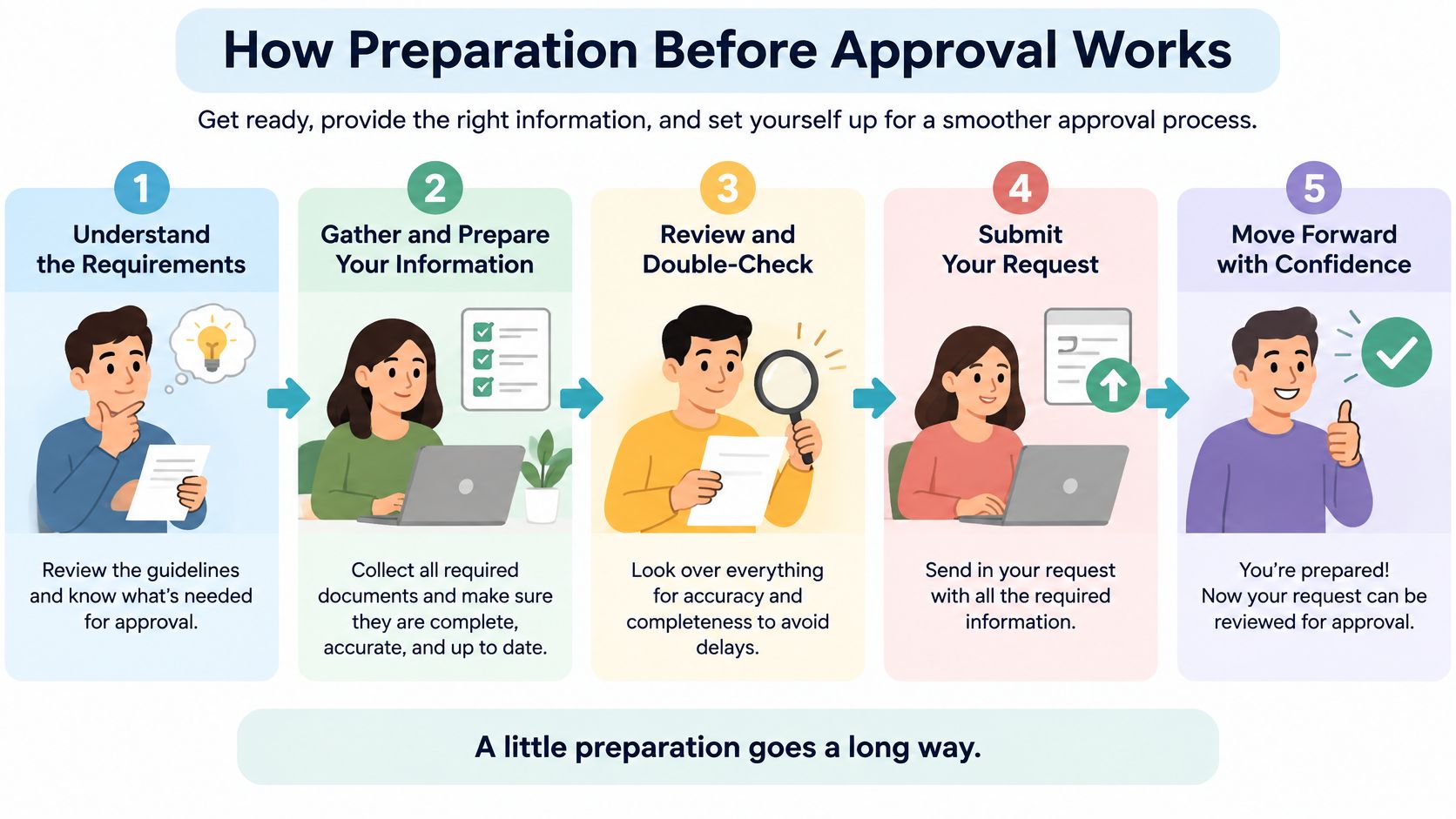
- Start a conversation. A phone call or email costs nothing and settles the first question: whether your household and circumstances fit what the agency is looking for right now. Do this before any form appears, because the answer shapes everything else.
- Arrange an initial or home visit. A worker comes out, looks at the spare bedroom and asks how the household runs on an ordinary Tuesday. It cuts both ways: the visit is also where the questions people forget to ask on the phone get answered.
- Apply and begin training. The application opens the formal stage, and preparation sessions usually run alongside it. The carer role stops being an idea and becomes a set of everyday tasks: school liaison, contact with a child's family, working alongside social workers.
- Complete the assessment, checks and references. An assessing social worker builds a picture of you and your household over several visits. Preparation sessions keep running while that picture takes shape, so the two strands reinforce each other rather than queue.
- Attend panel and move to approval. An independent panel reads the finished assessment and recommends whether to approve. Approval opens the way to a first placement, and the learning carries on from there.
Why the coursework comes first
The National Minimum Standards for Fostering Services, revised in April 2011, made the sequence explicit: fostering services, whether local authority or independent, must provide training before approval, induction after approval and continuing development throughout a carer's career. Preparation exists so a carer walks into a first placement already briefed on the role. An Ofsted-registered independent fostering agency such as Organic Fostering works within that same framework of law, regulations and statutory guidance.
Household shape is a separate question from readiness. Single people can foster, and they go through the same assessment, checks and training as couples.
The practical requirements a household has to meet stay the same for every applicant and are confirmed when you first enquire. Readiness is the harder thing to measure, and it is what the assessment is really testing.
A readiness check before you apply: can you describe a recent example of how you handled stress, change or a difficult conversation, and what you learned from it? That answer tells an assessor more than any list of personal qualities.
Learning Once a Placement Begins
After approval, training stops being a course with an end date and becomes a competency pathway. The TSD Standards expect approved mainstream foster carers to demonstrate capability within their first 12 months, across seven domains that include fostering principles and role boundaries, health and safety, communication, child development and safeguarding, as the guidance for supervisors of the TSD Standards sets out.
The cycle behind the workbook
A newly approved carer doesn't sit an exam. They apply what they've learned during a first placement, collect evidence against each competency, and review it formally with their supervising social worker. The evidence is specific: what happened, what the carer did, what they'd do differently next time.
Most of that work happens in conversation, which is why the relationship matters more than the folder. How foster care social workers support that reflective cycle explains why some carers finish their standards in months and others drift.
What the sessions contain
An effective programme mixes a mandatory layer with case-based work. The mandatory layer covers safeguarding, safer caring, first aid, recording and information sharing. The case-based layer is where the role gets harder: trauma, identity, culture, faith, language and sibling relationships, taught through scenarios rather than slides.
Each module should name an observable outcome rather than a topic. Producing a safer-caring plan for a named child, recognising the indicators of exploitation, or adapting communication for a child's developmental and cultural context are outcomes. "Understanding attachment" is a topic, and it tells nobody what the carer can now do.
That's why training is tied to the household's assessed capacity and the child's actual needs rather than a generic syllabus. The National Minimum Standards treat induction and ongoing development as core service functions, and Regulation 20 places a duty on fostering services to provide training, advice, information and support as necessary for children placed with carers.
A record that lists attendance tells an inspector where someone sat. A record that shows a safer-caring plan written for one child, by that carer, tells an inspector what they can do.
Why Training Completion Matters for Retention
England had 50,035 approved mainstream foster carers as at 31 March 2023, and 84% of them, about 42,029 people, had completed their mandatory training, according to the government's recruitment and retention in mainstream fostering analysis. Completion sits at nearly the same level whether a carer is approved by a local authority or an independent agency, so the training expectation lands in the same place across the sector. The same analysis records how the unfinished group breaks down and how completion tracks alongside staying approved:
| Measure | Figure |
|---|---|
| Approved mainstream foster carers, 31 March 2023 | 50,035 |
| Completed mandatory training | 84% (about 42,029 people) |
| Completed training, local-authority carers | 83% |
| Completed training, independent agency carers | 86% |
| Not completed: training started | 50% (4,630 people) |
| Not completed: training not yet started | 38% (3,580 people) |
| Not completed: awaiting sign-off | 5% (490 people) |
| Remained approved 12 months or more, workbooks completed | 91% |
| Later deregistered, workbooks completed | 81% |
The breakdown of the not-completed group matters more than the headline. The largest share of those carers had already started their training, a smaller share had not yet begun, and a small remainder were waiting only for sign-off.
That last position is instructive. The learning is done and the record has not caught up, so chasing a signature moves the completion figure by exactly as much as booking another course.
The retention rows work the same way. Among households approved for at least 12 months, a higher share of the carers who stayed had finished their workbooks than of those who later deregistered. That gap shows a link between completion and staying approved. It does not show that finishing the workbooks caused anyone to stay. What it does confirm is more practical: completion, supervision and prompt sign-off belong to the same operational work that keeps carers fostering.
What in progress means, and why the number matters
The picture at 31 March 2025 is more uneven. 7,540 individual foster carers were still in progress with the TSD Standards and 675 had an unknown training-status record, according to the Fostering in England 2025 underlying data. An in-progress marker usually means evidence is still being gathered, or has been gathered and is waiting for sign-off.
For a carer checking where they stand, that marker is a position in the pipeline. The useful question for a supervising social worker is which pieces of evidence are still open and who signs them off. Both collections are republished each year for England, so use the current release when checking your own status against the national picture.
Fitting Training Around Work, Family and a Live Placement
Most fostering training can be taken online, in person or as a blend of the two. The right mix depends on your work pattern, your household and whether a child is already with you, and it shifts as you move through the stages.
Three delivery formats and where each falls short
- Online, self-paced modules. They suit mandatory content and anyone fitting study around shifts. They fall short on anything that needs discussion, such as handling a disclosure or recognising exploitation.
- Blended courses. Online study plus fixed in-person days. Often the best fit for working carers, provided the in-person dates are published far enough ahead to book leave or arrange childcare.
- In-person workshops. Fixed times, and the strongest format for practising conversations. Also the least forgiving if you work weekends or care for someone at home.
Carer preference isn't uniform. A 2025 East Sussex foster carer training survey, covering 64 foster carers in a single county and a small sample, found 45% preferred online training, 42% wanted a blended online and in-person model, and 12.5% preferred in-person delivery. The same survey found nearly one-third of respondents hadn't used the anytime-learning resources available, which is the more useful finding: publishing digital content doesn't guarantee anyone opens it.
Carers in that survey asked for evening and weekend sessions, shorter bite-sized modules, disability-related training, and a clearer split between what newly approved and experienced carers are expected to cover. Those are practical requests about access rather than complaints about content.
Before applying, ask five things. How many hours a month are expected. Whether sessions are recorded or repeated. What flexibility exists around work and childcare. How training is arranged once a child is placed. What happens if a session is missed.
Expectations change with each carer's stage, and the agency confirms its own formats, timings and sequence. If you're weighing up employment alongside a placement, working and fostering explains how households usually arrange it.
How Peer Networks Keep Carers Connected
Peer networks are the other foster carers who answer what a training module can't. What to do when a school meeting turns hostile. How to handle a contact arrangement that leaves a child frantic for two days afterwards. What usually helps a placement that hasn't settled after a month.
Formal training is the map. Other carers are the people who have driven the same road and know where everyone misses the turn.
Connection isn't a bonus feature bolted onto a programme. It's part of how the learning sticks.
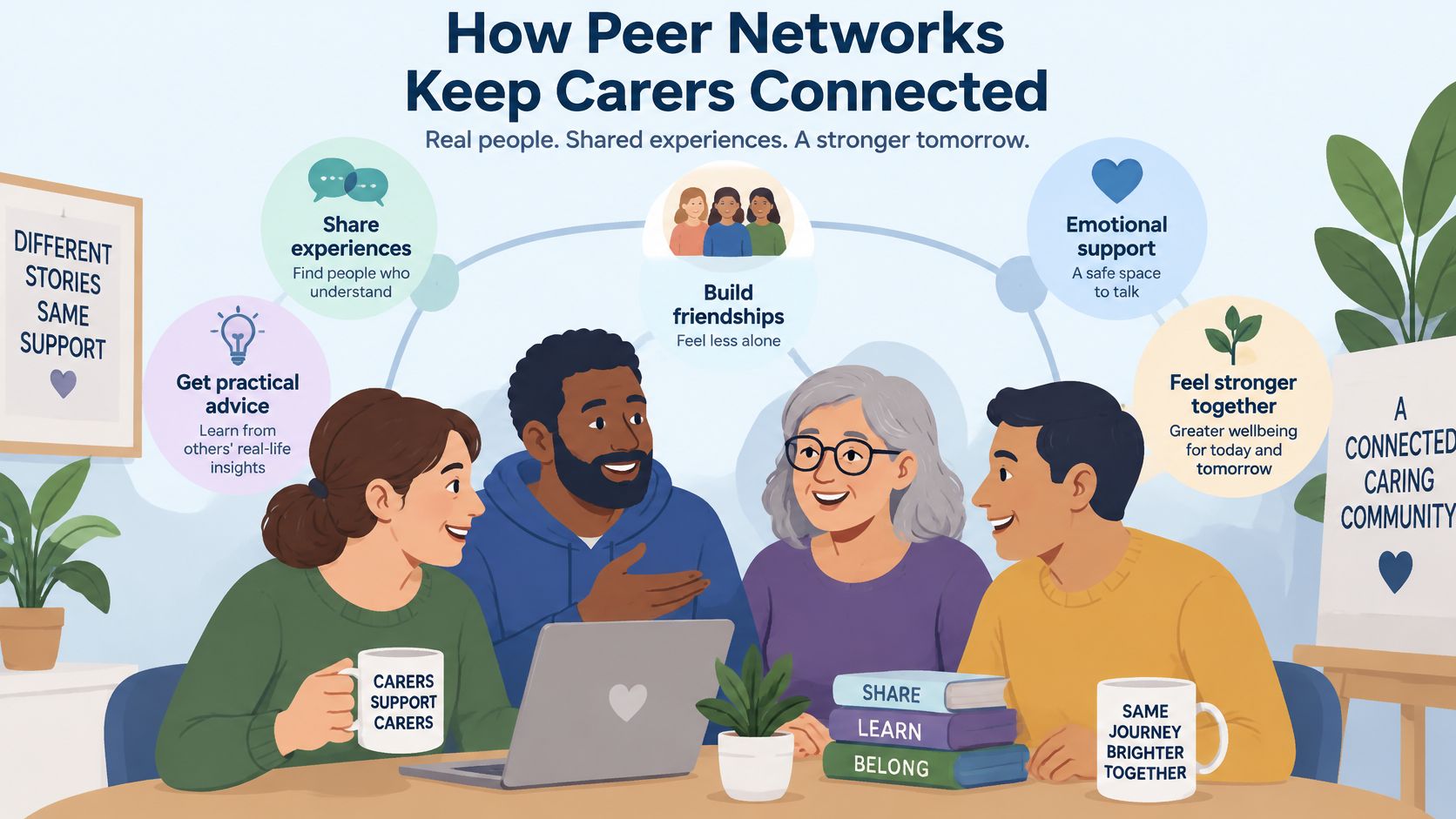
Peer learning sessions, support groups where they run locally, and ordinary contact between carers all do the same job: they turn a principle into something usable at 9pm on a Tuesday. So does a supervising social worker who knows the household, which is why support arrangements carry as much weight as the course list.
Availability is the honest caveat. Location affects any agency's ability to run training, groups and out-of-hours responses, so check the areas an agency covers before assuming a group meets nearby. Carers at Organic Fostering get a supervising social worker, preparation and ongoing learning, advice outside normal hours, contact with other foster carers, and help navigating a child's education and health needs.
Ask which groups meet near you, how often, whether there's an online option and how a new carer joins. A named contact and a date beat a promise of "peer support".
Evidence points the same way. A UK evidence review on fostering identifies regular social-work support, relevant training, peer contact and adequate remuneration as factors in retaining foster carers, and notes that core learning is generally refreshed every three years. The National Minimum Standards go further, expecting personal development plans, a review of how effective training has been, and access for carers who are harder to reach.
None of that replaces formal learning, and peer advice is no substitute for a safeguarding decision made by the agency. What it does is shorten the distance between knowing something and being able to use it under pressure, which is the part new carers consistently underestimate.
Training When Moving Between Agencies
The assumption worth challenging is that moving agency means starting training from zero. For an experienced carer it rarely does. What changes is the scaffolding around knowledge you already have.
Someone with eight years behind them doesn't need safeguarding explained again. They may need a walk-through of a new agency's recording system, its out-of-hours line, and the local authority contacts its referrals route into.
What travels with you and what doesn't
Some learning is portable because it describes children rather than employers. Child development, attachment and trauma, safeguarding principles, communication, and the habit of writing something up the same day don't expire because you changed agency.
Other requirements are local by design. Every agency has its own procedures, forms and escalation routes, and every move changes the multi-agency network around a placement, with different schools, different health professionals and different children's services contacts. A new agency's safeguarding arrangements need fresh preparation even where the underlying principles are identical.
- Which completed training will be recognised, and what evidence does the new agency need to see?
- Which areas will need refreshing, and who makes that judgement?
- Who holds the training record during and after the move?
- What happens to training already booked or part-finished?
The risk in a badly handled transfer isn't paperwork. It's a gap. A carer who moves mid-cycle can end up with evidence split across two agencies and nobody signing it off, which is why a written plan matters more than a warm welcome.
Organic Fostering can explain the transfer process and discuss continuity for the children in a carer's care. The transfer information and the guide to how to transfer to us set out the sequence. What applies to any individual carer is confirmed during that process rather than assumed in advance.
Ask About Your Training Pathway Before You Apply
A good enquiry starts from your stage, not from a blank page.
- Find your row. Check the stage table and mark where you are now, then the stage beneath it. That next row is the question to bring to an agency.
- Read the published route first. Organic Fostering describes a five-step route into fostering and support that continues after approval, so arrive ready to ask how the parts fit your household.
- Prepare three questions. Ask what learning starts before approval, how ongoing training is recorded once a placement begins, and what contact with other foster carers looks like near you.
- Then make contact. Use the enquiry route on Organic Fostering's site and say which stage you think you are at.
An informal first conversation carries no obligation, and Organic Fostering will talk through current requirements. Keep the eligibility basics in view from preparation, then use this conversation to test pace: what can overlap, what must wait, and how learning fits around work, family and a live placement.
Coverage has a practical meaning. Organic Fostering supports foster families across Manchester and the North West, and it publishes an area only after confirming it can provide assessment, supervision and continuing support there.
The commitment in plain terms: training continues for as long as someone fosters, and the person who benefits is the child in the house. The aim of a first conversation is an informed decision, not a rushed one.
Organic Fostering prepares carers before approval and keeps the learning going afterwards, with a supervising social worker, ongoing training and contact with other foster carers across Manchester and the North West. If you'd like to know what the next stage asks of you, visit Organic Fostering and start a conversation with no obligation attached.