

England had 33,435 fostering households at the end of March 2025, a 10% decline since 2021, according to the Department for Education. Behind that figure sits a quieter pattern that matters more to anyone weighing up fostering: the people who enquire far outnumber the people who apply, and the people who apply outnumber the people who are approved. Recruitment isn't one decision. It's a sequence of small ones, and it's possible to see exactly where each of them happens.
Table of Contents
- What Foster Care Recruitment Covers and Why It Matters
- The Route from First Enquiry to Approval
- Eligibility, Checks and What Assessment Covers
- Who Is Involved and What Each Party Does
- Common Recruitment Challenges and Their Causes
- Best Practice for Recruiting and Keeping Foster Carers
- Decide Whether to Make a First Enquiry
What Foster Care Recruitment Covers and Why It Matters
Foster care recruitment is the work of finding, assessing, approving and supporting the people who care for children in England who can't live with their birth families. It runs from a first enquiry, through assessment and panel, into the years of support that follow approval. Treating it as an advertisement is where most confusion starts.
The households recruited aren't one type. Single people foster, couples foster, and people who already have children foster. Applicants come from a wide range of cultural, faith and language backgrounds, which matters because the children who need homes do too. A spare bedroom and available time are practical starting points, not the whole picture.
It helps to picture recruitment as a funnel. Thousands of people show interest at the top. Fewer reach application, fewer still reach approval, and a proportion of approved households leave within a couple of years. People fall away at every stage, and each stage asks something different of them.
The work itself starts with people, not paperwork. A prospective carer's first proper conversation with a fostering service usually happens in their own home.

Five terms come up constantly. A fostering service is the organisation that recruits, assesses and supervises carers, whether a council runs it or it operates independently. An approved carer has completed assessment and been approved to look after children. A supervising social worker supports the household once children are placed. The fostering panel is an independent group that considers each application. Ofsted regulates and inspects fostering services in England.
The Route from First Enquiry to Approval
The route into fostering has five steps: start a conversation, an initial or home visit, apply and train, assessment, and panel and approval. They normally run in that order, though some overlap, and the pace depends on the agency and on the household. Two applicants in identical circumstances can move at different speeds.
| Stage | What happens | What the carer does |
|---|---|---|
| 1. Start a conversation | Eligibility, household basics and current requirements are explained | Share basic details and ask questions |
| 2. Initial or home visit | A worker discusses the spare room, household, availability and reasons for fostering | Show the home and talk through daily routines |
| 3. Apply and train | The formal application is completed and preparation training begins | Complete the application and attend training |
| 4. Assessment | A social worker completes the assessment, including checks, references and a medical statement | Provide references, medical information and personal history |
| 5. Panel and approval | The independent fostering panel recommends on suitability and terms, and the provider must consider the recommendation | Wait for the panel recommendation and decision |
What each stage is actually for
Stage one is deliberately low commitment. It exists so a household can hear the current requirements, ask awkward questions and find out whether fostering fits before anyone invests months. The most useful thing a prospective carer can do here is be honest about availability, work patterns and the ages they feel able to parent.
The home visit is where the conversation gets concrete. A worker sees the spare room, talks through the household's daily rhythm and asks why fostering, and why now. It isn't an inspection, but it isn't a formality either. Practical problems surface here and can be solved here.
Applying and training overlap on purpose. The formal application opens the assessment, and preparation training gives applicants a realistic picture of what placements ask of a household, including the behaviour that often sits behind a child's arrival.
The foster parent process is worth reading in full before starting, because knowing the sequence makes the waiting far easier to sit with.
Panel and approval, and why it isn't automatic
Approval is a decision made by others after they've read the evidence. Under the Fostering Services (England) Regulations 2011, a fostering provider must complete its assessment and have the fostering panel consider the application before approving someone as a foster parent. The panel recommends whether the applicant is suitable and, where approval is recommended, what terms should apply, such as the number, age range or needs of children the household may care for.
The provider must take that recommendation into account, and approval must be reviewed within one year and then at intervals of no more than one year. That review cycle matters more than people expect. It's the point where a household's capacity is looked at again rather than assumed forever.
Why the panel exists as a separate step: it's a check on the assessing social worker's conclusions, not a rubber stamp and not a second interview. It's also the reason nobody can promise an outcome in advance.
Keep a simple written record as you go: questions asked, dates of meetings, the name of each person you speak to. Households that track their own route lose far less time to confusion than those relying on memory.
Eligibility, Checks and What Assessment Covers
Many individuals begin by asking two questions: is my home suitable, and what will I be asked to prove? Both have specific answers. The practical requirements are a suitable spare bedroom, time and flexibility, the right to work in the UK, and a willingness to complete assessment, checks and training.
| Requirement | What is needed | Source |
|---|---|---|
| Assessment stages | Two stages, which may run separately or at the same time | Fostering assessment guidance (England) |
| Medical statement | Usually from a GP, for the applicant | Fostering assessment guidance (England) |
| Personal referees | At least two for the applicant and every adult in the household | Fostering assessment guidance (England) |
| Identity, relationship status, health and personal-reference checks | Applicants and adult household members | National Minimum Standards |
| Enhanced criminal-record checks | Applicants and adult household members | National Minimum Standards |
| Foster child over three | Own bedroom; sharing only with responsible authority agreement and a recorded decision | National Minimum Standards |
The two stages of the assessment
England's fostering assessment has two stages, which may be completed separately or at the same time, as set out in the guidance on the fostering assessment. In the practical stage, a social worker examines the applicant's home and pets, health, relationship history, household composition and any previous applications to foster, adopt or become a childminder.
The wider stage covers employment, standard of living, childcare experience, hobbies, skills, religion, ethnicity, cultural background and languages. Applicants normally need a medical statement, usually from a GP, and at least two personal referees for themselves and every adult living in the household. None of that is nosiness. A child's identity, safety and care needs drive matching, and a household is judged on its whole capacity to meet them.
Single people can foster, and people who already have children can foster. Where there are children at home, their views, ages, needs and the possible effect of fostering on family life form part of the assessment.
The bedroom rule, and why it's stricter than people expect
A spare bedroom is a significant practical requirement, but the national standard is more specific than a simple one room per child rule. The National Minimum Standards for fostering services state that each foster child over three should have their own bedroom.
If sharing is unavoidable, it requires agreement from each child's responsible authority, and every child must have their own area. Before agreeing, the fostering service must consider possible bullying, any history of abuse or abusive behaviour, the children's wishes and other relevant facts, and the decision and outcome must be recorded in writing. The same standards require identity, relationship-status, health, personal-reference and enhanced criminal-record checks for applicants and adult household members.
A household isn't rejected for the size of its house. It's assessed on whether it can offer a child safety, privacy and belonging, and the bedroom rule is one part of that judgment.
What to prepare now
Start with two practical tasks. List two people who could act as personal referees for you and for every adult in the household, and check they're willing. Then register with a GP practice if you aren't already, since the medical statement usually comes from there. Both are easy to do early and slow to fix later, and the fostering assessments page sets out what the process will ask of a household before anyone applies.
Who Is Involved and What Each Party Does
Recruitment is shared work, and no single person or body makes the decision alone. The table sets out who appears at each point.
| Stakeholder | Role in recruitment | Where they are involved |
|---|---|---|
| Prospective foster carer | Makes the enquiry, shares household information, completes training and assessment | From first enquiry to approval |
| Fostering service (council or independent agency) | Recruits, assesses, approves and supervises carers | Every stage |
| Assessing social worker | Examines the home, health, relationship history and household composition | Assessment |
| Independent fostering panel | Considers the application and recommends suitability and terms | Panel and approval |
| Supervising social worker | Gives support and guidance to the household after approval | After approval |
| Ofsted | Regulates and inspects fostering services in England | Ongoing oversight of the service |
| Schools, health professionals and birth families | Work with carers on a child's education, health and contact where appropriate | After placement |
Read the table down the middle column and a shape appears: the person who knows the household best changes as the process moves on. During assessment, that's the assessing social worker. After approval, it's the supervising social worker, whose job is support rather than judgment.
The supervising social worker role is the one prospective carers understand least and value most later, largely because it's the relationship that continues when a placement gets difficult at nine o'clock on a Friday evening.
Beyond the agency, carers work with social workers, schools, health professionals, and birth families where appropriate. Knowing who to ask at each stage removes much of the confusion that causes people to stop replying.
Common Recruitment Challenges and Their Causes
In the year ending 31 March 2023, potential mainstream fostering households in England made 125,195 initial enquiries, and only 6% of those enquiries resulted in an application, a rate that stayed between 6% and 8% in every year since 2018–19, according to government analysis of recruitment and retention in mainstream fostering. Interest was never the bottleneck. The path after first contact is. Timing is the first thing most households ask about, and the answer to how long it takes to become a foster carer explains where the months go.
Where the drop-off happens becomes obvious once the stages are laid out in sequence rather than described as a single opportunity.
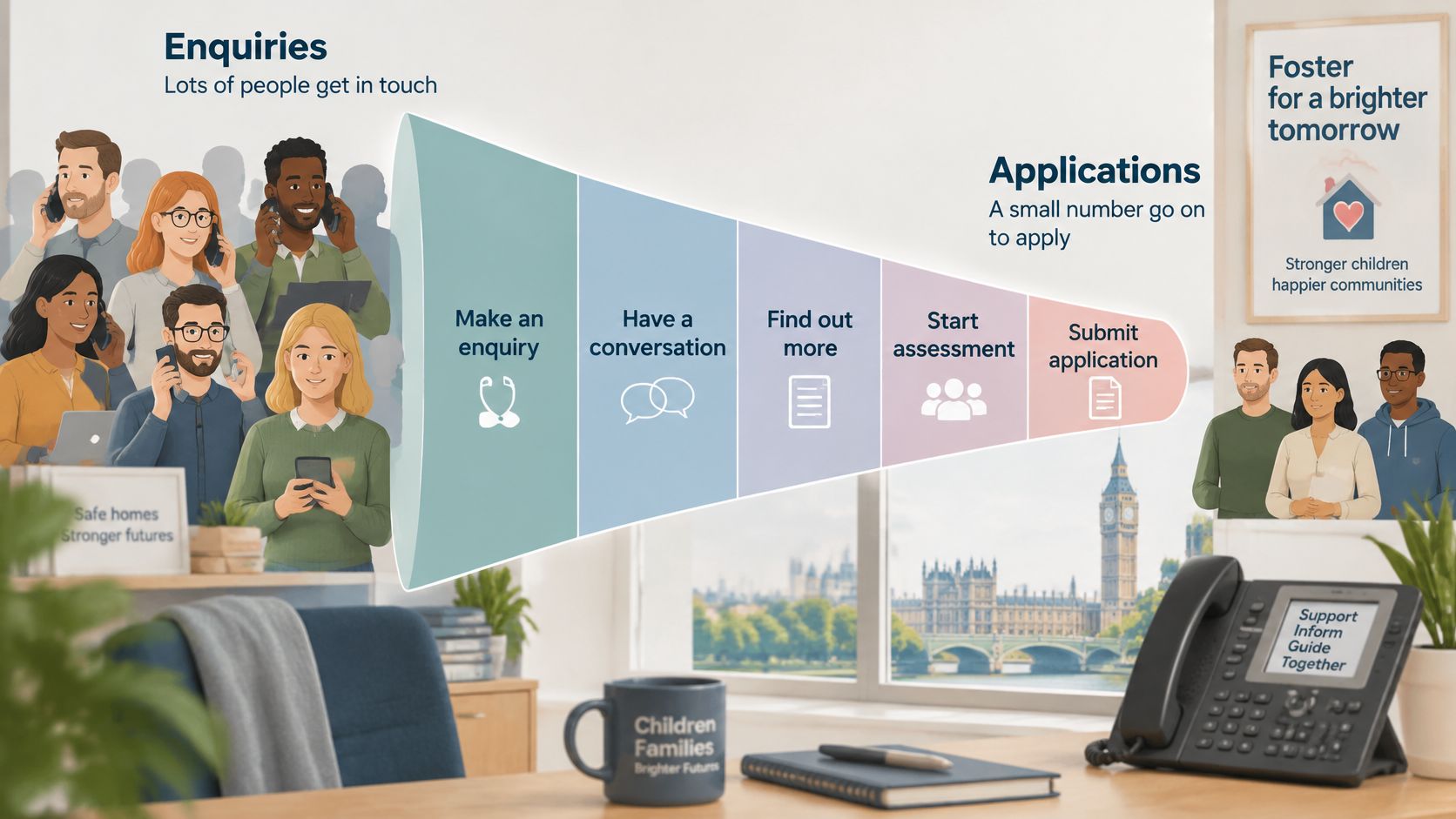
The pattern has repeated. In 2024–25, initial enquiries rose to 149,795 from 131,055 the year before, while applications fell from 8,495 to 8,290, as Community Care reported. More people asked. Slightly fewer applied.
Why people stop
- Eligibility stays vague for too long. Households spend weeks assuming they'll be turned down for a reason that turns out not to apply.
- The bedroom and checks get misunderstood. Applicants often expect a spare room to be enough, then discover the wider assessment and assume they've failed a test.
- The assessment feels intrusive. Questions about relationships, health and money unsettle people who weren't warned how personal the process is.
- Matching worries go unanswered. People want to know whether their faith, language and family life will be respected when a child is placed.
A campaign that produces enquiries but no applications has produced paperwork, not capacity.
These figures are England-wide, so a local service should measure its own conversion rather than assume the national picture applies. What follows after approval, and why households leave, is the other half of the same problem.
Best Practice for Recruiting and Keeping Foster Carers
The evidence on retention is blunt. Approved mainstream foster carers in England fell from 64,295 in 2019 to 56,345 in 2025, and in 2024–25, 4,430 households joined fostering while 4,690 left, according to the Renewing Fostering review. Nearly 30% of carers leave within their first two years.
Support after approval is the part prospective carers ask about least and value most later. It's also where the most credible recruitment message sits.

Feeling excluded, undervalued and insufficiently trusted, alongside limited mental health and special educational needs support, are named as important reasons carers disengage. That suggests where to put the effort.
Practice a provider can check itself against
- Describe the support journey early. Supervision, out-of-hours advice and contact with other carers belong in the first conversation, not the last.
- Be specific about timescales and training. Vagueness about the length of assessment breeds suspicion later.
- Respond quickly and track response times. Speed of first reply is the easiest conversion measure to improve.
- Match with culture and language in mind. Thoughtful matching lowers the risk of a placement breaking down.
- Involve carers in decisions about the children living in their home, rather than informing them afterwards.
- Offer structured help with education and health needs, which is often the pressure point that tips a household towards leaving.
- Measure what matters: enquiry-to-application conversion, assessment completion time and first-year retention.
Retention is a recruitment measure. Every household that stays is one that doesn't need replacing.
At Organic Fostering, approved carers get a supervising social worker, preparation and ongoing learning, advice outside normal hours, contact with other foster carers, and help navigating a child's education and health needs. Talking about that openly is more persuasive than promises about how rewarding fostering feels. Carers wanting peer contact can read about the foster carer support group before deciding whether to enquire.
Decide Whether to Make a First Enquiry
Three questions will tell you whether a conversation is worth having now. Does the home have a suitable spare bedroom? Does the household have the time and flexibility a placement would need? And what support would be available after approval, not just before it?
If the answers are yes, partly, and unknown, that's enough to start. Useful questions for the first call include how the stages are timed, who the supervising social worker would be, what happens out of hours, how households are matched to children, and what the payment policy covers.
Organic Fostering will talk prospective carers through its current requirements when they get in touch, and confirms the minimum applicant age at that point. Single people can foster. Experienced carers thinking about moving can ask about the transfer process and what it means for continuity for the children already in their care.
Nothing has to be decided on the first call, and nothing is lost by asking a question and then waiting a year.
Organic Fostering is an Ofsted-registered independent fostering agency in Manchester, recruiting and supporting foster carers across Greater Manchester and the North West. Its team handles enquiries, home visits, assessment, preparation training and the ongoing supervision that keeps households going once children arrive, with matching that takes culture, faith, language and identity seriously. If you're weighing up fostering, or you're an approved carer considering a transfer, visit Organic Fostering to start a conversation and hear what the current requirements would mean for your household.