

Around 3,800 mainstream fostering households were newly approved in England by March 2024, a total 18% lower than in 2020, even though applications had risen, according to the government statistics on fostering in England for 2023 to 2024. That gap is the core lesson for foster family recruitment. Interest alone doesn't create safe homes for children. Agencies need a clear route, honest information, careful screening and steady follow-up that helps suitable applicants keep moving.
Table of Contents
- Map the Recruitment Sequence and What to Measure
- Recruit Around the Placements Your Area Needs
- Outreach Channels That Attract Qualified Enquiries
- Eligibility Screening Before the Home Visit
- From First Enquiry to Approval and Where Applicants Drop Out
- Set Recruitment Targets That Include Retention
Map the Recruitment Sequence and What to Measure
Effective foster family recruitment works as a sequence, not as a single target for enquiries. Each stage has a different purpose, and weak performance at one point needs a different response from weak performance at another. A slow first reply needs staffing or a better rota. Withdrawals during assessment need better preparation, clearer explanations or more consistent contact. A low approval count doesn't, on its own, prove that marketing has failed.
Teams should record initial enquiry source, response time, initial-visit completion, visit outcome, application submission, application withdrawal, assessment completion and approval, as set out in the CEI report on foster carer retention and recruitment in England. The same source reports that typically fewer than two in every 100 people who enquire ultimately become foster carers. That makes raw volume a poor measure of success.
Recruitment funnel stages and what to record
| Stage | What to record | What a weak result signals |
|---|---|---|
| Initial enquiry | Source channel, date received, response time | Slow replies lose people before any visit |
| Initial visit | Completed or not, outcome, reason for any delay | Visits not booked point to unclear first contact |
| Application | Submitted, withdrawn, reason given | Withdrawals clustering at one stage show where communication slows |
| Assessment | Stage 1 and Stage 2 completion dates | Long gaps between stages raise the risk of drop-off |
| Approval | Panel date and decision | Low approval alone does not prove weak marketing |
| Closed enquiry | Reason coded as eligibility, household, applicant decision, agency delay or communication | Shows which stage to fix first |
Outreach comes first, with the channel, date and response time recorded for every enquiry. The first conversation and initial visit follow, with completion and outcome noted. Application, two-stage assessment and panel approval then need their own dates and decisions, rather than a single open or closed flag.
Practical rule: A closed enquiry without a coded reason teaches a team nothing. A coded close shows whether the loss was appropriate screening or a preventable delay.
The Fostering Network evidence cited in the CEI report found that 71% of completed foster-carer applications were withdrawn by applicants. That figure should prompt close attention to early communication, realistic role information and rapid follow-up. It shouldn't trigger pressure to push unsuitable applicants through. Checks, training and assessment are meant to help some people decide fostering isn't right, and to stop applications where safeguarding concerns arise.
Turning records into action
Service-level targets help. Set a clear target for first contact and for booking a home visit, then review actual times each month. Code every closed enquiry by reason, using categories such as eligibility, household circumstances, applicant decision, agency delay or communication failure. Review conversion by channel and, where numbers allow, by applicant group. A channel that produces many enquiries but few visits may be reaching curious households who don't yet meet basic requirements. A channel with fewer enquiries and stronger progression may deserve more investment.
The sequence set out in the foster parent process guide gives applicants the public version of these stages. Internally, the job is narrower. Name the stage with the largest avoidable loss, fix that cause first, and check whether the next month improves before changing the advertising. Qualified, informed enquiries matter first. Preventable attrition matters next. Both need measurement, because counting reach can't distinguish a strong pipeline from a busy inbox.
Recruit Around the Placements Your Area Needs
"More carers" is an easy message to print, but it tells a household very little. A stronger approach recruits around the placements an area struggles to match, then explains plainly what each type of care asks of the people providing it. That honesty helps applicants self-select with better information, and it gives assessing social workers a clearer starting point.
Teenage care illustrates why generic capacity is not enough. In 2024, 22,830 children in foster placements in England were aged 10 to 15, accounting for 40.5% of foster placements, according to the Department for Education children looked after statistics for 2024. Recruitment that only pictures babies and toddlers misses a large part of actual need and can leave new carers unprepared for school pressure, friendships, risk, conflict and growing independence.
Placement needs and the household capability each requires
| Placement need | Household capability | Preparation to plan |
|---|---|---|
| Teenagers | Time for school and social life, honest support for conflict and risk | Training on adolescent development and risk |
| Sibling groups | Space for more than one child, steady routines across the group | Assessment of space, income and daily routines |
| Emergency and short-notice care | Flexibility, a ready bedroom, quick response | Agreed response window and standby arrangements |
| Long-term care | Stability and commitment across a childhood | Planning for education, health and identity needs |
| Cultural, faith and language continuity | Community links or bilingual skills | Matching that considers identity and relationships |
| Respite | Reliable short breaks and a consistent routine | Clear arrangements with the child's main carer |
Sibling groups need practical capacity as much as warmth. Space, transport, school runs, mealtimes and one-to-one attention all multiply quickly. Emergency care needs a bedroom ready at short notice and adults who can respond calmly when a child arrives with little information and understandable distress. Long-term care asks for stability through changes in school, health, contact and identity as a child grows.
No referral is matched perfectly on paper. Good matching weighs safety, approval terms, household strengths and the child's known needs, then records what extra support will close the gaps.
Cultural, faith and language continuity deserves the same specificity. A bilingual household, knowledge of a child's faith practices, or links with a trusted community can help a child feel recognised rather than explained. That doesn't mean only carers who share a child's background can offer good care. It means identity needs active planning, not a well-meant assumption that kindness covers everything.
Government reporting on capacity notes that services continue to struggle to make suitable matches and that around 65% of England's foster carers are over 50, according to the GOV.UK announcement on foster care capacity and rising demand. Recruitment therefore has to widen the range of households available, not only replace numbers. The guide to types of foster care helps readers compare those roles. Carers also need permission, in plain terms, to decline an unsuitable referral. Saying no can protect a child and a household. It isn't failure, and pretending otherwise damages trust.
Outreach Channels That Attract Qualified Enquiries
Outreach should be judged by the quality of the conversations it starts. A busy campaign that attracts households without a spare bedroom, without time for assessment or without any interest in teenagers may look successful while creating work that leads nowhere. Channel planning starts with the audience, the likely strengths of that audience and the next step each person is being asked to take.
Channels worth testing and tracking
- Community and faith networks: Useful where belonging, language and shared values already matter, provided attendance and speaking invitations are welcomed.
- Employers with flexible working: Staff talks or internal notices can reach people who have stable routines and managers open to fostering-related appointments.
- Local media and community noticeboards: Helpful for households not actively searching online, especially where messages name a neighbourhood need without turning the advert into a list of towns.
- Existing foster carers as ambassadors: Valuable only with clear consent, agreed boundaries and no expectation that carers recruit at the expense of their own families.
- Digital advertising: Works best when each advert links to one clear first step and a short eligibility summary, not a generic homepage.
Each channel needs its own record. Count enquiries, then track how many reach a first conversation, an initial visit and an application. Cost matters, but cost per enquiry can mislead. Cost per qualified visit and cost per submitted application give managers a better basis for repeat spending. A channel that produces few enquiries but strong progression may be underused. A channel with high volume and repeated basic ineligibility needs sharper targeting or clearer copy.
Messaging does the screening work before staff pick up the phone. Adverts should name the basic requirements, describe the first conversation clearly and explain that an initial visit explores the home, household and reasons for fostering. Content explaining why people become foster carers can support that early thinking, provided it doesn't suggest fostering is easy or suitable for everyone. Children may arrive with trauma, changing care plans, school difficulties and complex feelings about family. Applicants deserve that reality early, alongside the support and training available.
Imagery and examples need discipline. Diverse British households should be shown without stereotypes, and children should never be presented as marketing proof. Real stories belong in recruitment only with confirmed consent and careful anonymisation where needed. Hypothetical examples must be labelled as illustrative. Invented testimonials might lift clicks briefly, but they undermine trust when applicants experience the actual process.
Drop channels that repeatedly bring curiosity without suitability. Repeat the channels that bring informed households to a visit, even if the headline enquiry count looks smaller.
Seasonal bursts also need follow-up capacity. There's little value in launching an awareness week if enquiries wait days for a reply. Staffing, call cover and visit availability should be planned before spending increases. Good outreach and good operations are the same investment viewed from opposite ends.
Eligibility Screening Before the Home Visit
Screening before a home visit is the first real conversion decision in recruitment. It should be a respectful conversation that checks the national floor, explains what fostering involves and names the issues that need a fuller assessment. Too light, and visit time goes to households who cannot proceed. Too harsh, and you lose people who would have continued once checks, time and family impact were explained plainly.
In England, applicants must be at least 18 and have the right to work in the UK, although most fostering services set a higher minimum age of 21, according to GOV.UK guidance on becoming a foster carer. Applicants must also show they can care for a child or young person and pass a fostering assessment. Marriage, home ownership and existing children are not required. Suitability rests on care capacity, safety and the required checks.
Screening points by household case
| Household case | What is needed | What to verify at screening |
|---|---|---|
| Single person | Can foster and be assessed in the same way as others | Spare bedroom, time and support network |
| Couple | Both adults assessed and checked | Each adult's availability, references and checks |
| Household with children | Children's views, ages and needs form part of the assessment | Likely effect of fostering on family life |
| Spare room | Bedroom dedicated to a foster child | Room is available and suitable |
| Applicant outside recruitment area | Not unsuitable, but another service may be better placed | Whether a local service can support the applicant |
| Right to work | Applicant must have the right to work in the UK | Documents confirming right to work |
Single people can foster. Ask the same practical questions you would ask a couple. Is there a suitable spare bedroom? Who provides backup during illness or an emergency? How would school runs, meetings, contact arrangements and night-time needs fit around work? A single applicant with a reliable support network can be better prepared than a couple whose shifts clash and who have not agreed who does what.
For couples, both adults matter. Confirm each person's availability and willingness, with both treated as applicants. References and checks apply to adult household members. If either adult is unsure, say so on this call. Waiting until assessment usually costs more, in time and in strain on the household.
Households with children need a family conversation before the application starts. A child's views, age and needs form part of the assessment, and the likely effect on family life should be discussed openly. Sleep, attention, routines and the arrival or departure of foster children can all affect sons and daughters. Their concerns do not automatically stop an application. Leaving them unheard stores up difficulty later.
What fostering services typically require is a suitable spare bedroom, time and flexibility, the right to work in the UK, and a willingness to complete assessment, checks and training. Identity, date of birth, address history, references, and criminal-record and barred-list information are covered in the background checks information. Applicants who know that list early can gather documents before delays build. That preparation keeps suitable people in the process. Households often drop out when the first mention of checks comes after they have already rearranged work for a visit.
A first-call checklist
- Age and right to work: Confirm both, and explain any agency minimum age.
- Household members: Record every adult and child living in the home.
- Spare room: Check the room is available, private and suitable for a foster child.
- Availability: Explore work patterns, caring duties and time for training and meetings.
- Support network: Identify practical backup and emergency help.
- Motivation: Ask why fostering, why now and which placements feel realistic.
Location needs a straight answer on the same call. Living outside the recruitment area does not make someone unsuitable, but another service may be better placed to supervise and support the household locally. I would rather make that referral at screening than open an application the service cannot support properly. Appropriate screening turns people away for reasons that protect the child and the household. Preventable drop-off is different: vague answers, slow follow-up, and a surprise list of checks after the visit is already in the diary.
From First Enquiry to Approval and Where Applicants Drop Out
The sharpest problem in recruitment is conversion, not reach. Only about 5 to 6% of enquiries progressed to application, and 25 to 33% of applicants withdrew during the process, in years when councils and independent fostering agencies in England received roughly 125,000 to 150,000 initial enquiries each year from 2021 to 2025, yet fewer than 8,500 applications were submitted annually, according to Community Care reporting on the national fostering recruitment campaign. Interest is already there. Uncertainty, perceived bureaucracy and thin preparation lose people after that interest appears. I would count each step below before buying more advertising, and separate a sound early "no" from a delay the service caused.
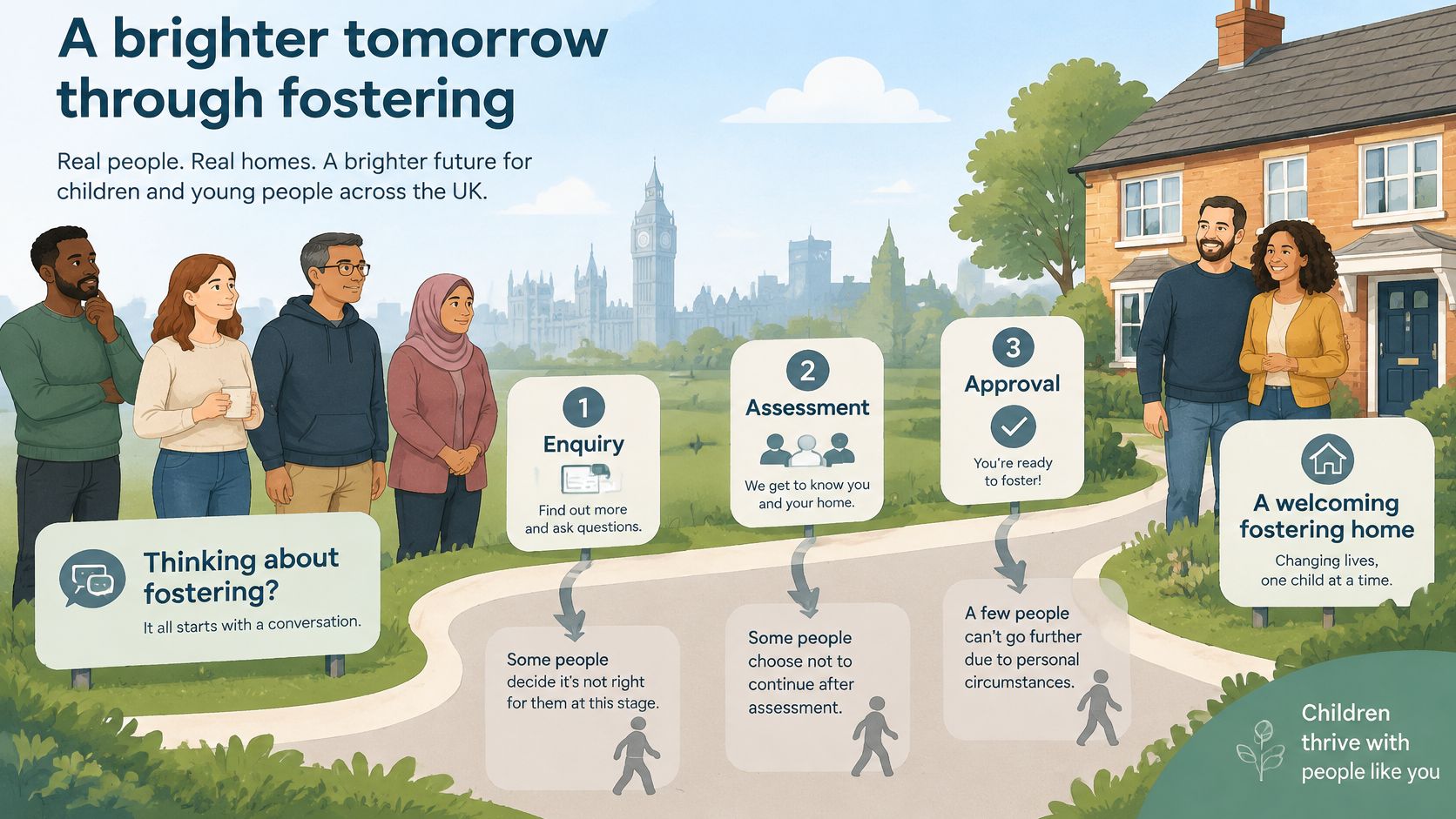
The numbered route
In public terms the route has five steps: start a conversation, an initial or home visit, apply and train, assessment, then panel and approval. Assessment is the long middle, and it is where withdrawals cluster.
- Start a conversation: Staff confirm minimum age, right to work, spare room, location and reasons for considering fostering. The common slip is vagueness. Applicants who hear only that fostering is rewarding can reach assessment shocked by checks, meetings and the effect on family life. That shock is preventable drop-off. A clear early decision that the location or the home cannot be supported is appropriate screening.
- Hold an initial visit: If location and initial requirements appear suitable, the agency may arrange an initial visit. The visit looks at the home, household, support network and placement preferences. Cluttered sleeping arrangements, or an adult household member who has not agreed to fostering, need an honest discussion on the day.
- Apply and prepare: Applicants provide identity, date of birth, address history and references. Recruitment and assessment can include criminal-record and barred-list information. Preparation training introduces safeguarding, trauma, behaviour, contact with birth families and the role of the fostering service. Missing documents and slow referees cause avoidable drift here. Chase those before the file goes quiet.
- Complete the assessment: The fostering assessment has two stages, which may be completed separately or at the same time, according to GOV.UK guidance on the fostering assessment. Stage 1 covers home and pets, relationship history, health and previous applications to foster, adopt or become a childminder. It asks about everyone in the household and requires at least two referees for the applicant and each adult household member. Stage 2 looks in greater depth at personality, employment, standard of living, childcare experience, religion, ethnicity, cultural background and languages. It also explores willingness to care for a child from a different cultural, religious or linguistic background. Applicants sometimes stall because the questions feel personal. Explain the purpose early. Assessors need evidence about care, reflection, resilience and identity.
- Panel and approval: A fostering panel considers the assessment and makes a recommendation, followed by the agency decision. Organic Fostering then matches a child's care plan and known needs against a carer's approval, household, experience and ability to provide safe care. Approval does not guarantee a placement, a particular type of placement or continuous income. Foster carers receive payments for active placements, so an empty approval is not a wage.
Where delays usually build
References are a frequent bottleneck. Applicants should warn referees early, check contact details and choose people who know them well enough to answer meaningfully. Employers may be approached where relevant, so shift patterns and time for training or meetings should be discussed before assessment begins. Address history gaps, name changes and incomplete identity documents also slow checks. Those gaps can usually be closed with records and a plain explanation, if someone asks for them early.
Household preparation needs the same attention. Adult children, lodgers and regular overnight visitors may affect checks or daily arrangements. Existing children need age-appropriate explanations, and a private chance to ask questions, before Stage 2 rather than during it. Pets need practical thought about safety, allergies, sleeping areas and a child's previous experiences. Leaving any of this until halfway through Stage 2 turns a solvable issue into a withdrawal.
Delays usually come from unprepared referees, unclear availability, missing address evidence or a household member hearing the full plan too late.
Illustrative scenarios
Illustrative scenario, shift work: A nurse working nights wants to foster teenagers. Assessment treats the shifts as a planning question: who is present overnight, how school mornings work, whether rest after a shift is realistic, and what backup exists in a crisis. The workable match may be respite or older children rather than emergency care.
Illustrative scenario, rented housing: A tenant with a spare bedroom assumes they must own the home. Tenants can proceed when permission is in place where it is needed, the tenancy looks stable, the room is suitable and the household is safe. Waiting to buy first is a delay the applicant invented.
Illustrative scenario, other caring duties: An applicant supports an elderly parent nearby. Map that responsibility against school runs, meetings and unpredictable placement needs. A clear support plan may make fostering workable. A vague promise to manage everything will not reassure an assessor, and it often becomes a late withdrawal.
Circumstances can change during assessment. A new job, a house move, illness, pregnancy or a change in household membership should be shared promptly. Pausing may be sensible. Withdrawing may also be the right decision, and a respectful service will say whether a future application could be considered. Concealing a change helps nobody, because approval terms must describe the household that will care for a child.
Set Recruitment Targets That Include Retention
About 10% of foster carers retire or resign each year, according to The Fostering Network page on fostering recruitment targets. A target built only from advertising hopes will miss that loss. Forecast the households you need, then plan the campaign around the gap.
The Fostering Network methodology builds the number from annual mainstream-carer turnover, changes in the number of children in mainstream foster care, and an extra pool so matching has real choice. Kinship carers sit outside that mainstream calculation. They are generally approved for identified children, not recruited as general capacity.
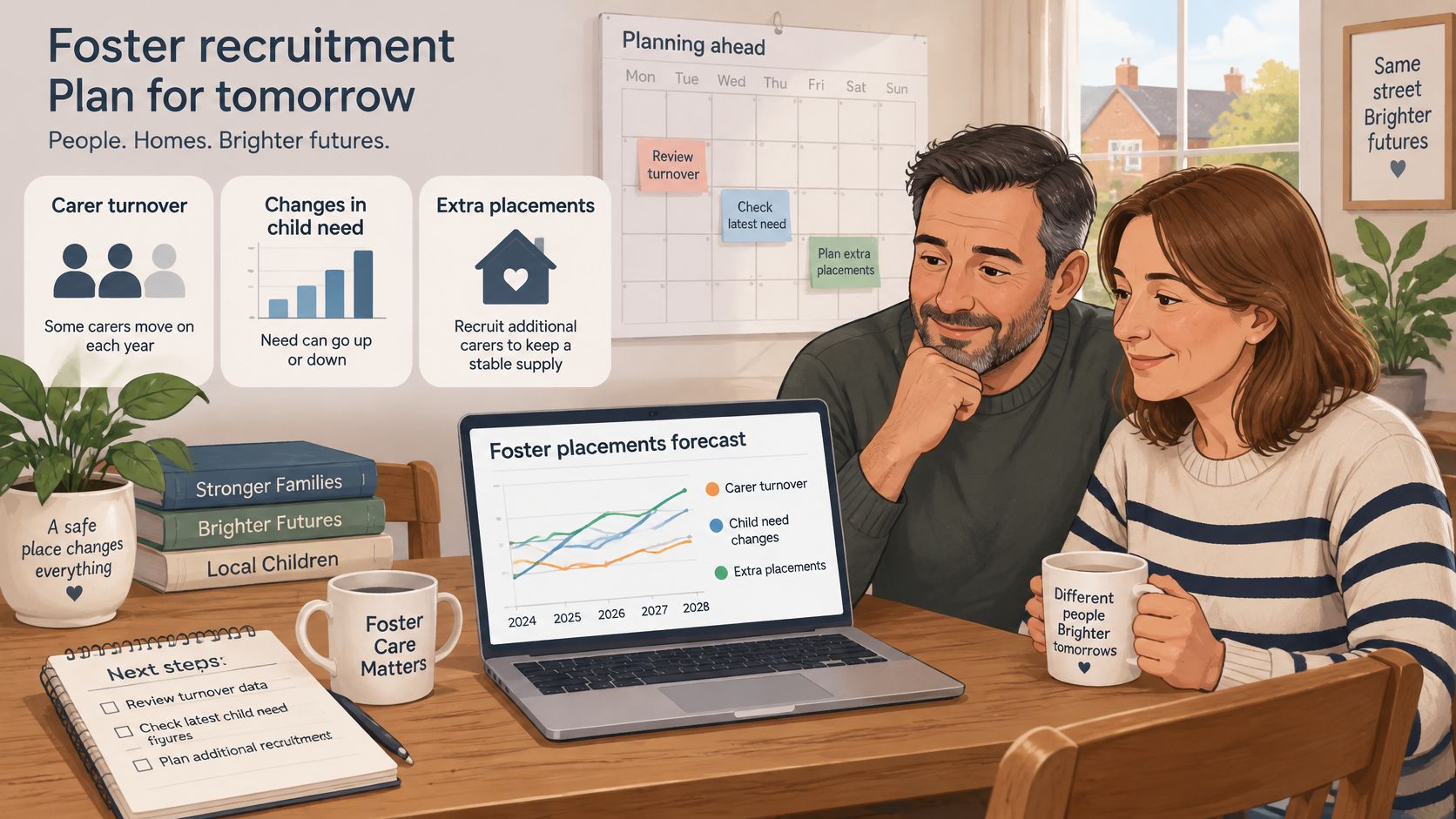
Build the target by capability
Start with current approved households and split them by what they can safely offer: teenagers, sibling groups, emergency care, respite, long-term care, and households with language, faith or cultural expertise. Subtract expected exits, using the agency's own resignation and retirement pattern where the history is long enough to trust. Then add the extra choice matching needs. A vacancy only helps if the household fits the child who needs a home. The result is a net-new target by capability, not one headline number.
Count the funnel as conversion, not reach. An enquiry that never becomes an approval, and an approval that leaves within a year, both fail the same test: did the service gain a household that can take the placements the area needs? Screening out someone without a spare bedroom, enough time, or the right to work in the UK is appropriate drop-off. Losing an approved carer because supervision was thin, training slipped, or a transfer had no plan for the children already in the home is preventable.
Retention belongs on the same dashboard. Track exits, reasons for leaving, time since approval, placement gaps, match disruption and training completion next to enquiry conversion. Approved carers in England must complete the Training, Support and Development Standards workbook within 12 months of approval, according to GOV.UK guidance on what happens after fostering assessment. Services should also support a personal development plan and provide learning opportunities. If new carers fall behind in the first months, managers can offer help before frustration becomes a resignation.
Recruiting ten households while losing nine experienced ones adds little capacity. Matching choice for children shrinks at the same time, and the cost of assessment is spent replacing people the service already had.
Support is what keeps carers fostering. A supervising social worker, preparation and ongoing learning, advice outside normal hours for approved carers, contact with other foster carers, and practical help with a child's education and health needs give a household somewhere to take pressure before it becomes an exit. The role set out in the guide to foster care social workers matters because a named worker who knows the household can spot strain early and coordinate help before a placement reaches crisis.
Match quality deserves board-level attention. A poor match stresses the child and the carer, raises the chance of disruption, and makes an experienced household hesitate over the next referral. I would review one recruitment target each quarter against the retention evidence. If teenage placements keep breaking down because training arrives too late, fix the training before buying more teenage-focused advertising. If sibling carers leave because practical help is thin, sort transport, respite and supervision first.
Experienced carers who are considering a transfer can sit inside capacity planning, but only if continuity for the children already in their care is discussed carefully. Organic Fostering can explain that transfer process and talk through continuity, support and whether the household's location fits current recruitment.