

England sets no universal number of free foster parent training hours. The Training, Support and Development Standards workbook is due within 12 months of approval, or 18 months for family and friends foster carers.
Advice that starts and ends with a headline number of hours misses the practical question: will the programme prepare a household for the children it may care for? A course can cost nothing to enrol on and still be difficult to attend, too general for a particular placement, or insufficient without supported practice.
For prospective and transferring foster carers, the useful comparison is requirements, access and evidence of learning, not the longest catalogue of free courses.
Table of Contents
- Free Foster Parent Training Hours at a Glance
- Preparation Before Approval and the TSD Clock
- How Services Measure Training Hours Differently
- Subjects That Free Training Should Cover
- Attending Sessions and Turning Them into Evidence
- Extra Learning for Complex Placements
- Questions to Ask Before You Apply or Transfer
Free Foster Parent Training Hours at a Glance
Free training has no single national hour allowance. England's fostering standards set expectations for induction, support to achieve the Training, Support and Development Standards, and completion within 12 months of approval, or 18 months for family and friends foster carers. The Fostering Services National Minimum Standards describe those requirements; fostering services set their own training programmes.
Training time benchmarks for foster carers in England
| Benchmark | Who it covers | Time expectation | What kind of rule |
|---|---|---|---|
| Training programme | Approved foster carers in England | Set by each fostering service | National standards require induction and support to achieve the TSD Standards; services plan the training |
| TSD Standards workbook | Mainstream foster carers | Within 12 months of approval | National Minimum Standards and Department for Education guidance |
| TSD Standards workbook | Family and friends foster carers | Within 18 months of approval | National Minimum Standards |
| Pre-placement preparation in the Sinclair study | 944 foster carers in older research | Average 26 hours, range 0 to 200 | Historical findings reported in the government evidence review of fostering in England, not a current allowance |
| Annual learning | Coventry City Council foster carers | About 20 hours per carer per year | Local policy published by Coventry City Council |
| Learning activities | Luton Council foster carers | At least 6 in the first 12 months, then at least 3 a year | Local policy published by Luton Council |
| Core courses | Bolton Council foster carers | 9 core courses within 2 years; sessions of 3 hours over 15 weeks | Local programme published by Bolton Council |
These figures measure different things. An hour measures time. An activity might be a workshop, structured reading or another accepted learning task. A course can include several sessions, preparation and assessment. Like comparing distance, journeys and vehicles, the numbers describe related but different units.
Before relying on a free training offer, ask what the service counts and what it provides. Does it record hours, activities, courses or demonstrated standards? Which sessions have no fee, and does that include learning after approval? What evidence must you provide beyond an attendance certificate?
A free course may still be difficult to attend or too general for a particular placement. Check how sessions fit around your availability and whether the programme offers learning suited to the children you may care for. A local annual target is a service's policy, not a national allowance that automatically follows a carer between services.
Preparation Before Approval and the TSD Clock
A carer might complete a trauma module before approval, then need to use what they learned on a child's first night in the home. Preparation builds knowledge; ongoing support helps carers apply it as a child's needs become clearer.

Before approval
The government evidence review of fostering in England describes a commonly used three-day preparation programme. It also reports an older study by Sinclair and colleagues of 944 foster carers: pre-placement training averaged 26 hours, with a range of 0 to 200 hours. These historical figures describe past practice, not a current offer of free training.
The review notes concerns that short preparation did not fully equip some carers and families to care for children affected by trauma. Preparation gives applicants a chance to consider how fostering may affect family routines, how they might respond to distress or family contact arrangements, and where to seek help when a familiar approach does not work.
Organic Fostering's guide to the steps to becoming a foster carer explains the route towards assessment and approval. Training and assessment can overlap, with likely timescales explained for each applicant's circumstances.
After approval
The Training, Support and Development Standards, usually shortened to TSD, set out knowledge and skills for foster carers to demonstrate. A workbook records evidence of practice, learning and supervision discussions, rather than attendance alone.
For example, attending a session on record-keeping shows participation. An anonymised example discussed with a supervising social worker can show how a carer separates observation from opinion and applies the learning.
Practical distinction: Attendance records show participation. Evidence and discussion show what a carer understands and can apply.
Ask which preparation must be completed before panel, when a recommendation about approval is considered, and what work remains afterwards. A clear plan makes the post-approval deadline easier to manage.
How Services Measure Training Hours Differently
National figures describe training completion, not a shared entitlement to free course hours. The government's analysis of mainstream fostering recruitment and retention recorded that 84% of approved mainstream foster carers, 50,035 people, had completed mandatory training at 31 March 2023. Completion stood at 83% among local-authority carers and 86% among independent fostering agency carers.
For carers who had not completed the requirement, the same government analysis recorded 50%, or 4,630 people, as having started, 38%, or 3,580, as not yet started, and 5%, or 490, as awaiting sign-off. Learning in progress, evidence awaiting approval and completed training are three separate categories.
Comparing local programmes fairly
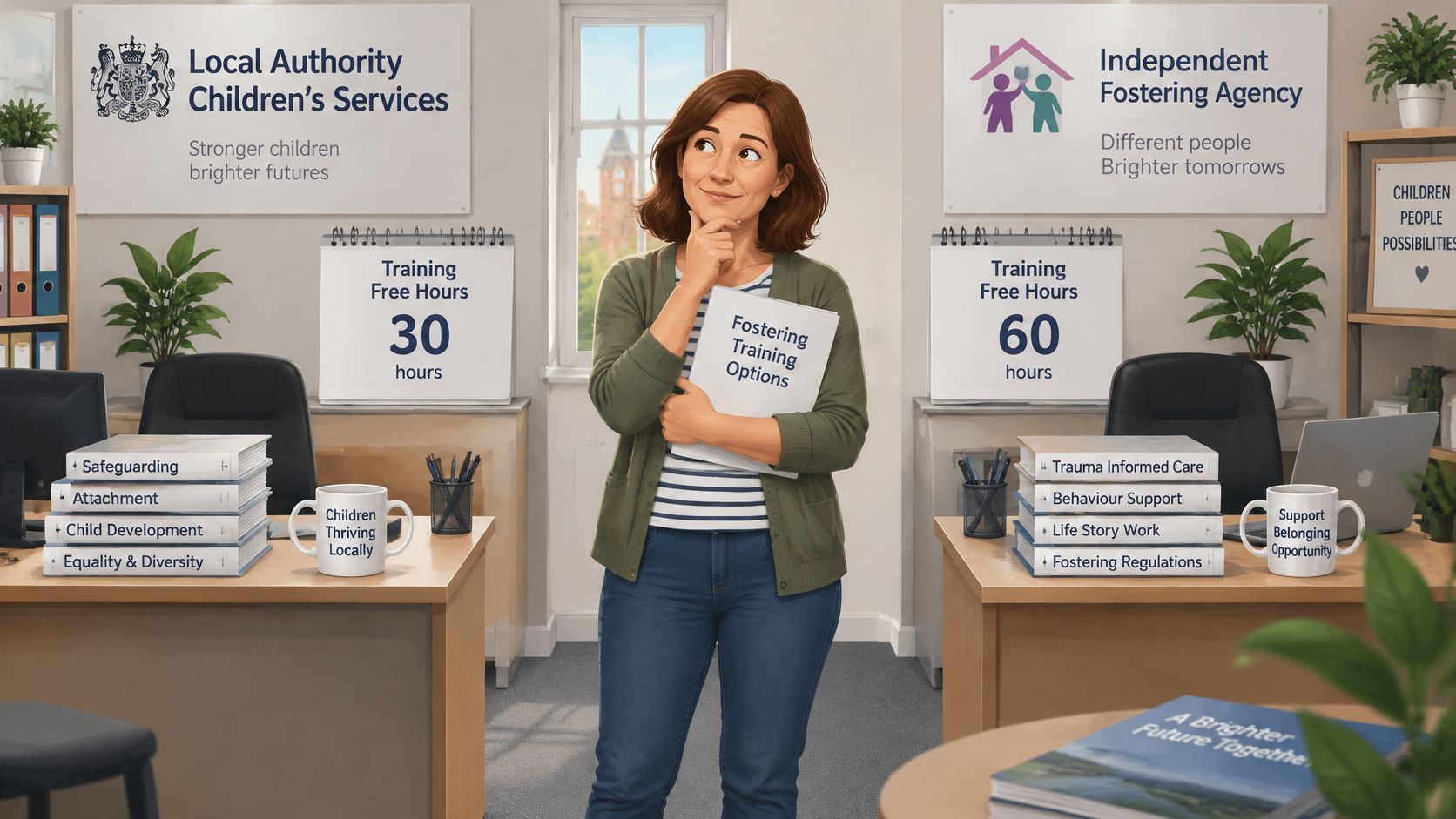
Local programmes measure learning in different ways. Coventry expresses its expectation through annual learning hours and accepts formats including reading and research. Luton counts learning activities. Bolton identifies core courses and uses an annual personal development plan reviewed through supervision.
A headline total is only one part of the picture. Ask whether the measure includes reading, reflection and workbook preparation, and who checks evidence or helps address gaps. After a transfer, the receiving service can explain how it treats learning already completed.
What this means in the North West
A household in Manchester, Greater Manchester or elsewhere in the North West should not assume that another council's published expectation applies to its own fostering service. Local examples can help carers frame questions, but each service sets its own approach.
Keep certificates, learning logs and assessment or sign-off records when considering a transfer. The receiving service can then explain which learning it recognises, what may need refreshing and whether its procedures require additional induction.
Subjects That Free Training Should Cover
The strongest test of free foster parent training hours is whether the teaching prepares carers for the work. A service should be able to explain how its programme develops safe practice, rather than just presenting a long list of titles.
A session called safeguarding may be useful, but carers also need to understand how to respond when a child makes a disclosure, where concerns should be reported and what to record. The course name alone doesn't establish that those skills have been practised.
Safety and everyday decisions
Safeguarding and safer caring should connect protection from harm with ordinary household life. That includes privacy, boundaries, visitors, online activity and the procedures to follow if a concern or allegation arises.
Delegated authority means the decisions a carer is authorised to make for a particular child. Training should help carers use the child's agreed arrangements rather than assume that every everyday decision belongs to the same person.
Health and first aid need practical attention. Bolton's published core programme includes paediatric first aid, illustrating that essential learning extends beyond understanding behaviour and relationships.
Record-keeping should cover accuracy, confidentiality and timely reporting. A useful practice exercise is to rewrite a judgement such as “the child was deliberately difficult” as a factual account of what happened, what was said and how the adult responded.
Development, relationships and identity
Teaching on child development, attachment and managing behaviour should help carers respond thoughtfully without diagnosing a child. A carer needs to consider what a child might be communicating while maintaining clear, safe boundaries.
Equality and identity also belong in practical preparation. Culture, faith, language and disability can affect daily care, communication and a child's sense of belonging. Training should support respectful questions and individual planning, not assumptions based on a child's background.
Organic Fostering's mandatory training information provides a starting point for understanding its required learning. A prospective carer can then seek a programme showing how those subjects are taught and assessed.
At an information evening, useful checks include:
- Mandatory or optional. Which subjects must every approved carer complete?
- Refreshers. Which learning has to be renewed, and how are reminders managed?
- Practice. Which sessions include scenarios, discussion or demonstrations?
- Placement relevance. How does the programme adapt to the age and needs of the children being considered?
A catalogue of webinars is a resource. It isn't, by itself, a complete preparation plan.
Attending Sessions and Turning Them into Evidence
- Obtain the current programme. The carer should identify mandatory sessions, booking arrangements and any preparatory reading before committing dates to the household calendar.
- Reserve essential commitments first. Induction, TSD evidence work and any required safeguarding or first-aid training need protected time, including time outside the session itself.
- Agree workable formats. Live teaching, online modules and catch-up arrangements should be discussed around employment, family responsibilities and access needs.
- Record learning promptly. A useful log includes the date, duration, subject, trainer and a specific change the carer plans to make in practice.
- Keep evidence together. Certificates and reflective notes should go into the development record used with the supervising social worker.
- Review progress in supervision. The discussion should identify unfinished evidence, unanswered questions and learning needed for the current placement.
Free enrolment doesn't remove attendance costs
The Department for Education's training and development guidance confirms the place of training within approved carers' development. Turning that expectation into a workable household plan requires practical arrangements, not just access to a booking system.
Travel, childcare and lost working time can make a course difficult to attend even when there's no enrolment fee. A fixed timetable may also clash with shift work, disability-related needs, religious observance or a child's appointments.
Before booking, a carer should establish:
- Expenses. Whether travel and childcare costs are covered, and what needs prior agreement.
- Accessibility. Whether materials, venues and online delivery meet the carer's needs.
- Alternatives. Whether an equivalent session, recording or supported catch-up is available.
- Disruption. Who should be contacted if a child's immediate needs prevent attendance.
A course isn't accessible merely because the booking page describes it as free.
Recording application rather than collecting certificates
Reading can form part of an hours-based learning programme where the service accepts it. A useful reflective note identifies the material, the learning point and how that learning affects care, rather than recording only that an article was opened.
Similarly, an e-learning certificate may show completion of a module without showing how a carer would respond under pressure. Supervision gives space to test understanding through discussion and practical examples.
An illustrative log entry might record that online-safety learning prompted a discussion with the supervising social worker about a child's agreed device arrangements. The entry should describe the learning and action without copying unnecessary sensitive information into a training folder.
Training also connects with wider foster carer roles and responsibilities. Foster carers have a formal review of their approval at least once a year, alongside regular supervision, so an accurate development record helps keep progress visible.
A missed session needs an agreed catch-up plan. Leaving a blank space until review makes it harder to distinguish a scheduling problem from an unresolved learning need.
Extra Learning for Complex Placements
A carer who has prepared to care for a teenager at risk of exploitation may need further learning about online contact, communication and working with other professionals. That preparation can help the household respond to the child's particular needs.
The same applies to sibling groups and children with complex health needs. For siblings, learning should help carers consider each child's relationships and needs, while supporting them to live together where appropriate. For a child with complex health needs, preparation should address their specific care arrangements, communication and equipment.
Completion needs active support
The government's underlying fostering data for England recorded 51,145 carers who had completed the Training and Development Standards at 31 March 2025, with 2,045 still in progress and 150 awaiting sign-off. These figures point to a practical need: carers need support to apply learning to the child in their care.
A webinar can introduce a subject, and a quiz can check recall. A live workshop gives carers space to discuss and rehearse responses. Supervision can then explore how those responses worked in practice. Accredited learning can provide a defined assessment framework, while placement-specific guidance connects learning to a child's circumstances.
Learning must connect with matching
Before a placement is agreed, the household's preparation should be considered alongside the child's needs. If knowledge is missing, identify the teaching, advice and practical support the carer will need.
For example, learning about disability should relate to the child's communication, equipment and care arrangements. A general course alone cannot account for those individual details.
Organic Fostering's guide to therapeutic foster care explains care that responds to trauma. Its support for carers includes preparation, supervision and practical help around the household.
A useful outcome: The record should show what changed in the child's day-to-day care, not merely that the carer logged in.
When a placement need changes, further learning may be needed around culture, faith, language or disability-related support. Supervision can help the carer consider whether the new approach is helping and what still needs attention.
Questions to Ask Before You Apply or Transfer
A useful training offer should be clear enough for a household to plan around. Before applying or transferring, a prospective carer can take these questions to the fostering service:
- Preparation before panel. How is preparation scheduled alongside assessment?
- Outstanding work. What learning and evidence remain after approval?
- Measurement. Is progress recorded through hours, activities, courses or demonstrated TSD standards?
- The household's deadline. Which completion deadline applies to these circumstances?
- Mandatory sessions. Which courses must be completed during the initial period of approval?
- Attendance barriers. What happens when work, childcare, disability or faith commitments clash with a session?
- Previous learning. Which certificates and assessed learning are accepted when transferring?
- Completion support. Who helps with evidence that is unfinished or awaiting sign-off?
Choosing a workable commitment
The strongest answer isn't necessarily the largest number. It's a programme with clear expectations, realistic access arrangements and someone responsible for helping the carer apply the learning.
Organic Fostering will talk prospective carers through its current requirements when they get in touch. An informal first conversation can explore whether the training commitment fits the household without committing that household to approval or a placement.
For an approved carer considering a move, Organic Fostering's transfer process provides a starting point for discussing existing learning and continuity for children already in the carer's care. Bringing a current development record makes that discussion more useful than relying on a total number of completed hours.
Organic Fostering offers preparation, ongoing learning and support to help carers put training into everyday practice. Prospective and transferring carers can visit Organic Fostering to start a conversation about current training requirements, likely commitments and the support their household would need.