

Is a spare bedroom enough if a child needs somewhere safe tonight? To become an emergency foster carer in England, an applicant must complete the normal fostering approval process, then have the availability, preparation and agreed placement limits to respond at short notice. The emergency is in the child's circumstances, not a shortcut through assessment.
Good preparation means deciding what the household can safely offer before a referral arrives. That includes sleeping arrangements, work commitments, overnight support and what happens if a stay lasts longer than expected.
Table of Contents
- Who Can Become an Emergency Foster Carer
- How to Get Approved for Emergency Fostering
- What an Emergency Placement Really Means
- Getting Your Home Ready for Short-Notice Placements
- Setting Limits That Protect Placement Stability
- What the First 24 Hours of a Placement Involve
- Training and Support Once You Are Approved
- Start Your Enquiry About Emergency Fostering
Who Can Become an Emergency Foster Carer
Emergency foster carers go through the same approval route as other foster carers. According to the government's eligibility guidance for England, applicants must be at least 18, have the right to work in the UK and be able to care for a child or young person, although most fostering services set a minimum age of 21.
Age alone doesn't establish suitability. Assessment and training explore whether an applicant can offer safe care, work with professionals and respond to a child whose circumstances may not yet be fully understood.
Single people can foster. Renting needn't rule someone out either, but secure accommodation, a suitable spare bedroom and any permission required under the tenancy will normally be needed.
Eligibility requirements for emergency foster carers in England
| Requirement | What England expects | What to check first |
|---|---|---|
| Minimum age | Legal minimum 18; most services set a minimum of 21, as stated in the government guidance linked above | Confirm the service's own minimum age |
| Right to work | Must have the right to work in the UK | Confirm immigration and work status before enquiring |
| Ability to care | Must be able to care for a child or young person | Consider experience with children and willingness to learn |
| Home | Safe, suitable space for a child to sleep | Measure the room and check how it's used now |
| Household checks | Enhanced DBS with barred-list information for every adult in the household | List everyone who lives in the home |
| Health | Health checks form part of approval | Gather GP contact details |
| Time and flexibility | Capacity for training, assessment and placements | Map work and caring commitments |
Organic Fostering normally requires a suitable spare bedroom, time and flexibility, the right to work in the UK, and willingness to complete assessment, checks and training. Its guide to questions about who can foster can help prospective applicants consider their circumstances.
A useful starting point: Eligibility opens the conversation. Household capacity determines what kind of fostering may be suitable.
Before enquiring, a prospective carer can check whether the age and work-status requirements are met, identify a safe bedroom, and consider where assessment and short-notice care would fit into an ordinary week. An honest answer is more useful than an optimistic promise.
How to Get Approved for Emergency Fostering
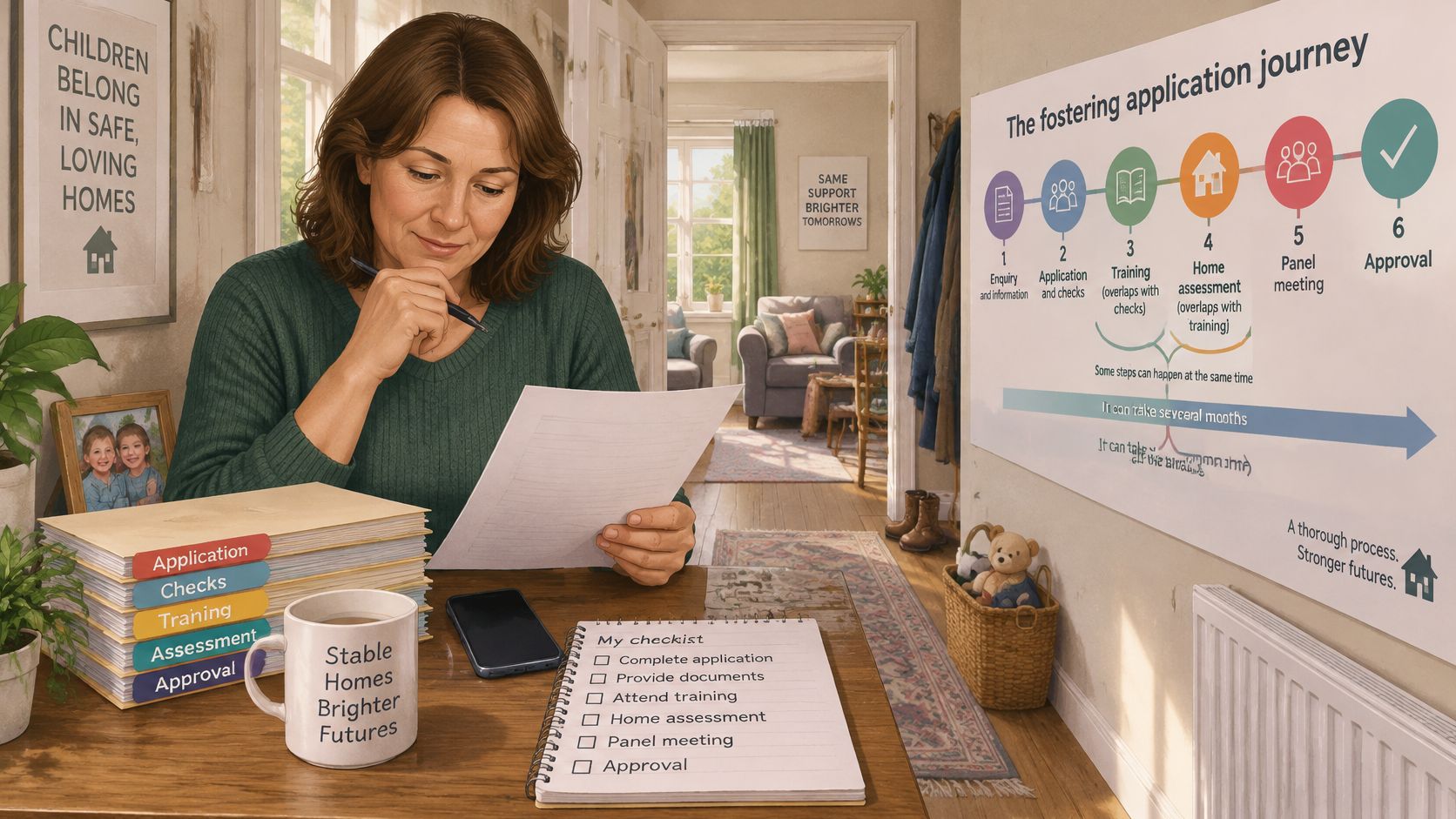
Emergency fostering runs through the same structured approval as any other placement type. The government's application guidance expects applicants to apply through one fostering service at a time, and the full process can take up to eight months, with stages sometimes taking place in a different order. What differs for emergency work is the evidence you give about availability and the pace at which the agency may use it.
Organic Fostering describes its route as five stages: start a conversation, initial or home visit, apply and train, assessment, and panel and approval. Its fostering assessment guidance explains the assessment element in more detail.
The application and decision process
Make an enquiry. The initial conversation explores motivation, household circumstances and practical suitability. Submitting an enquiry doesn't create a foster carer agreement, guarantee an assessment or mean approval has been granted.
Choose a fostering service and apply. Working with a single service gives the applicant and the assessing team one clear route for gathering evidence and discussing suitability. Say early that you want short-notice work, then ask how referrals arrive and what advice exists outside normal hours, because an approved carer needs someone to call on a Sunday evening. Organic Fostering publishes an area only once it has confirmed it is recruiting foster carers there and can provide the assessment, supervision and continuing support that follows.
Attend preparation training. The course introduces the responsibilities of caring for children in foster care. A useful approach is to bring difficult questions about family life, uncertainty and behaviour, rather than treating attendance as a formality.
Complete checks and provide references. Recruitment and assessment can include identity, date of birth, address history, references, health information, and criminal-record and barred-list information. The household list needs to be complete, including adults whose work patterns mean they're frequently away.
Participate in the social work assessment. This examines the applicant's experiences, relationships, parenting capacity and household arrangements. For emergency work, expect questions about a Tuesday evening at short notice: who is at home, who drives, who gets woken, and who covers the school run the next morning for a child who arrives with little more than a bag. Overnight cover, transport and commitments that cannot move belong in this conversation early, and emergency availability is normally written into the approval itself, usually as ages, numbers and the notice period you can accept.
Proceed to fostering panel. The service reviews the assessment and refers it to a panel, which makes a recommendation. Panel reviews the assessment and does not replace it, so unresolved practical concerns belong in the report well before this stage. A panel asked to recommend approval for emergency work needs to see the overnight plan, not just a willingness to help.
Receive the agency's decision. The agency decision-maker makes the final approval decision. Read the approval carefully, because a mismatch between what you believe you offered and what the paperwork records causes trouble at the first referral.
Make emergency capability part of the evidence
The Fostering Services National Minimum Standards require an evidence-based assessment that distinguishes fact, opinion and third-party information. Consistent, honest accounts help the assessor understand both strengths and limits.
For emergency work, a room is only part of that evidence. A credible plan also explains who answers an overnight call, how existing children's needs are protected when a stranger moves in, and what you would do when essential information about a child is missing at the door.
What an Emergency Placement Really Means
Emergency describes the urgency of the move, not a guaranteed leaving date. At referral, the service may still be clarifying the expected duration, legal status, health information, family contact arrangements, belongings and school plans.
These are separate questions. An urgent arrival doesn't explain who can authorise a medical decision, whether family contact is supervised, or whether the placement might become a longer-term arrangement.
The Department for Education's placement-duration figures record that 6,530 foster placements in England ended after 1 to 7 days in the year ending 31 March 2025, representing 13% of placements that ceased. Those figures cover foster placements generally, not emergency placements alone, but they demonstrate why carers need preparation for rapid transitions.
Primary provision and additional availability
Emergency care can be a household's main fostering offer or something offered alongside another placement type. In official fostering statistics for 2019 to 2020, 1% of fostering households offered emergency care as their primary placement type, compared with 21% when additional placement types were included.
Those categories describe provision, not a separate emergency qualification or a promise of regular calls. Approval, a current vacancy and genuine availability must all align with a child's needs.
Organic Fostering's explanation of temporary foster care provides context for care while future arrangements are being planned.
Before offering emergency availability, prospective carers should ask:
- Duration: How long do emergency placements last in the service's practice, and when is the plan reviewed?
- Decision-making: Who holds legal responsibility, and which decisions can the carer make?
- Extension: What happens if a longer stay is proposed?
A short stay can involve demanding care. A longer stay requires an explicit discussion, not an assumption that the original agreement continues.
Getting Your Home Ready for Short-Notice Placements
An emergency-ready bedroom isn't a storage room that could eventually become usable. It's a safe, welcoming space that can receive a child without a hurried clear-out while someone waits downstairs.
The government's guidance on what happens after assessment explains that approved carers join the service's available-carer list and receive profiles where a suitable match is considered. A child may meet a carer beforehand, but that meeting may not happen during an emergency.

Prepare essentials without making assumptions
A modest, adaptable supply cupboard works better than buying extensively for an imagined child. Supplies should fit the household's proposed age range, with room for the child's preferences once known.
- Sleeping space: A made bed, clean bedding, suitable lighting and an uncluttered route to the bathroom.
- Personal belongings: An empty drawer or cupboard, with somewhere safe for valued possessions.
- Everyday supplies: Basic clothing in relevant sizes, unopened toiletries and spare towels.
- Food: Straightforward meal options, with dietary, allergy and faith requirements checked before serving.
- Safety: Secure storage for medicines and hazardous products, plus an accessible first-aid kit for the responsible adult.
Organic Fostering's foster care bedroom guidance can help applicants think through the room before a home visit. Measuring the space is useful, but so is checking privacy, noise and how other household members currently use it.
Rehearse the household routine
Whether a foster carer can also work depends on the child's needs and the carer's availability. A flexible employer helps, but doesn't replace a practical plan for school journeys, appointments or a child who cannot attend school immediately.
A rehearsal can expose gaps before an application progresses. The household can prepare a school bag, check likely travel routes and test whether the morning routine still works when someone needs extra reassurance.
A reliable plan names the person who can help and the arrangements the agency must approve. It doesn't stop at someone probably being available.
Before the first agency conversation, applicants should gather room measurements, work schedules and existing caring commitments. Any proposed help from relatives or friends should be discussed with the service rather than assumed to be an approved childcare arrangement.
Setting Limits That Protect Placement Stability
In 2024, 10% of looked-after children in England experienced three or more placements during the year, rising to 14% among children who had been in care for less than 12 months, according to the Department for Education's looked-after children statistics. Those figures cover the whole care system, and they explain why an urgent referral still needs matching rather than plain speed.
Agree your limits before the first referral, not during the call. A household that has already written down what it can and cannot take on answers a 9pm request in minutes. One that improvises tends to accept the wrong child and hand the placement back a fortnight later, which is harder on everyone than an early no.
Limits to agree before accepting emergency referrals
| Limit | Why it matters | Example to agree |
|---|---|---|
| Maximum notice | Establishes how quickly the household can respond | Same-day call-out only with confirmed overnight cover |
| Age range | Keeps referrals within the home's assessed capacity | Under-fives only, or teenagers only |
| Number of children | Protects space, sleep and individual attention | One child, or an agreed sibling group |
| Sibling capacity | Clarifies whether brothers and sisters can stay together | The largest sibling group the household could keep together |
| Exclusions | Records needs the household cannot safely meet | Specific medical or safety needs beyond its skills or facilities |
| Review point | Prevents an emergency arrangement continuing without discussion | A scheduled call with the supervising social worker soon after arrival |
Express “maximum notice” as two mutual commitments. It records the minimum preparation time the household needs, the hours when calls can realistically be answered, and any conditions attached to immediate availability, such as confirmed overnight cover. Anything vaguer invites a social worker to assume twenty minutes is enough.
Limits should also account for school travel, family relationships, language, faith and identity. A bedroom can be free and the placement still not work, because the child would lose the school they attend, the sibling contact that anchors them, or the only adult who speaks their first language.
Respond to behaviour without overlooking safety
A child refusing food or staying awake may be communicating fear, unfamiliarity or a need for control. Stay curious without deciding that every behaviour has an obvious explanation behind it.
Organic Fostering helps carers look beyond a child's immediate behaviour, remain curious about its meaning and respond with safety, boundaries and empathy. In everyday terms, that means offering manageable choices, explaining routines before they change and raising concerns with the supervising social worker early rather than after a difficult weekend.
Matching principle: A thoughtful refusal before placement can be safer than an optimistic acceptance that the household cannot sustain.
Set the review point within the first 24 to 72 hours and make it do real work. The conversation should test whether the arrangement is safe, whether the support promised has arrived, and whether the boundaries agreed at referral still hold in the household as it is now running.
If suitability is in doubt, raise it the same day. A planned transition is always better than letting a wobble become a crisis, and social workers can only begin looking for an alternative while the placement is still stable.
What the First 24 Hours of a Placement Involve
Consider an illustrative referral arriving by phone during the evening. The worker explains the child's immediate circumstances, but some health information and the following day's arrangements remain unconfirmed.
The prospective placement decision isn't just whether the bedroom is free. The carer needs to establish whether essential safety information is available, whether the household can meet the identified needs and which gaps require clarification before acceptance.
Questions to keep beside the phone
- Health and medication: What is known about allergies, health needs, medicines and the instructions accompanying them?
- Safeguarding: What risks are known, and what safety arrangements must begin immediately?
- Family contact: What contact is agreed, who supervises it where necessary, and who authorises changes?
- Education: Is there a school or nursery to return to, and who will confirm attendance and transport?
- Belongings: What clothing, comfort items, documents and equipment should arrive?
- Overnight help: Who is the out-of-hours contact, how is urgent advice obtained, and what happens if the first contact cannot be reached?
- Review: Who will make the next contact, and when will the placement plan be discussed?
A carer should distinguish unknown information from information that is unsafe to proceed without. Missing a favourite food preference is different from having medicine with no confirmed administration instructions.
Keep the welcome calm and manageable
On arrival, a child needs an introduction to the people present, the bedroom and the bathroom. Offering a drink, suitable food and a choice about a small everyday matter can make the surroundings less unfamiliar.
A detailed household tour or a stream of personal questions can wait. The carer can explain what will happen next without promising a return home or a particular leaving date.
Records should separate what happened, what the child said and the carer's interpretation. If a child shares something concerning, the adult should listen without pressing for an account, record the words accurately and follow safeguarding procedures.
The reference card beside the phone should hold the out-of-hours contact, referral questions and agreed household limits. Confidential records belong in the service's approved recording arrangements, not on a visible household noticeboard.
Training and Support Once You Are Approved
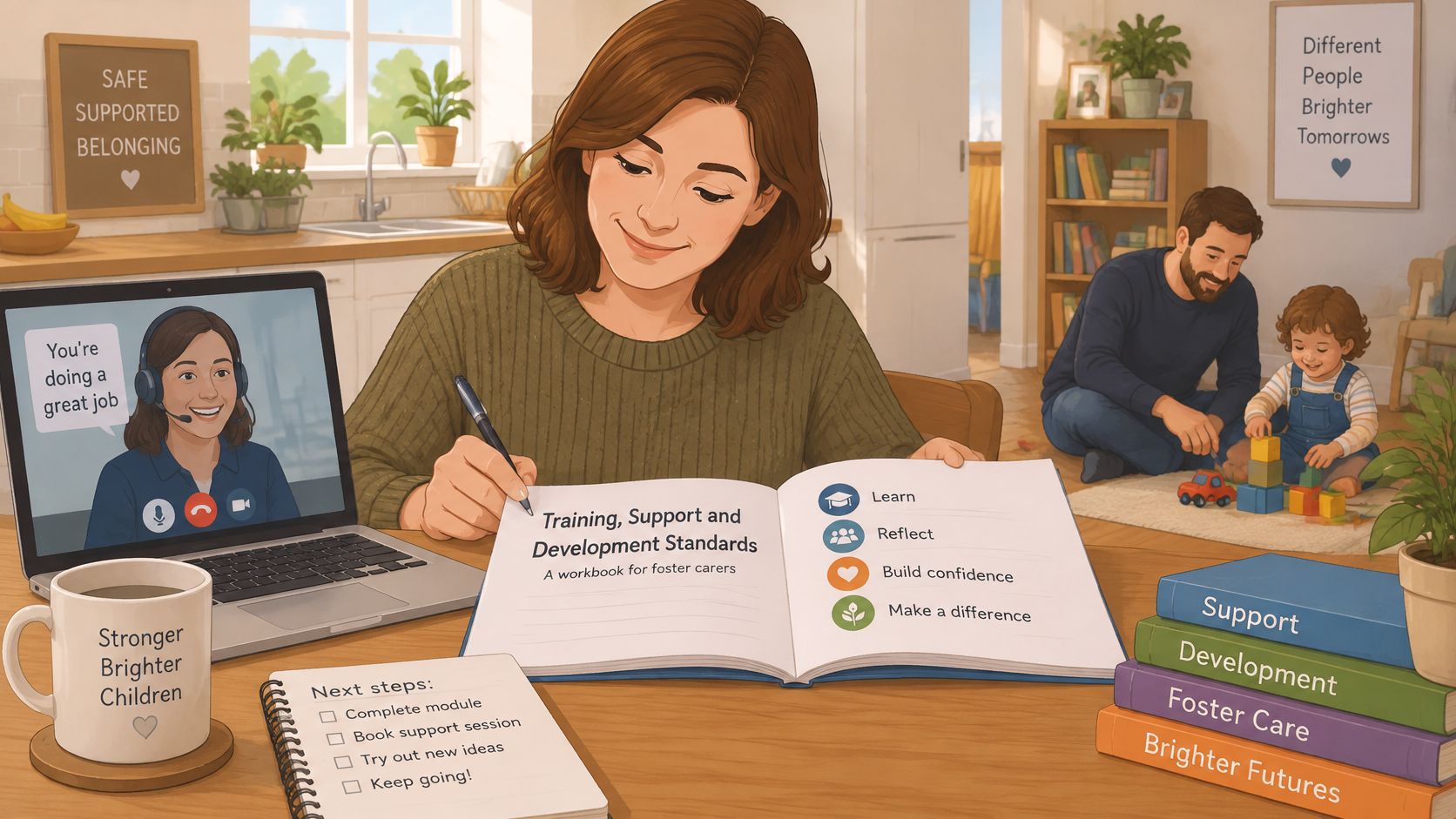
Approval marks the start of supported practice, not the end of learning. The government's training and development guidance says foster carers in England must complete the Training, Support and Development Standards workbook within 12 months of approval, and their service should provide a personal development plan and access to further learning.
For emergency carers, learning needs to translate into decisions made under pressure. Knowing how to recognise a safeguarding concern matters, but so does knowing whom to call and what information to record.
Turn support into usable arrangements
Organic Fostering provides approved carers with a supervising social worker, preparation and ongoing learning, advice outside normal hours, contact with other carers, and help navigating education and health needs. The supervising social worker focuses on the carer's development and the household's fostering practice.
That role is distinct from managing the child's wider care plan. Clear communication helps each professional understand what the household needs and which decisions require action elsewhere.
Organic Fostering's foster parent training guidance offers a starting point for discussing preparation and continued learning.
Useful habits include:
- Save contact details: Keep the out-of-hours number and escalation arrangements accessible once supplied.
- Record consistently: Use the agreed system for observations, medication records and significant conversations.
- Choose relevant learning: Discuss trauma-related behaviour, safer caring, identity needs and communication across agencies.
- Request focused supervision: Bring specific questions about sleep, household impact and changing placement needs.
Regular check-ins help carers identify concerns before they become harder to manage. In short-notice fostering, useful support isn't merely the existence of a telephone number, it's a shared understanding of how and when to use it.
Start Your Enquiry About Emergency Fostering
An enquiry is a conversation about suitability, not a commitment to accept a child. Prospective carers should have space to understand the demands and decide whether emergency availability fits their household.
Organic Fostering will explain its current requirements when prospective carers get in touch. The most useful first discussion is grounded in ordinary life, including fixed work hours, existing caring responsibilities and concerns about overnight care.
Prepare for a useful conversation
- Personal eligibility: Age and right-to-work status, with any questions about the relevant requirements.
- Household and bedroom: Who lives at home, how the proposed room is used and any tenancy permissions needed.
- Realistic availability: When short-notice referrals could be considered and which commitments cannot be changed.
Applicants don't need a polished answer to every question. A clear account of uncertainties gives the agency something practical to discuss, while concealing constraints makes matching harder.
Organic Fostering offers short-term, long-term, emergency and respite fostering, alongside fostering siblings and teenagers. Exploring these options can help establish whether emergency care is the right fit rather than the only route being considered.
Approved carers thinking about transferring can also begin with a conversation about their circumstances. Organic Fostering allows that initial discussion without requiring resignation from the current service first.
Organic Fostering provides assessment, preparation and ongoing support for carers considering emergency fostering. Prospective applicants and approved carers exploring a transfer can visit Organic Fostering and use the website's enquiry option to discuss their household, availability and next steps.