

Only 6% of initial fostering enquiries became applications in England in the year ending 31 March 2021, with 160,635 enquiries and 10,145 applications recorded in the government's fostering statistics. Effective foster carer recruitment therefore means more than attracting interest. It means giving prospective carers clear answers, enough time to make an informed decision and dependable communication through assessment.
Table of Contents
- Where Enquiries Are Lost in England
- The Five Stages From Enquiry to Approval
- Writing Messages That Answer Eligibility Questions
- Local Outreach That Reaches Diverse Communities
- Keeping Applicants Engaged Through Assessment
- Support and Training That Reduce Drop-Off
- What Applicants Ask About Pay and Tax
- Confirm Your Next Recruitment Step
Where Enquiries Are Lost in England
In England, 6% of initial fostering enquiries became formal applications in 2022–23. The government's mainstream fostering recruitment and retention report records 125,195 enquiries from prospective mainstream fostering households and approximately 7,500 applications. The report also found that 75% of mainstream applications approved during that period were completed within 240 days, measured from the start of Stage 1 to approval.
Enquiry, application and carer figures for England
| Measure | Period | Figure |
|---|---|---|
| Initial enquiries from prospective fostering households | Year ending 31 March 2021 | 160,635 |
| Applications received | Year ending 31 March 2021 | 10,145, equivalent to 6% of enquiries |
| Initial enquiries from prospective mainstream fostering households | 2022–23 | 125,195 |
| Progressed to a formal application | 2022–23 | About 7,500, equivalent to 6% |
| Mainstream applications approved within 240 days | 2022–23 | 75% |
| Approved mainstream foster carers | 2021 | 63,890 |
| Approved mainstream foster carers | March 2025 | 56,345, down 12% from 2021 |
The government's fostering statistics for England report the 2021 and March 2025 approved-carer figures. These figures measure different things and should not be combined into one approval rate. In particular, dividing approvals by enquiry totals from a different period would produce a misleading result.
A large gap between enquiries and applications deserves attention, but the figures do not explain why people stop. Some households decide fostering is not right for them; others postpone because of family circumstances or lose confidence when requirements and next steps are unclear.
Measure informed progress, not pressure. An applicant who decides against fostering after an honest conversation has received a useful answer, even if they do not apply.
Track unanswered enquiries, households outside the recruitment area, people who are postponing and applicants waiting for a next step. Each category points to a different response: improve the initial conversation, clarify a requirement or resolve an avoidable delay.
The Five Stages From Enquiry to Approval
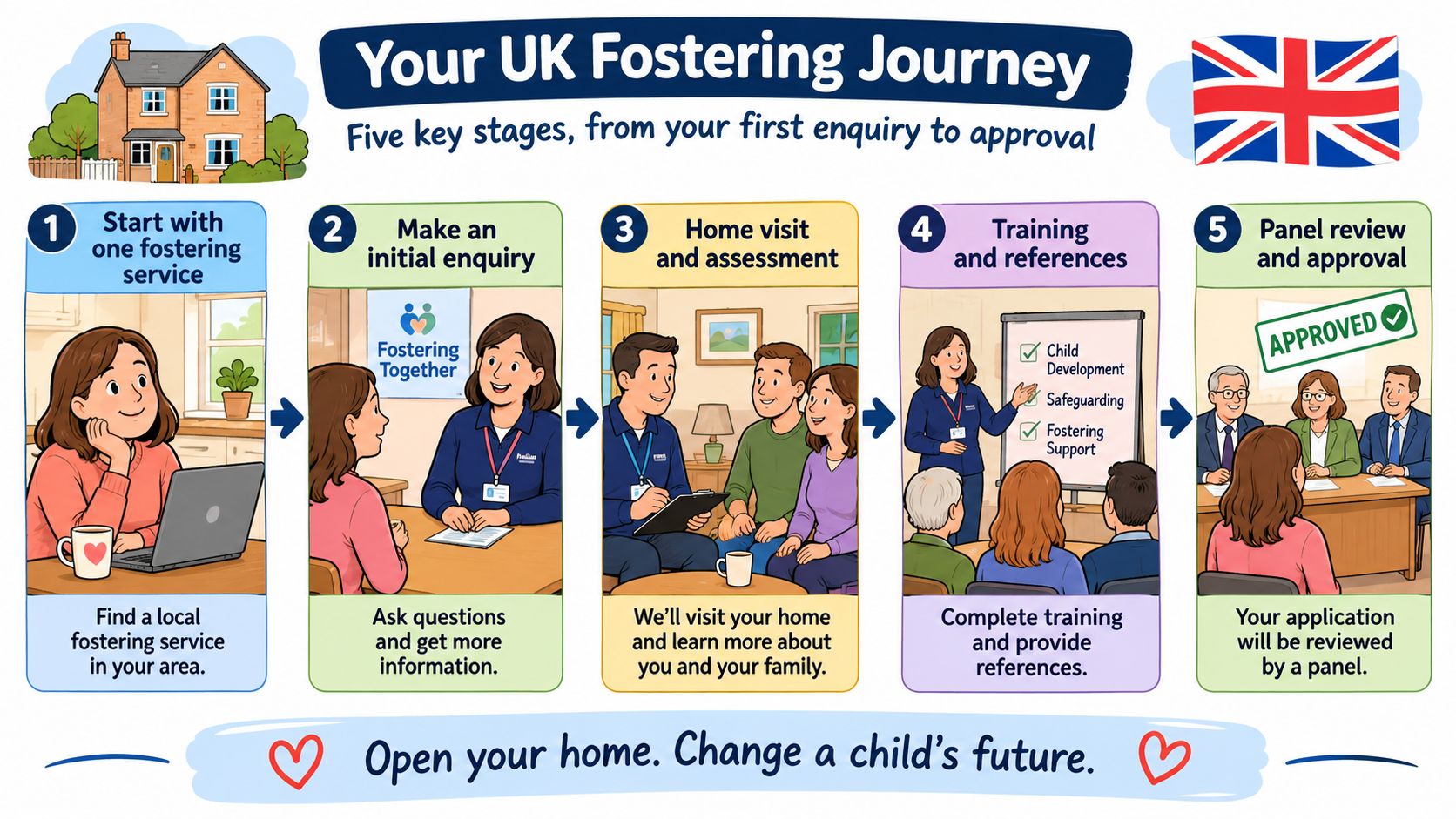
Applicants apply through one fostering service only, which may be a council, regional recruitment hub or independent fostering agency. The GOV.UK application guide sets out preparation training, household checks, social-work assessment, panel consideration and the service's final decision.
Organic Fostering describes its route in five steps: start a conversation, initial/home visit, apply and train, assessment, and panel/approval. Those early conversations and visits help a household explore suitability before entering the formal assessment route.
What the formal route involves
Apply and prepare. The prospective carer applies to the chosen service and attends a preparation course. This should help the household examine the responsibilities of fostering, rather than encourage an application.
Complete the checks. The applicant and every adult living in the household undergo an enhanced Disclosure and Barring Service check, including barred-list checks. The recruiter should explain who needs to provide information and how to submit it securely.
Take part in assessment. A social worker assesses the applicant and family. Discussions include the children the household may be able to care for, including preferences about age or gender, alongside the household's capacity to meet their needs.
Meet the fostering panel. The service reviews the completed assessment, and the applicant meets the panel. Preparation should explain the meeting's purpose and give the applicant space to raise questions, not coach a rehearsed performance.
Receive the decision. The fostering service makes the final decision about approval. Recruiters shouldn't describe the panel meeting itself as guaranteed approval.
Explain what fostering isn't
Applicants cannot select a particular child from a group, and there isn't a trial period with a foster child. Matching must centre on whether the household can meet a child's needs, rather than resemble a selection process.
After the first conversation, the recruiter should send a short written summary explaining the route, the current position and the next action. A clear account of what happens next is more useful than a reassuring but vague promise that everything will be straightforward.
Writing Messages That Answer Eligibility Questions
A reader may meet England's basic eligibility rules and still need to check whether fostering fits their household. GOV.UK explains that applicants must be at least 18 and have the right to work in the UK. Home ownership is not required, a spare bedroom is usually needed, and some fostering services set a minimum age of 21. These national points are a starting place, not a promise of approval.
Plain answers to practical questions
- Can renters foster? Renting may be compatible with fostering. Applicants will normally need secure accommodation, a suitable spare bedroom and any permission required under their tenancy.
- What is normally needed? A suitable spare bedroom, time and flexibility, the right to work in the UK, and willingness to complete assessment, checks and training.
- Is there an upper age limit? There is no fixed upper age limit. Assessment considers health, energy and the ability to meet a child's needs.
- Does meeting the requirements guarantee approval? No. Applicants must complete an assessment of their suitability to care for a child.
The bedroom question can affect which placements a household might consider, including caring for teenagers or siblings. It is useful to explain this early, while making clear that the child's needs must fit the household's circumstances.
Make the next question easy
For a fuller explanation, read this guide to who can foster and common eligibility questions. A recruitment message should make it easy to ask about a specific concern, such as accommodation, availability or family circumstances. A clear first answer helps applicants identify what they already meet and what they still need to discuss, without asking them to disclose personal details prematurely.
Local Outreach That Reaches Diverse Communities
An enquiry can stop before assessment if a household cannot tell whether support is available locally or whether its questions about culture, faith and language will be taken seriously. Clear local information gives people a practical reason to continue.
For households in Manchester, Greater Manchester or elsewhere in the North West, postcode-level clarity is more useful than a broad regional slogan. The area where an agency recruits carers and the area children are placed from are not always the same. Organic Fostering's team can tell prospective carers which areas it currently recruits in.
Choose channels through relationships
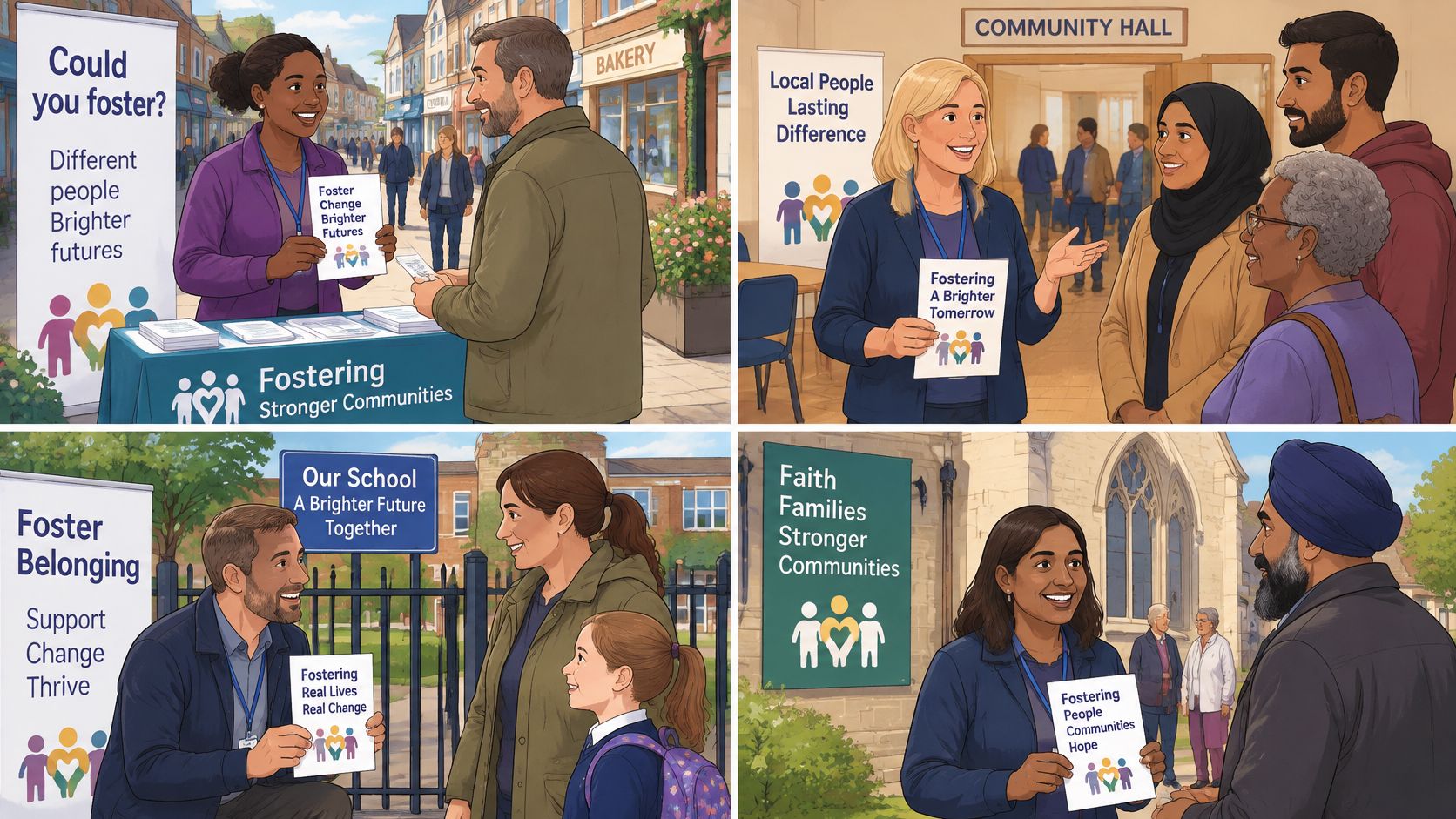
A local mosque, church or community centre may be a suitable venue for an information session if its organisers agree. Ask what questions people want answered, then provide the organiser with a clear event description, eligibility information and contact details to share. Agree in advance how questions will be handled, especially where someone wants to discuss personal circumstances privately.
Language groups can also help identify where translated information would improve understanding. Any translation should explain assessment, checks and household responsibilities accurately, rather than reproduce an appealing headline. Schools and local services can share information through agreed channels without using their relationships with children to pressure families.
Explore the questions people bring
Organic Fostering's guide to Muslim foster care can help start conversations about faith, identity and belonging. The practical task is to hear what matters to each household and explain how those considerations can inform a child's placement.
Living outside the recruitment area does not by itself make someone unsuitable. If another service is better placed to provide local support, explain that clearly and suggest contacting the local council fostering team.
Review outreach by looking at whether enquiries progress to applications and assessment, not just how many people respond. If a channel reaches a community but few enquiries continue, check whether the information answered their questions before deciding to stop using it.
Keeping Applicants Engaged Through Assessment
A reference arriving late can leave applicants wondering whether their assessment has stalled. A named contact should explain what remains outstanding, what the service is doing and whether the household needs to take any action.
England's Fostering Services National Minimum Standards state that the panel should make its recommendation on suitability within eight months of the application being received for assessment. The same standards expect approved carers to evidence achievement of the Training, Support and Development Standards within 12 months of approval, or 18 months for family-and-friends foster carers. These are national expectations, not a guaranteed finish date for each application.
From application to assessment visits
At the outset, explain the difference between a panel recommendation and the final approval decision. Then give applicants a clear account of what information to gather and how to submit it securely. Assessment can include identity, date of birth, address history, references, and criminal-record and barred-list information.
Organic Fostering can talk prospective carers through its current requirements. Its guide to fostering assessment questions outlines the kinds of discussion applicants may encounter. Assessment is a conversation about the household's circumstances and ability to provide safe care, not a test with model answers.
From completed visits to panel
After each visit, the named contact should confirm what is complete and what remains. For example: “Your reference from [the referee] has not arrived yet. We contacted them today and will update you when it comes in. You don't need to take any action at present.” This tells applicants what is happening without promising a date the service cannot control.
Before panel, explain the meeting and the remaining decision-making steps. Keep agreed update points during delays, even when there is no major change. Regular, specific contact helps applicants understand where they are in the process and what happens next.
Support and Training That Reduce Drop-Off
Preparation training should help applicants decide whether fostering fits their household. It should cover difficult situations, family boundaries and working with professionals, while giving applicants room to consider the demands as well as the rewards.
Approved foster carers receive a supervising social worker, preparation and ongoing learning, advice outside normal hours, contact with other foster carers, and help with a child's education and health needs. Applicants should understand what support is available and how to access it before approval.
Drop-off points, causes and fixes
| Drop-off point | Likely cause | Fix |
|---|---|---|
| After the first enquiry | Requirements unclear or no reply | Send a written summary of requirements and provide a named contact |
| After the checks are explained | Forms and checks feel overwhelming | Explain each check and why it is needed |
| During preparation training | Sessions clash with work or family life | Offer flexible dates where possible and set out the time commitment early |
| During assessment | Uncertainty about what happens next | Explain the remaining stages and who is responsible for each |
| After approval | Worry about support in early placements | Explain before approval what support the service provides |
Match the response to the obstacle
A written summary after an enquiry gives the household something concrete to discuss. If checks feel overwhelming, explain their purpose and break down the tasks rather than sending an unexplained bundle of forms.
For training clashes, set out available dates and the expected commitment early. The foster parent training guide introduces the preparation and learning involved.
Assessment can involve difficult decisions about family life and readiness to foster. Clear explanations of the steps ahead help applicants understand what they are being asked to consider. Before approval, explain who carers can contact for support, how to reach them and what happens when difficulties arise.
Support must be usable. Naming a service matters less than explaining who the carer contacts and how to get help.
A hesitation may signal that the household needs a practical arrangement clarified. In some cases, pausing is the responsible choice.
What Applicants Ask About Pay and Tax
The GOV.UK guidance sets minimum weekly fostering allowances in England for the 2026–27 tax year, from £176 for children aged 0–2 to £267 for those aged 16–17. The same government guidance on fostering costs and qualifying-care relief sets out the tax relief figures: a £20,440 annual household exemption, plus weekly relief of £435 per child under 11 or £515 per child aged 11 or over, subject to the applicable conditions.
These national minimums are not a forecast of a particular household's payments. A fostering payment may include an allowance intended to meet care costs and a professional fee. The amount and any conditions should be explained before a household makes financial plans.
Separate the payment components
Ask what the allowance is intended to cover, whether a quoted total includes a professional fee, and whether any additional payments have conditions. Payments are made for active placements, so a household budget should account for periods without a placement.
Tax relief is separate from the fostering service's payments. The tax position depends on the applicable rules and the household's circumstances, so applicants should check current government guidance rather than rely on an informal estimate or an old leaflet.
Organic Fostering's tax and allowance guide for foster carers offers further context. Use it alongside the current GOV.UK guidance when considering how payments and tax relief may affect a household budget.
Confirm Your Next Recruitment Step
A recruitment review is useful only when it shows where applicants lose clarity or confidence. Compare recent enquiries with completed applications, taking account of differences in enquiry sources and recording methods. Separate informed decisions to stop from withdrawals after unanswered questions.
Choose a repair that matches the gap
- First-conversation losses. Make the eligibility explanation clear and specify the next action.
- Losses after a visit. Check whether applicants understood the paperwork, checks and household commitment.
- Assessment withdrawals. Identify communication gaps and unresolved practical concerns before increasing outreach.
Applicants can prepare by describing their household openly, including their available space, routines and reasons for considering fostering. A good first conversation gives them a clear next step and gives the recruiter a grounded understanding of the household's circumstances.
Make room for a considered decision
For experienced carers considering a transfer, Organic Fostering can explain its process and discuss continuity for children already in their care. Existing reports, training and experience may inform the assessment, but transferring carers must complete the agency's own assessment and approval process.
Fostering is a substantial commitment. Recruitment should give applicants enough information to decide whether they are ready, while keeping the focus on safe, sustainable care for children.
Organic Fostering recruits, assesses and supports foster carers. Visit Organic Fostering to start a conversation about whether fostering may suit your household, or to discuss transferring while considering continuity for children already in your care.