

What does a foster carer need at 2 a.m., a phone number that gets answered, or a person who can make a decision, record it properly and make sure the right professionals act on it the next morning? That distinction sits at the heart of out of hours support. A line that's technically open doesn't help much if the person answering can't see the placement plan, doesn't know who else lives in the household, or leaves no clear record for daytime staff to follow up.
Availability is only the first test. The harder questions concern who answers, what authority that person has, which route fits which situation and what happens after the call ends. Sorting those routes in advance, calmly and in writing, matters far more than remembering a headline promise about round the clock access. A foster carer facing a missing child, a medication concern or an allegation doesn't have time to guess which number applies, and shouldn't have to.
Table of Contents
- Who to Call Outside Office Hours
- How an Out of Hours Call Unfolds, Step by Step
- Common Out of Hours Situations and First Steps
- Why Out of Hours Support Matters and What Rules Apply
- Questions to Ask About Out of Hours Cover
- Check Your Area and Start a Conversation
Who to Call Outside Office Hours
Outside office hours, a foster carer uses one of four routes, and those routes aren't interchangeable. The simple rule is this. Call 999 if anyone's in immediate danger, contact the local authority emergency duty team for an urgent concern about a child's safety, and use agency advice for placement questions in between. Anything that can safely wait goes to the supervising social worker on the next working day.
Practical rule: 999 for danger now, the emergency duty team for a child's safety tonight, agency advice for guidance, and the supervising social worker for everything that can wait until morning.
| Situation | Who to contact | What happens next |
|---|---|---|
| Immediate danger to a child, carer or anyone else | Call 999 | Emergency services respond straight away; forms and websites are not emergency routes |
| Child missing, or urgent concern for a child's safety | Local authority emergency duty team | Duty social worker assesses and records the call; police involved where a child is missing |
| Placement advice, a hard evening or a routine question | Agency out of hours advice, where your agency offers it | Advice given on the call; any further action agreed with the professional team |
| Issue that can wait until the next working day | Supervising social worker | Followed up during normal office hours |
Why the routes stay separate
In England, the National Minimum Standards for Fostering Services require fostering services to provide an effective out-of-hours advice and support service for foster carers under Standard 21.3. The same standards state that emergency restrictions on contact with a child should only be imposed to protect the child from significant risk to safety or welfare, and that the responsible authority must be informed within 24 hours. That framework makes out of hours support a regulatory expectation, not an optional extra, and an agency should explain clearly how advice is accessed and how urgent decisions escalate.
Advice and emergency intervention remain different jobs. Lancashire County Council's fostering resources explain that its fostering advice line runs Monday to Friday from 6pm to 11pm and from 8am to 11pm on weekends and bank holidays, and that this line is complementary to, and doesn't replace, the emergency duty team. Hours differ between councils, so local arrangements always need checking rather than assuming.
Approved carers with Organic Fostering can contact an out-of-hours service for urgent advice when the office is closed, and fuller detail sits on the page covering support for foster carers. The website and enquiry forms are not emergency reporting services, so immediate danger always means 999. Before a first placement, it's worth saving three numbers together in one place. Those are the agency out of hours number, the supervising social worker's number and the local emergency duty number, labelled clearly so nobody has to search under pressure.
How an Out of Hours Call Unfolds, Step by Step
A good call follows a predictable shape, even when the situation itself feels messy. Knowing that shape in advance helps a foster carer give the right information quickly and leave the call with a clear, agreed next step rather than vague reassurance.
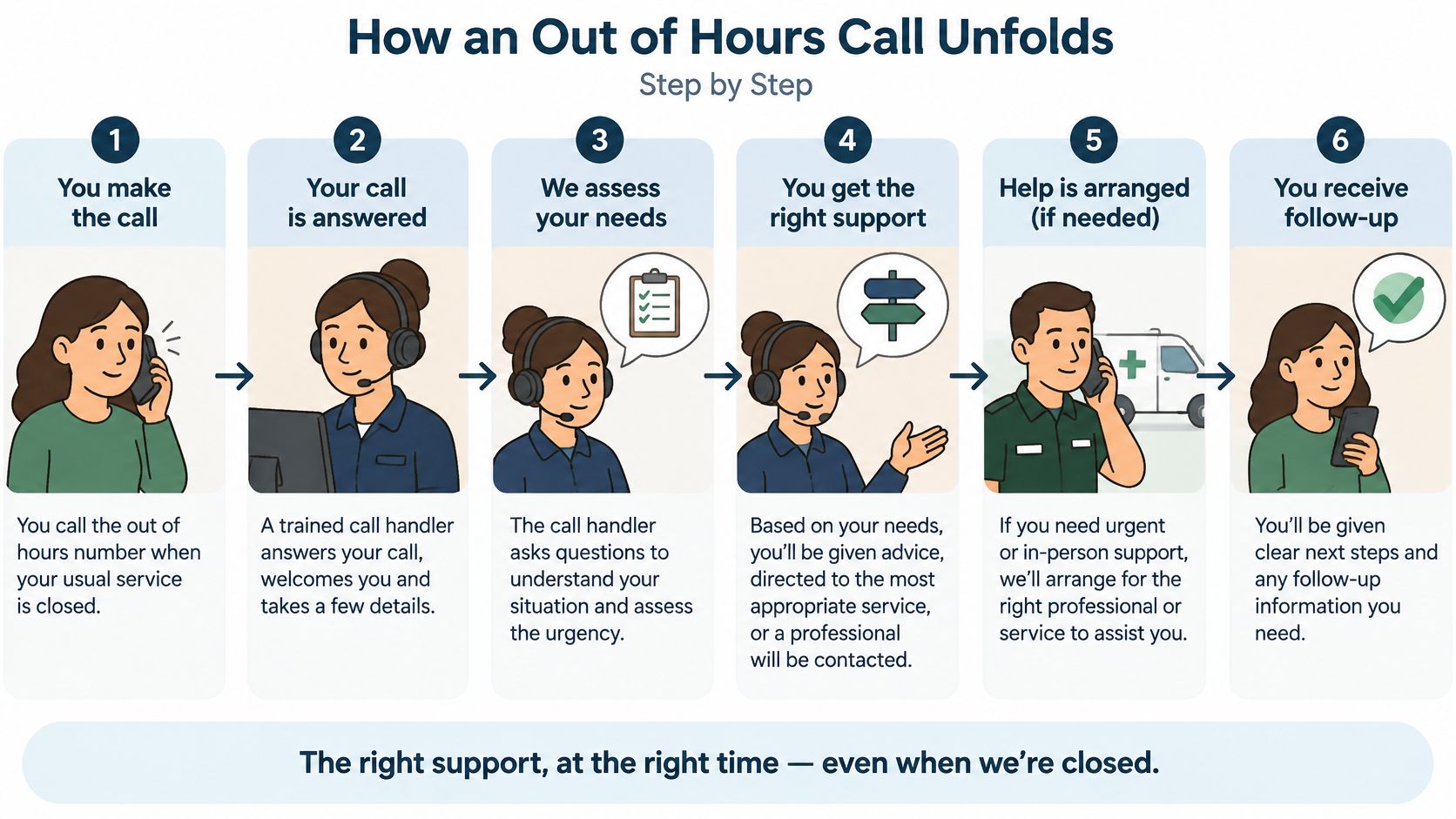
- Have the facts ready. The child's age, the placement type, what happened, when it happened and what's already been done should come first. Those basics let the person answering judge urgency without a long back and forth.
- Expect triage questions. Questions usually cover whether anyone's at immediate risk, whether a child is missing, any medical concern, who else is in the home and whether police are involved. The answers decide which route applies, so short, factual replies help more than a full history at this stage.
- Agree the next action. That might be advice on the call itself, contact with the child's social worker or the emergency duty team, or a review on the next working day. Further background on foster care social workers explains how these roles divide between the child's worker and the carer's own supervising social worker.
- Ask for a record of the call. The name of the person spoken to, the time and the advice given should all be noted, because overnight decisions are easy to lose once daytime staff take over.
- Check the follow-up. The call should end with agreement on whether a support plan is needed, and who owns each action.
What a support plan might include
A support plan for a difficult placement may consider additional social work contact, a professionals meeting, changes to routines or risk plans, specialist advice or training, and practical help or respite where appropriate and agreed. None of that should be assumed in advance. Organic Fostering provides or arranges the specialist support agreed for a placement, and access to any particular service is not automatic, so the plan needs naming clearly rather than relying on general promises.
Two habits protect everyone involved. Call details should be written down the same night, while they're fresh, including times and exact words where an allegation or disclosure is involved. And if a line can't be reached or is engaged, nobody should wait for a return call when a child's safety is at risk. A child who's gone missing while an agency line is busy means going straight to the police and the emergency duty route, then recording the attempt, the time and who was tried, so the account is complete when the next working day starts.
Common Out of Hours Situations and First Steps
Most overnight difficulty falls into a small number of recognisable situations. Each one has a sensible first step, and taking that step promptly matters more than handling the whole situation alone. The table below is designed to be scanned quickly, under pressure, without wading through paragraphs.
| Situation | First step | Who to involve |
|---|---|---|
| Child missing | Report to the police straight away | Emergency duty team and placing authority |
| Allegation made against a carer | Record exactly what was said and do not investigate | LADO (local authority designated officer) through the child's local authority |
| Self-harm or risk to life | Call 999 | Emergency services, then agency out of hours advice |
| Medication concern | Call NHS 111 for advice, or 999 if someone is unwell or an overdose is suspected | NHS 111 or emergency services, then agency out of hours advice |
| Unplanned contact from birth family | Follow the placement plan and do not agree changes alone | Agency out of hours advice and the child's social worker |
| Placement under strain | Ask for urgent advice before a crisis builds | Agency out of hours advice, then a professionals meeting if needed |
Missing episodes and allegations
A missing child is a police matter first, not a wait and see judgement for a foster carer to make alone at night. Reporting straight away, then informing the emergency duty team and the placing authority, keeps the response coordinated and properly recorded. Details that help include when the child was last seen, what the child was wearing, likely whereabouts, friendship groups and any phone or messaging contact.
An allegation against a carer calls for the opposite instinct. The carer shouldn't investigate, question the child repeatedly or try to establish what really happened. Recording exactly what was said, in the child's own words where possible, and passing it promptly to the LADO (local authority designated officer) through the child's local authority protects both the child and the carer. It's an unsettling position to be in, and a clear written process matters precisely because emotions run high.
Health, contact and strain
Self-harm or any risk to life means 999 without delay, with agency advice informed once emergency help is on its way. A medication concern sits differently. NHS 111 can advise where a dose has been missed or doubled and nobody appears unwell, while 999 applies if someone is unwell or an overdose is suspected. Reading the medication label and the placement health information aloud on the call avoids guesswork.
Unplanned contact from a birth family member should be handled through the placement plan rather than negotiated on the doorstep or by message late at night. A carer shouldn't agree changes alone, however reasonable a request sounds, because contact arrangements usually sit within a wider care plan. Situations like these also arise in emergency placements, where information can be limited at the point a child arrives.
Asking for help early, while a placement is under strain rather than in crisis, gives professionals something to work with.
Placement strain deserves the same early phone call as any incident. Carers are advised to ask for help early when a placement is under pressure, because an agency can then agree a support plan and arrange a professionals meeting if needed, before exhaustion turns a hard week into a breakdown.
Why Out of Hours Support Matters and What Rules Apply
The case for taking out of hours support seriously is measurable. The Fostering Network's 2024 State of the Nations survey collected responses from more than 3,000 foster carers and 114 fostering services across the UK, and its findings were stark: only 35% of foster carers rated their out-of-hours support as "excellent" or "good"; that was a decline from 43% in 2021, an 8-percentage-point fall over three years; and it made out-of-hours support the lowest-rated area of support in the survey, below general support from fostering services at 51% and support from children's social workers at 42%.
The majority of carers surveyed, in other words, rated the help they get at night below "good".
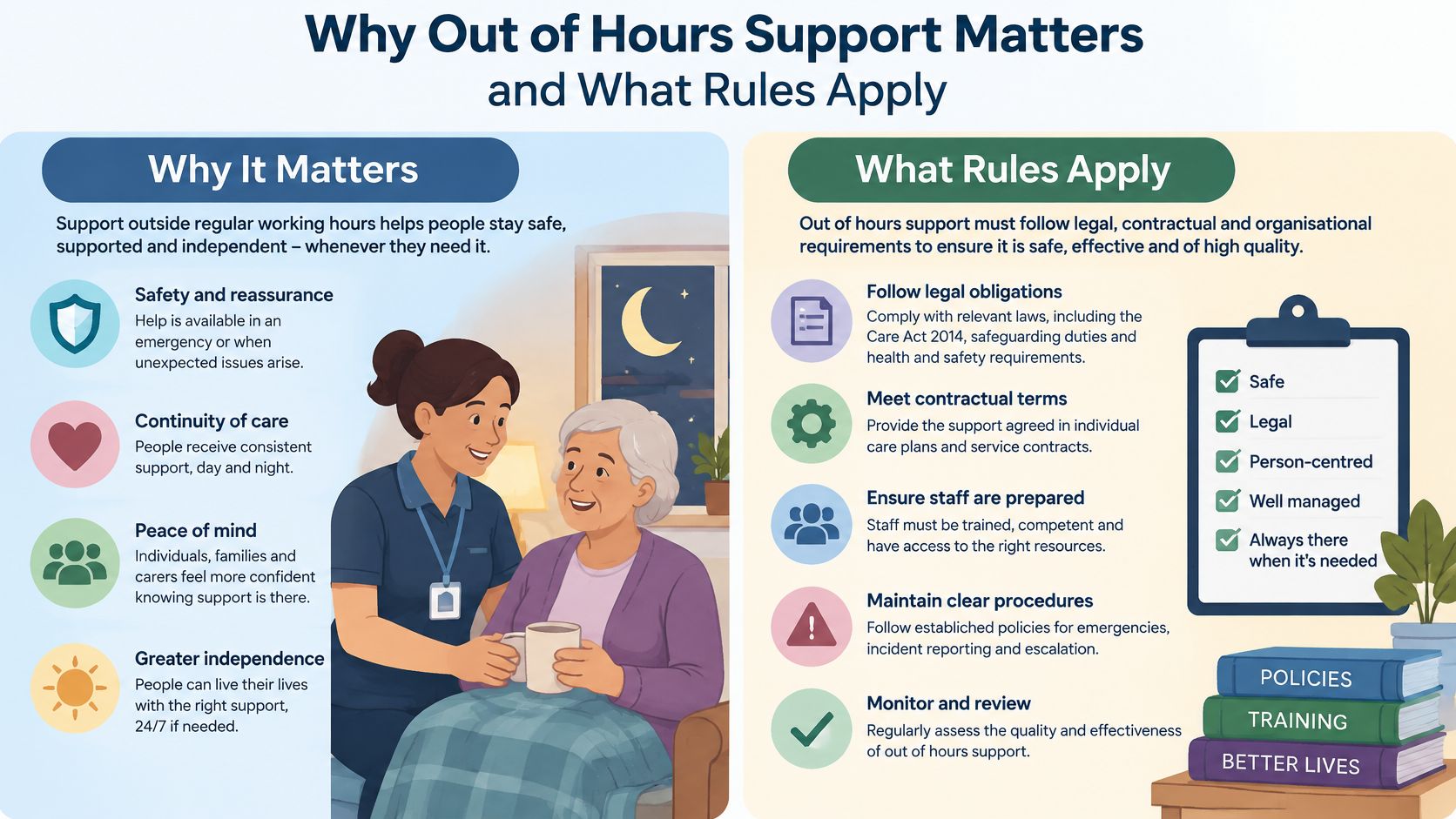
The practical reason is plain. Difficulties arise at night, at weekends and on public holidays, when office-based social work access stops and a household still has to respond safely. A child who is distressed at midnight, a teenager who has not come home, or a sudden allegation cannot wait until Monday morning. Reliable telephone advice and emergency guidance fill an established service gap affecting a substantial majority of carers, since only around one in three currently reports a positive experience.
What the rules in England require
In England, guidance on the Children Act 1989 fostering services framework reflects Regulation 17 of the Fostering Services (England) Regulations 2011, which requires fostering service providers to give foster parents the training, advice, information and support, including support outside office hours, necessary in the interests of children placed with them. In practice, that means a defined escalation pathway, an accessible contact route and a documented response procedure that keep working when the supervising social worker is off duty.
The rules also draw a line between two routes carers mix up. Immediate danger to life or safety goes to 999. Urgent safeguarding and placement matters, including missing episodes, serious injury, allegations and sudden placement instability, go to the agency's on-call social work route. That second route carries duties beyond the call itself: recording what happened, notifying the right professionals and reviewing the incident afterwards. How those duties sit alongside everyday caring tasks is covered in the guide to foster carer roles and responsibilities.
One limit needs stating plainly. These are England rules. Scotland, Wales and Northern Ireland operate their own fostering frameworks, so anyone fostering outside England should check the regulations for the nation where the placement will take place, rather than assuming identical duties.
Questions to Ask About Out of Hours Cover
Headline claims about round the clock cover tell a prospective foster carer very little. Written answers to specific questions tell much more, and they give an experienced carer considering a transfer something concrete to compare. Any agency, including Organic Fostering, should be asked the same set.
- Who answers outside office hours: Is it a social worker, a duty rota or a call handling service, and can that person see the child's history and placement plan?
- How is advice accessed: Is there a set number for approved carers, and what happens if that number isn't answered?
- How is each call recorded: Does the record reach daytime professionals, and is it reviewed on the next working day?
- Who supervises the household: Who is the supervising social worker, and how often is supervision held? The role is explained in detail in the article on the supervising social worker role.
- Is there protected reflection time: Can supervision cover how the placement is progressing, safeguarding and safer caring, and preparation for reviews or care plan changes?
- Does support cover the whole household: What help exists for a carer's own children when routines or relationships feel stretched?
- How are allowances explained: Is the explanation transparent, and how can a concern be raised if it isn't clear?
Comparing answers fairly
Foster carers at Organic Fostering get a supervising social worker, preparation and ongoing learning, advice outside normal hours for approved carers, contact with other foster carers, and help navigating a child's education and health needs. Organic Fostering also gives carers a transparent explanation of allowances and opportunities to give feedback and raise concerns. Current detailed out of hours arrangements aren't set out here, so the team should be asked for the current written policy on each point above.
Location deserves a direct question too. Location affects Organic Fostering's ability to provide assessment and home visits, regular supervision, training and support groups, help during a placement, and an out-of-hours response, so distance from the team is a practical consideration rather than a minor detail.
Written answers from at least two other agencies make comparison possible. Relying on a headline claim or website wording alone leaves the most important questions, about context, recording and next day follow-up, unanswered until the first difficult night tests them.
Check Your Area and Start a Conversation
A sensible first step is checking whether a home postcode sits within the area where Organic Fostering currently recruits. The agency publishes an area only after confirming it is recruiting foster carers there and can provide the assessment, supervision and continuing support that follows. That check matters because all of this depends on the team being able to reach a household reliably, not just on a carer's willingness to foster.
If a postcode sits near the edge of the current recruitment area or needs manual review, a team member confirms whether support is available. Living outside the recruitment area does not make an applicant unsuitable; another service may be better placed to support that household locally, and it is better to establish that early than after an assessment has begun.
Ways to get in touch
- By phone: Call 0161 241 1332 for a conversation about individual circumstances.
- By email: Write to info@organicfostering.co.uk with questions about fostering or transferring.
- Online: Use the enquiry form to apply or ask a question.
During that first contact, it is reasonable to ask what the initial conversation involves, what the next step would be, and how out of hours support works in practice for approved carers. Asking those questions before applying is sensible, and it is how a careful carer checks whether an agency's arrangements would hold up on a difficult night. A confidential enquiry can be started by leaving details; a member of the Manchester team then explains the next step without pressure or obligation.
If anyone is in immediate danger, call 999. The website and enquiry routes are for fostering questions, and urgent situations need the emergency services directly.
Everything else about fostering can be explored at a comfortable pace, with questions asked in writing and answers compared calmly. Deciding the emergency route in advance, before it is ever needed, protects children, carers and everyone else in the household.
Organic Fostering supports approved foster carers across its recruitment area with a supervising social worker, preparation and ongoing learning, and access to out of hours advice when the office is closed. Anyone considering fostering, or thinking about transferring, can ask how that support works in practice before making any commitment. Visit Organic Fostering to check area coverage, read more about the support available and start a confidential conversation with the team.