

Single people can and do foster in England. Government figures recorded 31% of fostering households as single-carer households, with single carers making up 18% of approved carers while caring for around 25% of children placed. The assessment question isn't whether a single parent is allowed to apply, but whether one adult can offer a stable, safe and well-supported home.
A solo carer may be managing the school run, working around school hours, and looking at a spare bedroom while a sister lives nearby and is willing to help. That household might be a strong fostering home. It might also need a clearer plan for illness, emergencies, contact arrangements and time away from work before an application can move forward.
The three things a single applicant must demonstrate are capacity, resilience and a realistic placement match. Marital status isn't a disqualifier. The practical test is whether the household can meet a child's needs consistently, including on difficult days when there isn't another adult at home.
Table of Contents
- Can You Foster as a Single Parent in England
- Core Eligibility Rules for Single Applicants
- Why Your Support Network Matters Even More
- What the Assessment Actually Looks At
- Allowances, Work and the 30 Hours Childcare Rule
- Placement Types That Tend to Suit Single Carers
- Practical Steps to Prepare Your Application
- Next Steps and an Informal First Conversation
Can You Foster as a Single Parent in England
The direct answer to can you foster as a single parent is yes. UK government guidance says adults apply through a local council or an independent fostering agency and complete a social worker assessment before approval. A single adult is assessed against the same safeguarding, housing, health and suitability standards as any other applicant, as outlined in the official fostering application guidance.
Government figures for England show that single carers aren't a marginal part of the system. On 31 March 2020, around 44,500 fostering households and 75,300 approved foster carers were caring for about 56,500 children. Single-carer households accounted for 31% of fostering households, while single carers represented 18% of the carer population, around 13,100 carers, and cared for around 25% of children placed, approximately 14,500 children. The same 31% pattern appeared in the 2020 to 2021 data. These figures are set out by The Fostering Network.
The real test is household resilience
Assessors focus on whether the applicant can:
- Provide consistent care: The child needs dependable routines, supervision and emotional availability.
- Manage pressure safely: The applicant must recognise personal limits and know when to seek help.
- Accept the right match: A placement should suit the carer's time, skills, household and support network.
That means a single applicant shouldn't try to prove they can handle every possible placement. A stronger approach is to be honest about the types of children and arrangements that fit the household now. A thoughtful match protects the child and gives the carer a better chance of sustaining the placement.
Practical rule: A named support plan is more persuasive than general confidence.
Core Eligibility Rules for Single Applicants
Single applicants must meet the ordinary fostering requirements. The assessment considers the whole household, not just whether the applicant is parenting alone.
| Criterion | What It Requires | Single-Applicant Watchpoint |
|---|---|---|
| Age | The applicant must generally be at least 21. | There's no upper age cap, but maturity, health and stamina still matter. |
| Residency | The applicant needs full-time UK residency or settled status. | The service will need clear evidence of the applicant's right to live and work in the UK. |
| Bedroom | The foster child normally needs a spare bedroom of their own. | A child usually cannot share with the applicant's birth child, so a home office may need to change purpose. |
| Health | A GP report considers whether the applicant can provide care safely. | The form isn't looking for perfect health. It examines capacity, stress management and likely sustainability. |
| Checks | DBS and other suitability checks apply to relevant household members. | The applicant must identify adults who live in or regularly spend significant time at the property. |
The spare room is one of the most common practical obstacles. It needs to function as a child's bedroom, with suitable space for sleep, belongings and privacy. A room used as an office, storage area or occasional guest room may need reorganising before approval.
Health discussions are equally direct. A medical report helps the fostering service understand how an applicant's physical and mental health could affect daily care, appointments, contact, school routines and emergencies. A past health issue doesn't automatically prevent approval, but hiding it creates a bigger problem than discussing it openly.
Financial history also needs a sensible explanation. Recent upheaval, unstable housing or difficulty meeting current commitments matters more than the fact that an applicant once had debt. Previous convictions rarely create an automatic bar, but disclosure must be honest from the beginning. The agency's guidance on background checks for fostering explains why openness matters.
Why Your Support Network Matters Even More
A two-adult household may be able to divide a school collection, a medical appointment or a difficult bedtime between the adults present. A single carer can't divide the immediate responsibility, so assessors examine the backup arrangement much more closely.
The useful question isn't whether relatives are supportive in principle. It's who can answer the phone and step in when a child is ill, a contact visit overruns, work changes unexpectedly or an incident happens outside ordinary hours.
Turn goodwill into a working plan
A credible network may include:
- A sibling or parent: Someone able to help with planned school collections or urgent cover.
- A close friend: A reliable person who understands the household and can provide practical help.
- A trusted neighbour: Useful for short-notice support when the main carer is delayed.
- A daytime contact: Someone available for illness cover, appointments or changes during working hours.
- A wider emotional network: People who can help the carer stay connected and avoid isolation.
The applicant should write down three to five named people, what each person has agreed to do, how often they realistically meet the household and what limitations apply. “Friends would help” is weaker than “a sister can collect from school on a regular Sunday arrangement and a neighbour can be contacted for an urgent delay”.
The fostering service also supplies professional support. A supervising social worker, training, out-of-hours advice and contact with other carers form part of the wider support model. The applicant should ask how that support works in practice and review the agency's published information about support for foster carers.
What the Assessment Actually Looks At
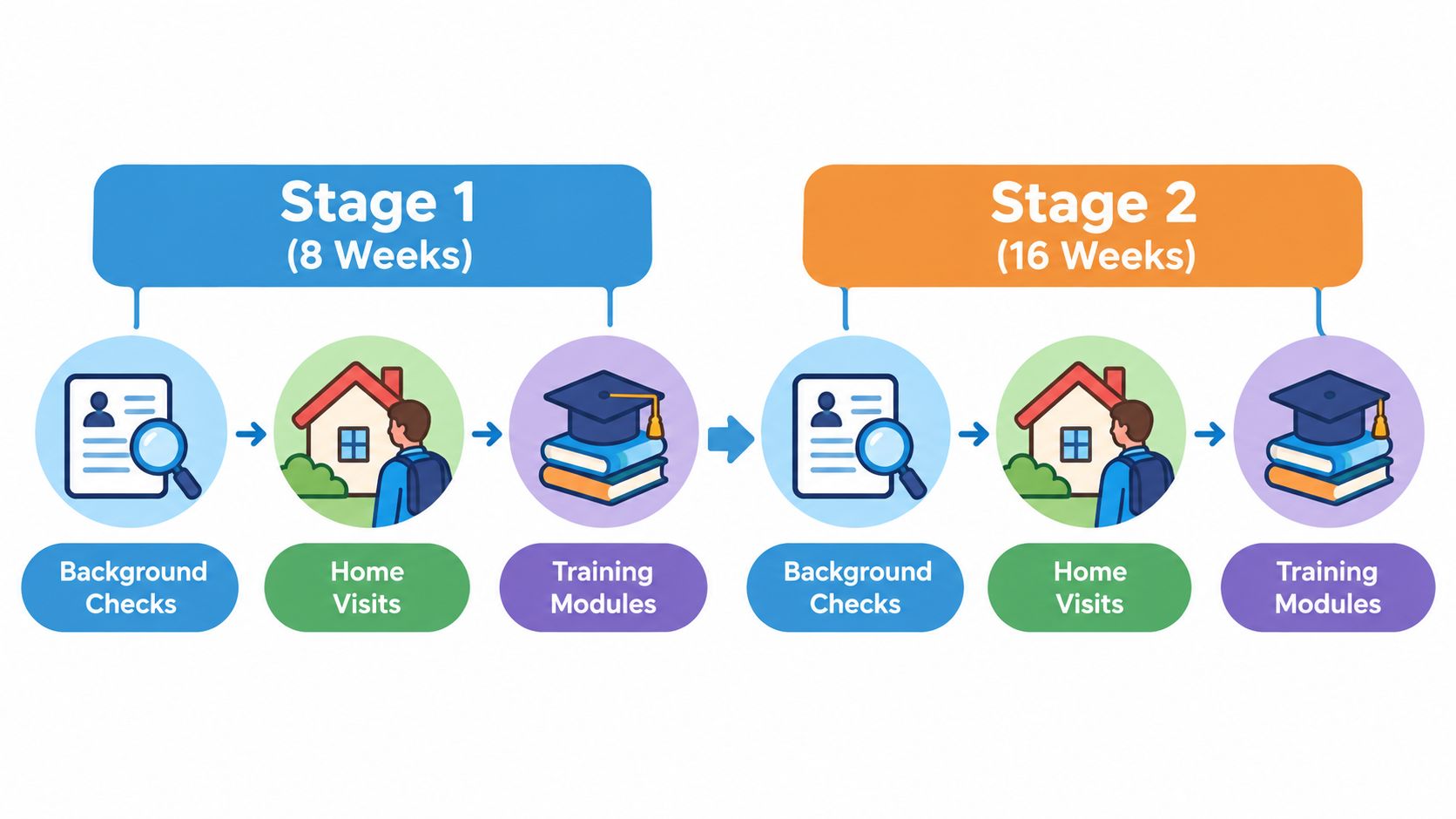
In England, fostering applications are usually assessed in two stages. Stage 1 covers initial checks and household information, including home details, health, relationship history, household members, references and other adults living in the home. Stage 2 explores the applicant in greater depth, including personality, beliefs, ethnicity, cultural background, languages, employment history, hobbies, relevant skills and willingness to care for a child from a different background. The assessment process is described in further detail by UK Fostering.
Stage 1 is commonly described as taking roughly eight weeks, while Stage 2, the fuller fostering assessment, typically takes up to 16 weeks. The exact experience depends on the applicant's circumstances, the availability of information and the progress of required checks.

Checks and conversations to expect
A single applicant should prepare for:
- An enhanced DBS check: Relevant criminal record information is considered alongside the full circumstances, not in isolation.
- A medical report: The fostering service may request a GP report using the CoramBAAF Form AH.
- Personal references: These may include someone who knows the applicant well and, where safe and appropriate, an ex-partner or co-parent.
- Home visits: The assessing social worker will need to see the space, routines and household environment directly.
The social worker isn't searching for a flawless CV. They're looking for self-awareness, emotional regulation and credible answers about time, exhaustion, conflict and recovery. A single applicant who can say what happens when they feel overwhelmed is safer than one who insists that burnout could never happen.
The resulting Form F report records the applicant's strengths, limitations, household circumstances, support and the kinds of placements likely to be suitable. That information helps shape future referrals. A recommendation for older children or planned short-term care isn't a judgement on the applicant. It may be the most responsible match for a one-adult household. Applicants can read more about fostering assessments.
Allowances, Work and the 30 Hours Childcare Rule
Money needs careful planning, particularly where one adult carries the household income and the practical care. The minimum weekly fostering allowance in England for the tax year 6 April 2026 to 5 April 2027 varies by age band and region. In the Rest of England, the published minimums are £176 for ages 0 to 2, £182 for ages 3 to 4, £201 for ages 5 to 10, £227 for ages 11 to 15, and £267 for ages 16 to 17, according to The Fostering Network's allowances briefing.
| Age Band | National Minimum per week | Typical Local Top-Up |
|---|---|---|
| 0 to 2 | £176 | Varies by fostering service |
| 3 to 4 | £182 | Varies by fostering service |
| 5 to 10 | £201 | Varies by fostering service |
| 11 to 15 | £227 | Varies by fostering service |
| 16 to 17 | £267 | Varies by fostering service |
The allowance is intended to meet the child's costs. Some services also pay a fee element where a carer's skills, experience and approved role justify it. Applicants should ask for the agency's current payment policy rather than rely on figures from another service. Organic Fostering publishes information about its fostering allowance, including payment explanations and budgeting tools.
Work and childcare decisions
A single foster carer can work, but the working pattern must fit the child's care plan and daily requirements. Government guidance says a single-parent foster family can qualify for 30 hours of childcare only where the foster parent does paid work outside fostering and the responsible local authority agrees that the arrangement fits the child's care plan. There's no minimum-income requirement, and the rule applies in England through the responsible local authority. A practical explanation of the wider entitlement is available in this guide to free childcare hours explained.
The key issue isn't whether a salary alone disqualifies an applicant. It doesn't. The panel will examine how work, school arrangements, contact, appointments, training and unexpected disruption fit together. A written plan is essential, especially where the applicant works fixed hours or has limited flexibility.
Placement Types That Tend to Suit Single Carers
Single carers aren't restricted to one type of fostering. Matching should consider the child's needs, the applicant's availability, the household's experience and the support available around the placement.
| Placement Type | Fit for Single Carer | Why |
|---|---|---|
| Short-break or respite | Often suitable | Planned support gives the carer a defined arrangement and allows preparation around work and home routines. |
| Long-term school-age care | Can be strong | Established school routines may fit a carer who can provide consistent weekday structure. |
| Caring for siblings | Possible with careful matching | A sibling group may suit one adult where the space, experience and daily demands are realistic. |
| Babies and toddlers | Requires careful scrutiny | Frequent care, sleep disruption and appointments can be difficult for one adult without robust cover. |
| Children with severe attachment trauma | May require substantial support | The service must consider whether one carer can safely absorb intense and unpredictable needs. |
| Large sibling groups | Often more demanding | Supervision, transport and competing needs can exceed what one adult can manage safely. |
A single applicant may be a particularly good fit for an older child who wants calm evenings, a stable routine or support with growing independence. That isn't a consolation placement. For some children, one consistent adult can offer the clarity and attention they need.
Matching works both ways. A carer can decline a referral that doesn't fit, and a fostering service should explain why a particular placement isn't appropriate. The approved range may change later as the carer gains experience, completes training and builds a track record. The available types of fostering can help applicants compare arrangements before discussing a preferred route.
Practical Steps to Prepare Your Application
A single applicant doesn't need to wait for the first enquiry before getting organised. Four to six weeks of focused preparation can expose practical gaps early and make later conversations more useful.
Weeks one and two
Start with the support network. Write down three to five people, their availability, the help they can offer and the situations they cannot cover. Ask specific questions rather than collecting vague promises. The plan should include school collections, illness, emergencies, respite and the applicant's own need for rest.
Book a GP appointment and arrange any routine dental check that has been delayed. Gather identification, address history, employment details and information needed for checks. Honesty at this stage prevents avoidable delays later.
Weeks three and four
Prepare the spare bedroom. Remove office equipment and storage that would stop the room feeling like the child's own space. Check privacy, storage, heating and basic safety, then ask the fostering service what household changes it expects before approval.
Draft a short household resilience statement covering:
- Work: working hours, travel and flexibility.
- Childcare: school arrangements and illness cover.
- Existing children: their routines, feelings and privacy.
- Emergencies: who responds when the applicant can't leave work.
- Recovery: how the carer protects time for rest and reflection.
Review household finances against the published allowance rates. The allowance mustn't be treated as a substitute for a stable plan to meet existing commitments. A general introduction to starting the process is available in this Cura Academy fostering guide.
Weeks five and six
Rehearse honest answers about motivation, work, childcare, relationships and the limits of the proposed placement. A simple weekly journal can record reflections on children's behaviour, boundaries, identity, loss and how the applicant responds under pressure. This isn't homework for appearance's sake. It helps the Form F discussion draw on real thinking rather than improvised answers.
Assessment preparation: Specific plans build confidence. They don't guarantee approval, but they show that the applicant understands the responsibility.
Next Steps and an Informal First Conversation
The first call with a fostering service should feel like an information exchange, not an audition. An advisor will usually ask why the applicant wants to foster, who lives in the household, what the work pattern looks like and when the applicant could realistically provide care.
A single applicant should use the call to ask direct questions:
- Matching: Which placements are commonly considered for one-adult households?
- Cover: What out-of-hours advice and emergency support are available?
- Training: What preparation is required before approval and what learning follows?
- Payments: What allowances and fee arrangements are published?
- Childcare: How does the local authority assess the 30-hours rule against a child's care plan?
- Identity: How are culture, faith, language and existing relationships considered during matching?
Honest answers save time. If the applicant works long hours, has limited family nearby or isn't ready for a particular age group, saying so early helps the service discuss realistic options. Walking away after an initial conversation is also valid. No responsible agency should pressure someone into applying before the household is ready.
For adults in Manchester and the wider North West, Organic Fostering can provide an informal, no-obligation conversation about becoming a foster carer or transferring from another agency. The discussion can cover eligibility, the spare bedroom, assessment checks, training, support, matching and published payment information. If the conversation suggests that fostering may be suitable, the advisor can explain how a follow-up home visit is arranged. If it doesn't feel right, the applicant can stop there.
Organic Fostering supports single applicants and experienced carers considering a transfer across Manchester and the North West, with assessment guidance, preparation, supervising social worker support and placement matching that considers a child's identity and relationships. Visit Organic Fostering to arrange an informal, no-obligation conversation and discuss whether fostering fits the household.
Generated with Outrank tool