

How much of an emergency placement is settled before the child reaches the door?
An emergency foster carer is an approved foster carer who can take a child into their home at short notice, often on the day a local authority decides the child can't stay where they are. The role sits inside a wider approval. A household might mostly offer short-term placements, keep children for longer, or provide respite, and still be on the list a duty social worker rings when a child needs a bed tonight. Many approved households hold that permission and use it rarely.
A Friday referral at 6pm, with the child due by 9pm, shows what short notice can mean. The call gives an age and why the child is moving. School, health, and how long the stay might last are still blank.
The sequence does not change with the night. Find out what is known. Decide whether this household can meet the need: spare room, other children, and your own availability. Write down what nobody could tell you. Get the placement reviewed once the picture fills in. I would turn a referral down when those gaps make safe care unrealistic tonight, and accept when the household can cover the known risks until morning. Approval puts you in the pool. It does not guarantee a call, and it does not require a yes.
Table of Contents
- What an Emergency Foster Carer Does
- Emergency Placements Compared With Other Types
- Matching Under Uncertainty and When to Decline
- Information to Record for Each Placement
- What to Do From Arrival to the First Week
- Support You Get as an Emergency Carer
- How Pay and Tax Work for Emergency Carers
- Check Eligibility and Make Your Enquiry
What an Emergency Foster Carer Does
The same 2017 to 2018 release records the primary-offer group doubling from 190 to 385, with the whole increase among independent fostering agency services (DfE, fostering in England 2017 to 2018).
Emergency approval usually sits beside other fostering work. A household might mostly offer short-term placements, keep children for years, or provide respite, and still be the household a duty social worker rings when a child needs a bed tonight.
Approval puts a household in the pool duty teams draw from, but it does not guarantee a referral. England had 42,190 fostering households at the end of March 2025 (DfE fostering statistics for 2024 to 2025). Duty teams choose from the households approved and available that night. There is no fixed queue.

The first hour is concrete. If you have any notice, make the bed and clear a quiet space before the child arrives. On arrival, check whether medication has come with the child, what you were told about the dose, and whether anything looks missing or unsafe. Call the duty social worker first when the referral and the child in front of you do not match. Then give a short explanation: where they will sleep, who else is in the house, and what happens in the morning.
Day to day, the work stays specific. You take the call and ask what matters for tonight: age, known risks, school the next day, health needs, and who holds parental responsibility. Once the child is in, you provide supervision, a routine that holds, and enough calm that a frightened child can sleep. You keep the child's social worker, school and health contacts moving, and you write down what you were told and what you were not.
Permanency planning, court timetables and reunification sit with the local authority and the courts. A carer's contribution is stability, observation and an honest record.
I would only treat emergency care as a fit if you can keep a room ready, answer at short notice and work from an incomplete picture. If a predictable start date matters more, a planned placement type will suit you better.
Emergency Placements Compared With Other Types
A duty worker calls late. A child needs a bed tonight. You may have a name, an age and why the last arrangement ended, and still have no school, no health summary and no date the stay will end.
Emergency placements differ in how much you know on arrival, not in how long they last.
| Placement type | What you usually know at the door | What you hold in the first days | Who decides what happens next |
|---|---|---|---|
| Emergency | A safeguarding reason and whatever the duty worker can pass on by phone | What you were told, what you saw, and the gaps | The child's social worker, once a plan exists |
| Short-term placements | A stated need while next steps are still open | Notes against the care plan and any change in the child | Review meetings with the local authority |
| Long-term placements | A match already made for a stay expected to continue | Routines, school and health contacts over time | The care plan, reviewed as it runs |
| Respite placements | Handover notes and a return date | What changed during the break, written for the main household | The child's social worker and the main carers |
Planned rows start from a referral you can prepare for. An emergency row starts from a call that will not wait, so the file is built after the child is in the house.
Approval puts the household in the pool duty teams draw from. It does not promise a referral, and it does not require you to take one the household cannot safely hold tonight. If the known risks, the spare room and the children already here do not add up, decline and name what is missing. If they do, accept knowing that Tuesday's plan may still be blank.
Evidence reviewed by the Department for Education found that around 50% of children placed in emergency arrangements returned to their families within 12 months (The fostering system in England evidence review). I read that 50% as a return-home rate, not as a promised length of stay and not as proof the placement went well. A household planned around a fixed finish, short or long, is planned around a number the referral has not given you.
Judge the first night and the first fortnight on safety and on what you can actually record.
In that fortnight you provide supervision while history, health and risks are still incomplete. Sleeping arrangements, how the child arrived, and early contact with the social worker and health colleagues belong in your notes from night one, because later planning will ask for those facts. A free bed is not a match. The child's care plan still has to be set against your approval, the household and what you can safely provide.
If you need the week mapped before the child arrives, temporary foster care describes a planned stay. Emergency work asks you to keep the household steady while other people write that plan.
Matching Under Uncertainty and When to Decline
Can this household meet the child's needs tonight, with the training, resources and support the placement plan names? Accept only when that is true. Decline when it is not, and say why in terms of need.
Approved mainstream fostering places in England fell from 70,465 in 2024 to 69,825 in 2025, with about 60% filled, 17% vacant and roughly one in five unavailable (Matching in foster care). Fewer usable places mean children who are harder to match wait longer, and the pressure on an available carer to say yes rises with every incomplete referral.
I treat an incomplete referral as a reason to ask more questions, not to improvise. A nominal place that cannot be used tonight helps nobody.
Five Questions to Ask Before You Say Yes
- What risks are already known? Ask for the specific behaviour, health or safety concerns, not a general description of the child. If the answer is only "there might be issues", you do not yet have enough to supervise safely.
- What's missing, and who will supply it? Name the gaps out loud and agree who is chasing them, so the answer does not land on you at midnight.
- Can this household meet these needs alongside the children already here? Count your own family, the spare room, and the school run. Approval to foster is not the same as capacity for this child tonight.
- Is there time and support tonight and over the coming weeks? A yes that depends on a rota of favours is not a yes. Out-of-hours advice has to be a named route, not a hope.
- What would make you change your decision? Decide the trigger in advance, so a later rethink is judgement rather than panic. A new risk, a missing bedroom, or support that does not arrive are all fair triggers.
Cultural, faith, language and identity needs often arrive as unknowns. Sibling relationships may or may not be able to stay together. Ask even when the answer is "we don't know yet". The question puts the gap in the plan instead of leaving you to fill it. Organic Fostering matches a child's care plan and known needs against a carer's approval, household, experience and ability to provide safe care. Use that same test before you accept.
Practical rule: a yes you can't resource is a placement that breaks in week three.
Declining is a legitimate part of the role. Give the reason plainly to the child's social worker and your agency, in terms of need rather than preference, and follow the agency's current written policy on refusals. Approval does not guarantee a referral, and a referral does not oblige a yes. For how the decision is reached on the other side of the phone, see how placement matches work.
Information to Record for Each Placement
A risk written as "unknown" is a shared problem. A risk you have filled in yourself is yours alone at 2am.
Hold these items before arrival, or in the first hours after it. The first version of an emergency referral is incomplete, so the record is what stops tonight's decisions resting on memory.
| Item to record | Why it matters | Usually confirmed by |
|---|---|---|
| Known risks and safety concerns | Shapes supervision, sleeping and contact decisions | Child's social worker |
| Missing information and open questions | Shows what to ask before decisions are made | Carer and social worker |
| Medication and allergies | Prevents avoidable harm in the first night | Social worker and health contacts |
| Education and school contact | Keeps routine and learning continuous | Social worker and school |
| Contact arrangements | Clarifies family and professional contact from day one | Social worker |
| Belongings and documents | Records what arrived and what is still needed | Carer at arrival |
| Out-of-hours decision-maker | Avoids delay when the team cannot be reached | Agency and social worker |
| Post-arrival review date | Triggers a fuller match check once information is complete | Supervising social worker |
Referral analysis in England found that 16% of referrals, 1,850 children, requested emergency placements, that incomplete referral information could delay finding a suitable carer because professionals had to go back to local-authority teams and social workers for detail, and that emergency referrals included violent behaviour in 10% of cases and child sexual exploitation concerns in 8% (Matching in foster care).
Take a night arrival where the referral mentions aggression toward younger children. Write the wording you were given, who said it, and the time. Sleeping arrangements and supervision then follow a recorded concern, and the child's social worker and your supervising social worker can see the same line. If the call only said "a bit unsettled" and you treat that as low risk, the assumption never reaches the team. You are managing it alone when the house is quiet.
Medication, allergies, education and contact affect tonight and tomorrow, so they come first. Other gaps can wait for the review if they are on the list with a name against who will supply them. Keep your own dated notes of what you were told, by whom, and when. Follow your agency's record-keeping policy on which system is the official one. Foster carer roles and responsibilities sets out that wider record-keeping picture.
The post-arrival review is where fuller information replaces early assumptions. Record the date on this list. Confirming it, and bringing it forward if the placement is not working, sits in the first-week steps. I would rather see "unknown" in a cell than a tidy guess that nobody else can check.
What to Do From Arrival to the First Week
The first week is a sequence of small decisions. It has to be safe, written down, and tied to a named person who can authorise the next step.
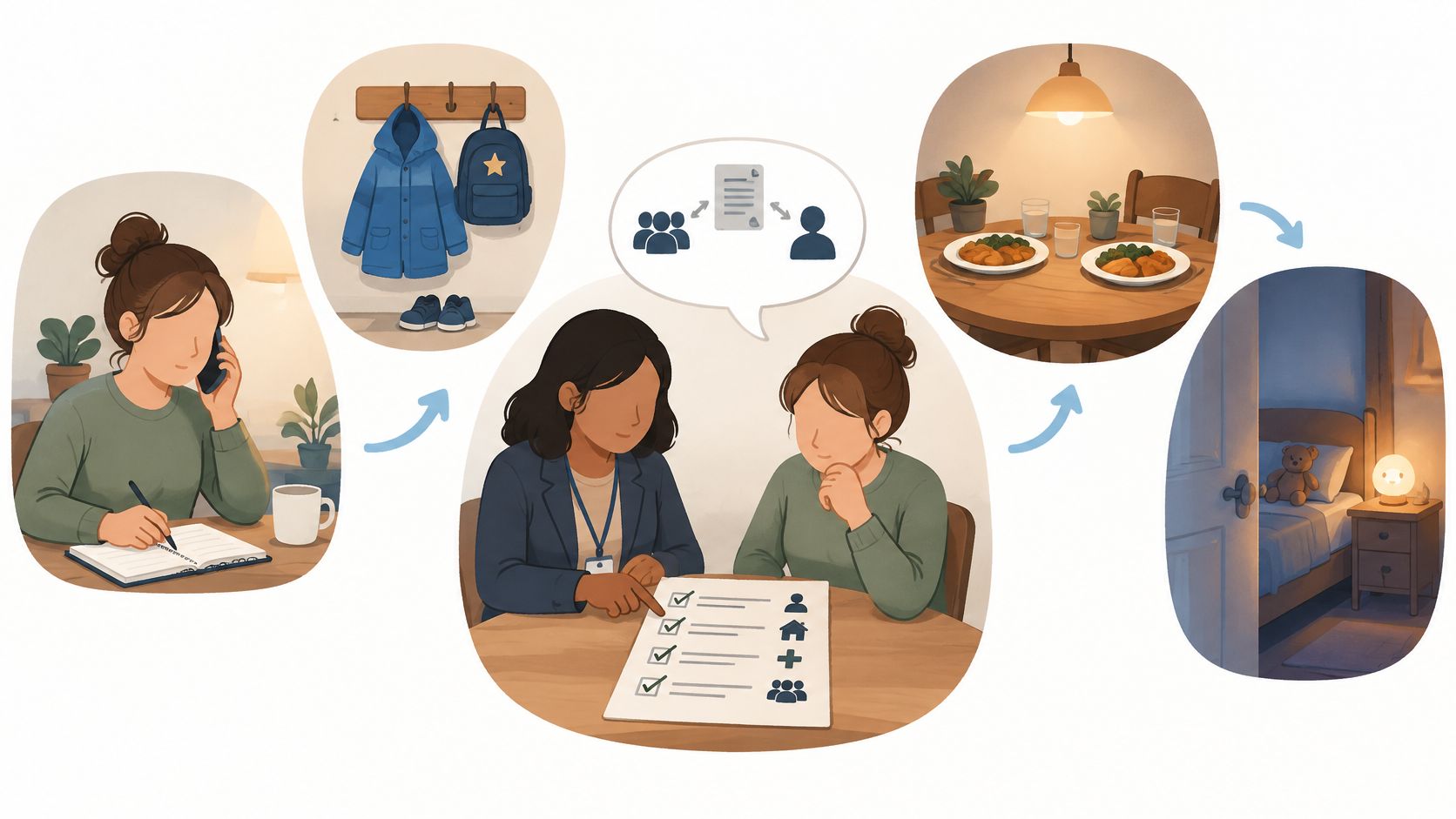
A child can arrive with a thin file and the evening still ahead. I would accept only if you can cover the night safely with the information you have. If a gap would leave you guessing about medication, legal authority, or who to call when the office is shut, say so before you agree. Approval does not mean every referral is one you should take.
Once the child is through the door, work in this order.
- Confirm the essentials and the authority. Ask the child's social worker to state what is known, what is still outstanding, and who authorises decisions out of hours. Unclear authority is what stalls a decision after the office has closed.
- Settle the physical basics. Sleeping space, bathroom access, a secure place for medication, and an agreed routine for each dose come before any talk of school or contact.
- Keep the first evening quiet. A familiar meal, a clear bedtime and a short account of tomorrow, in words the child understands, is enough. A house tour and a stack of forms can wait.
- Check what arrived. Match belongings, documents and medication against the handover list. Record each missing item rather than assuming it will turn up later.
- Open school and health contact. When the care plan allows, ring the school and the health contacts and agree who attends the first meetings. Leaving that call for another professional is how a day gets lost.
- Use the review date already on your records. Confirming that date with your supervising social worker, and asking to bring it forward if the placement is not working, belongs with the notes made on arrival.
Do not treat a name and a date of birth as a complete history. Write each gap in the same note as the facts you were given, with who said it and when, so the team can fill it.
Who supports you through that week, including your supervising social worker and advice outside normal hours, is set out in Support You Get as an Emergency Carer. Use that cover. Do not sit on an unclear decision alone overnight.
The Common Questions, Answered Straight
How much notice is typical, and what belongings, medication and clothing arrive with the child?
Notice is short, and the handover is often partial. Plan on receiving whatever the placing authority can send that day. Clothing, medication and documents may all be incomplete, and items that are missing do not reliably follow later. Confirm in writing, the same day if you can: what physically arrived, what is missing, the medication and dose routine you are to follow, and the name of the person who can authorise decisions out of hours. Ask Organic Fostering for its current written requirements before you are on call, so you are working from that record rather than from memory of a phone call.
Support You Get as an Emergency Carer
The structure after approval is predictable, and you can test it before you commit. Approval gives you that structure. It does not guarantee a referral.
Every approved household has a supervising social worker. Their focus is your development and the household's fostering practice. The child's social worker holds the care plan, the placement and family contact. You will speak to both, often in the same week, and they decide different things. Your supervisor looks at how you work, what you record and whether the household can keep offering safe care. The child's social worker decides the plan for that child.
Approval is reviewed formally at least once a year, alongside regular supervision. Ask what that review looks like in the first year and who contributes to it. I would get the frequency of supervision in writing before the first placement, not after a difficult night.
Questions Worth Asking Before You Commit
- Who do I call first at 10pm? Get a name and a number, not a general office line.
- How does out-of-hours cover work in practice? Ask what the person on the other end can authorise. Advice that cannot change a decision is only reassurance. Out-of-hours support sets out what to expect on evenings and weekends.
- What training happens before a first placement, and what follows? Preparation before approval is one thing. Ongoing learning afterwards is another. Preparation should cover how to look past the behaviour in front of you, stay curious about what it means, and respond with safety, boundaries and empathy. Learning after approval sits with supervision, not instead of it.
- How often is supervision, and with whom? Confirm both in writing.
Ask before you commit: if nobody can tell you who answers the phone on a Sunday evening, the support is thinner than it looks.
The working relationships carry the role too. Carers work with social workers, schools, health professionals and birth families where appropriate. In a short-notice placement, say clearly who you have spoken to, what you were told, and what is still missing. That record is what the next professional can act on.
How Pay and Tax Work for Emergency Carers
Three layers sit between an emergency placement and your bank account, and they shouldn't be muddled.
The national minimum allowance. The UK Government sets a minimum allowance for foster carers in England, and the amount varies with the child's age and the fostering service. Check the current figure for the financial year you're in through help with the cost of fostering rather than relying on a figure quoted somewhere else.
The agency's own allowance and any carer fee. These are set by current written policy, not by this article, and they're explained on the allowance page.
Tax. Foster carers are generally treated as self-employed for tax purposes, which normally means registering with HM Revenue and Customs (HMRC) and completing Self Assessment. Qualifying care relief may reduce what's due depending on the household and the children placed, and the relief amounts change each year, so check the current guidance on tax and allowances.
An allowance is intended to cover the costs of caring for a child. It isn't a salary, and because emergency placements can start and end at short notice, it can't be treated as guaranteed or automatically tax-free income. For the fuller picture, see foster carer tax. If you want to test scenarios by age band, the allowance calculator does that without pretending to be a payslip.
Check Eligibility and Make Your Enquiry
Ask one question before you treat emergency fostering as your plan: will this household still meet the approval rules when a child arrives at short notice?
Organic Fostering will talk prospective carers through its current requirements when they get in touch. You get honest information before you apply, then a thorough and respectful assessment. Approval does not guarantee a referral.
You will normally need a suitable spare bedroom, so a child can sleep safely and have some privacy, and enough time and flexibility to be contacted outside normal hours. You also need the right to work in the UK, and the willingness to complete assessment, checks and training. If you rent, secure accommodation, that spare bedroom, and any permission your tenancy requires all sit in the same check. Raise the tenancy point in the first conversation, not at panel.
Keeping other paid work is possible only when the child's needs and your availability allow it. Discuss that against a placement, not as a blanket yes. There is no fixed upper age limit. Health, energy and the ability to meet a child's needs are what get assessed.
The team will tell you which areas it currently recruits in when you contact them. Use the enquiry form. Write down the questions already raised in this guide, the out-of-hours one first, and bring them to that conversation. It carries no obligation and no pressure to decide.
Organic Fostering recruits, assesses and supports foster carers so children and young people can experience safe, nurturing family life, including households approved for short-notice care. Visit Organic Fostering to start the conversation.