

For most applicants in England, expect a fostering assessment planned to reach a panel recommendation within about eight months of first applying, a planning timescale rather than a guarantee. In 2022–23, 75% of mainstream applications approved that year were completed within 240 days, about eight months, measured from the start of Stage 1 to approval.
But what does an agency mean when it says an assessment is complete: the checks, the written report, the panel recommendation or the final approval? That distinction matters when a household is arranging work, family commitments and preparation for fostering.
Table of Contents
- How Long a Fostering Assessment Takes in England
- Stage 1 and Stage 2 Timing Markers
- Stage 2 and Panel Decisions
- What Adds Time Checks and Investigations
- Planning Your Own Assessment Calendar
- Timescales Compared by Provider Type
- Confirm the Timeline with Your Agency Before You Apply
How Long a Fostering Assessment Takes in England
Fostering assessment timescales describe a pathway, not just a wait for an appointment. The agency needs information about the applicant and household, opportunities to explore suitability, and time to reach a properly informed decision.
England's process has two stages. Stage 1 gathers essential information and initial suitability checks; Stage 2 involves the fuller assessment of the prospective foster household. These can happen separately or alongside each other.
The government's mainstream fostering recruitment and retention publication reports that, in 2022–23, 76% of mainstream fostering households approved during the year, 2,805 households, experienced both stages concurrently, while 75% of mainstream applications approved that year were completed within 240 days, measured from the start of Stage 1 to approval.
What overlapping stages actually mean
Concurrent working means an assessor can progress suitable assessment activities while checks are being gathered. It doesn't mean the agency can overlook missing information or treat an outstanding safeguarding concern as resolved.
A household may therefore be attending training and discussing family life while the agency waits for references. Progress in one area doesn't necessarily mean every other part is complete.
Organic Fostering describes its route through five steps:
- Start a conversation about fostering and the household's circumstances.
- Initial/home visit to explore the practical arrangements.
- Apply and train as preparation develops.
- Assessment of the household and suitability.
- Panel/approval to consider the assessment and reach a decision.
The guide to becoming a foster carer explains the starting point. More detailed information is available through the full fostering journey.
Planning principle: A fast-sounding assessment still needs checks, references, training, household assessment and panel consideration.
These arrangements concern England. Scotland, Wales and Northern Ireland have their own systems, so an English timetable shouldn't be applied across the UK. An applicant's practical starting point is a written indicative pathway, with clear milestones rather than an approval promise.
Stage 1 and Stage 2 Timing Markers
The most easily misunderstood deadline concerns when the agency has all the information, not when an applicant first makes contact.
England's statutory assessment and approval guidance says the service must seek Stage 1 information as soon as possible and decide whether Stage 1 has been completed within 10 working days after receiving all required information.
Assessment stages and timing markers
| Stage | What happens | Timing marker |
|---|---|---|
| Stage 1 | Essential information gathered and initial suitability checks completed | Decision within 10 working days of receiving all Stage 1 information |
| Stage 2 | Fuller assessment of the household and suitability | Planned so the panel can recommend approval within eight months of first application |
| Panel and decision | Fostering panel considers the assessment; the agency then makes its decision | Confirm the scheduled panel date and subsequent agency decision arrangements |
| Overall pathway | Stages may run separately or concurrently | 75% of mainstream applications approved in 2022–23 completed within 240 days |
The overall figures and panel benchmark describe different milestones. Neither should be mistaken for the Stage 1 decision point.
Why complete information matters
Recruitment and assessment can include identity, date of birth, address history, references, and criminal-record and barred-list information. Criminal-record checks may involve the Disclosure and Barring Service (DBS).
A missing reference can prevent the agency from reaching its Stage 1 decision even when the applicant has supplied everything personally requested. The useful question is therefore which information remains outstanding, who is obtaining it and what happens next.
Before the first visit, preparation should include:
- Identity documents: Gather the documents requested by the agency and flag any differences between names.
- Address history: Prepare a complete sequence and identify gaps that need clarification.
- Referee contact details: Check that potential referees are willing and contactable.
- Household information: List everyone living in the home and explain any changing arrangements.
Organic Fostering explains likely timescales for each applicant's circumstances, and training and assessment can overlap. That makes an individual schedule more useful than assuming every household follows identical appointments.
The fostering assessment questions guide can help applicants prepare for discussions, while the assessment overview explains the fuller process. Written stage dates should identify what triggers each decision, because completion of Stage 1 isn't approval to foster.
Stage 2 and Panel Decisions
Stage 2 turns household information into an assessment of suitability. An assessor explores how the applicant's experiences, relationships, home and practical arrangements could support a child's needs.
The conversations typically cover personal and employment history, the home environment, support networks and preparation for fostering. Applicants don't need rehearsed answers. They need space to reflect, including on experiences that were difficult and the support they might need.
Preparing for the fuller assessment
Useful preparation involves more than collecting documents:
- Household and employment history: Prepare a clear account, including changes and gaps that need explaining.
- Relevant experiences: Consider what previous caring responsibilities, relationships and challenges have taught the applicant.
- Time off and childcare: Examine how appointments, training and existing responsibilities could fit together.
- Support network: Identify people who could offer practical or emotional help, without assuming they can take on fostering responsibilities.
- Availability: Keep realistic space for visits and preparation, using the training information to understand that part of the journey.
Organic Fostering normally needs applicants to have a suitable spare bedroom, time and flexibility, the right to work in the UK, and willingness to complete assessment, checks and training. Its eligibility discussion covers the spare room, household, availability and reasons for considering fostering; individual arrangements should be clarified before an application progresses.
Report completion isn't the final decision
England's Fostering Services National Minimum Standards set an overall timetable designed to enable the fostering panel to recommend approval within eight months of the applicant first applying to be assessed.
That benchmark concerns the panel recommendation. It isn't a promise that every applicant will receive approval on an identical schedule.
The assessment report brings together the information and professional analysis. Panel consideration and the agency's decision remain separate steps, so a completed report shouldn't be described as approval.
A useful completion date names the milestone: report ready, panel meeting or agency decision.
Applicants should establish when the report needs to be ready for the intended panel and what could prevent consideration at that meeting. Organic Fostering's panel and approvals guide explains this part of the route.
What Adds Time Checks and Investigations
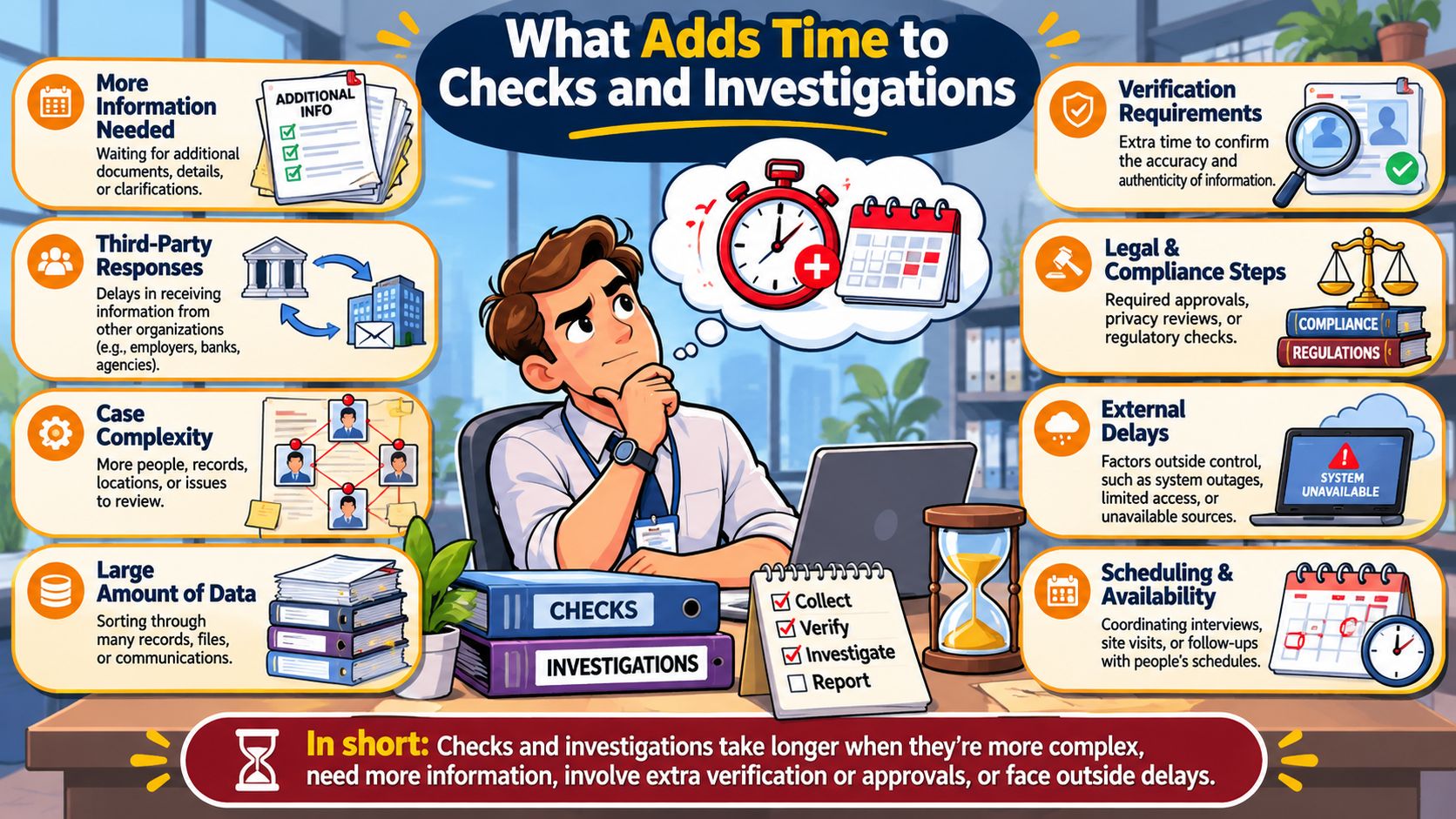
Applicant checks were the most frequently reported cause of delay among services reporting delays in the State of the Nations' Foster Care 2024 survey: 52% cited checks, including medical and DBS checks, 39% cited social-worker capacity and availability, and 17% cited applicant availability or illness.
These are reported causes, not measures of applicant fault. A household can respond promptly while an agency still waits for information held elsewhere.
Checks and investigations need different treatment
Routine checks establish information. An investigation may require clarification of allegations, historical concerns or information from several organisations, and shouldn't be treated as an ordinary missing-document request.
The government's Fostering in England underlying data displays 740 investigations completed within 21 working days, 235 taking 22–30 working days, 175 taking 31–50 working days and 415 taking more than 50 working days.
Those investigation figures aren't a forecast for a prospective foster carer's DBS check or assessment. They demonstrate why an agency dealing with a substantive concern may need additional time rather than promising a routine turnaround.
Preventing avoidable hold-ups
Applicants can help the agency maintain progress without rushing the assessment:
- Arrange appointments promptly: Follow the agency's instructions for medical information and DBS arrangements rather than obtaining an unsuitable check independently.
- Complete histories carefully: Resolve unexplained gaps in household, address and employment information.
- Prepare referees: Explain that the agency will contact them and check their current details.
- Protect availability: Flag work patterns, planned absences or illness that could affect visits and training.
- Establish panel arrangements early: Clarify the intended meeting and the requirements for getting the report ready.
The background checks guide provides further context for this preparation. Sensitive documents should be supplied through the method the agency specifies, not sent casually to several contacts.
Complex family circumstances, additional safeguarding enquiries and difficulty obtaining records may still extend the timetable. A constructive discussion establishes who owns each outstanding request, its expected return date and how non-responses are escalated.
A better progress question: Which unresolved item prevents the next decision, and what action is being taken?
For a prolonged investigation, applicants can request a documented review explaining what remains unresolved and how the agency will maintain appropriate scrutiny.
Planning Your Own Assessment Calendar
A useful assessment calendar records dependencies, not just appointments. A visit can take place while another activity remains outstanding, but a decision may still require both to be complete.
The household's calendar and the agency's timetable should therefore distinguish confirmed commitments from provisional milestones. Booking leave around an unconfirmed approval date can create pressure without making the assessment more predictable.
Recognising different patterns
When information arrives promptly, stages running alongside each other can support steady progress. The calendar should still leave room for reflection and clarification rather than filling every available slot with assessment tasks.
When a reference or medical report is slow, the agency should explain whether other work can continue. The household needs an updated plan showing whether the outstanding information affects the intended panel, rather than assuming the whole assessment has stopped.
When a safeguarding investigation becomes prolonged, the useful next step is a documented review. An applicant shouldn't infer a new approval date by adding the investigation's duration to an earlier estimate, because other assessment work may have continued meanwhile.
These are conditional patterns, not predictions. The same missing document can have different consequences depending on when it is needed.
Building a workable record
- Record the application date. Ask the agency to confirm which date it uses as the start of the formal assessment.
- Enter the indicative panel target. Label it as provisional and distinguish it from the final agency decision.
- Track checks and references. Note when each was requested, who is following it up and whether it has been received.
- Add stage decision dates. Include the information needed before each decision can be made.
- Update missed milestones. Record the revised action and its effect on the intended pathway.
A simple calendar and an outstanding-items list are enough. The household doesn't need access to confidential reference material to understand whether it has arrived.
Organic Fostering's training preparation checklist can support the practical preparation around those commitments. Where applicants already have children, Organic Fostering considers their views, ages, needs and the possible effect of fostering on family life, so household availability deserves deliberate planning too.
A national completion percentage isn't a midpoint or an individual deadline. A workable calendar uses the agency's actual arrangements and changes when the evidence or household circumstances change.
Timescales Compared by Provider Type
Completion times differ between provider categories, but a category-wide result can't predict an individual household's experience.
The government's 2026 fostering reform action plan, citing Ofsted data, reports 41% of local-authority fostering approvals completed within six months, compared with 61% for independent fostering agencies, with nearly 29% and 18% respectively taking eight months or more.
Assessment completion benchmarks by provider type
| Provider type | Completed within six months | Took eight months or more |
|---|---|---|
| Local authority | 41% | Nearly 29% |
| Independent fostering agency | 61% | 18% |
These are shares of approvals, not average assessment lengths. They don't establish that every independent agency works faster than every local authority, or that an applicant will follow the more common timetable.
Comparing pathways rather than promises
The action plan proposed an expectation that assessments should not exceed six months, while recognising the existing eight-month standard. A proposal shouldn't be presented as proof that every agency has adopted a new timetable or that an applicant has a guaranteed completion date.
For anyone comparing organisations, the useful questions concern how work is organised:
- Stage scheduling: How are the initial checks and fuller assessment planned?
- Concurrent working: Which activities can proceed together, and when would that be inappropriate?
- Escalation: Who follows up delayed checks and missing information?
- Panel planning: When is an intended meeting identified, and what must be complete beforehand?
Safeguarding checks, references, medical information, training availability and panel scheduling can affect an individual assessment regardless of provider category. A credible explanation names those dependencies instead of advertising speed alone.
For Organic Fostering, likely timescales are explained around the applicant's circumstances. That individual explanation is more useful for planning than assuming the independent-agency percentages describe Organic Fostering's own performance.
Confirm the Timeline with Your Agency Before You Apply
The most useful commitment is a clear written pathway, not an unconditional approval date. Before submitting an application, prospective carers should understand what the agency expects, what it will arrange and how it will explain a change of plan.
Organic Fostering gives prospective carers honest information before applying and carries out a thorough, respectful assessment. An early discussion should make the next steps understandable without suggesting that an initial conversation guarantees suitability or approval.
Questions that make the timetable clearer
- What is the indicative pathway? The answer should identify each stage, the information needed and what triggers the next step.
- Will the stages run separately or concurrently? The agency should explain how that decision relates to the household's circumstances.
- How are checks followed up? Applicants need to understand how delayed references or medical information are monitored and escalated.
- When are panel dates set? Clarify the intended interval between a finished report, panel consideration and the agency's decision.
- How does a transfer change the assessment? Existing carers need an explanation of how their approval, reports, training and experience will inform the receiving agency's process.
Transferring carers must be assessed and approved through Organic Fostering's own process. Existing experience can inform that assessment, but it doesn't replace it.
The information for carers considering a transfer and the transfer process guide explain the next steps. Organic Fostering can also discuss continuity for children already in a carer's care.
Turning the answers into a decision
Applicants can reduce avoidable delay by preparing documents early, keeping referees informed and responding promptly to requests. They shouldn't conceal uncertainty or difficult history in an attempt to maintain a target date.
Prospective and transferring carers can contact Organic Fostering on 0161 241 1332, email info@organicfostering.co.uk, or submit an assessment enquiry. A useful enquiry includes household availability, any known preparation needs and questions about the indicative schedule.
All timescales remain indicative and depend on individual circumstances. Written milestones make that uncertainty manageable rather than removing it.
Organic Fostering recruits, assesses and supports foster carers, explaining likely assessment timescales around each applicant's circumstances. Visit Organic Fostering to start a conversation about preparation, checks and the route to panel, or to discuss an assessment when transferring from another service.