

Is a placement long term because that's the plan, or because a child can keep living safely with the same carers as their needs change? Long term foster carers provide a settled home and sustained everyday care, while working with the professionals responsible for the child's wider plan. The commitment involves ordinary family routines, clear boundaries and a willingness to adapt over years, not just an intention to offer a permanent address.
Table of Contents
- What Long Term Foster Carers Do Each Day
- Who Decides What in Long-Term Care
- Long Term Fostering in England by the Numbers
- How Long-Term Matching Works
- What Support Keeps Long-Term Placements Steady
- How to Start Long-Term Fostering in England
What Long Term Foster Carers Do Each Day
What does a child need from a dependable adult on an ordinary school morning? Usually, practical care comes first: breakfast, clean clothes, help finding school equipment and reassurance about the day ahead. A long term foster carer keeps those essentials reliable while learning what helps that particular child feel comfortable and understood.
Long-term fostering aims for continuity rather than a fixed departure date. A placement may span primary school and adolescence, with planning for adult independence becoming increasingly important. Any arrangement continuing into adulthood needs its own discussion and planning rather than being assumed.
The carer acts as the household's engine room, keeping daily life running while social workers, school staff and health professionals contribute to the wider care plan. Readers unfamiliar with that distinction can explore what fostering means and how long-term placements are arranged.

Ordinary routines require thoughtful care
A routine isn't helpful just because the adult prefers it. Carers need to explain expectations, notice what causes distress and make sensible adjustments without removing every boundary. Predictability and flexibility can sit together.
The work becomes clearer through everyday responsibilities:
- After a school move: Keep familiar meals and bedtime arrangements steady, explain the new morning journey and agree how school staff will share concerns.
- When homework confidence is low: Break the task into manageable parts, recognise effort and tell the teacher when the child needs a different explanation rather than treating difficulty as refusal.
- During a difficult week: Respond calmly to conflict, maintain safe limits and avoid treating a child's anger as a personal verdict on the relationship.
Practical care also includes helping a child maintain friendships, choose activities and participate in household life. Belonging shouldn't require a child to hide their language, faith, family connections or preferences. Carers need curiosity about what matters to the child, including things the adult doesn't immediately understand.
Stability means more than staying at an address
The Department for Education's statistics for England recorded that 55% of children looked after had remained in the same placement throughout the previous two years in 2023, compared with 52% in 2019. These figures concern children looked after across placement settings, not only children formally recorded in long-term fostering.
That distinction matters. A long-term plan describes an intention, while safe continuity describes what happens in a child's life. Neither an address nor a placement label, on its own, shows whether a child feels heard and receives appropriate care.
Practical test: A settled home needs room for difficult feelings, not just an expectation of settled behaviour.
Patience doesn't mean accepting unsafe behaviour without action. It means responding proportionately, recognising limits and seeking help before exhaustion turns into resentment. A carer also needs to acknowledge mistakes and repair disagreements without making the child responsible for the adult's feelings.
For a prospective carer, the useful reflection is concrete: does the household have the time, space and steadiness to offer dependable care across many years?
Who Decides What in Long-Term Care
Who holds which decision
| Decision area | Who holds it | What the carer does |
|---|---|---|
| Daily routine, meals, bedtime and leisure | Carer | Makes everyday choices within the placement plan |
| Placement plan and significant changes | Local authority | Checks with the social worker before acting |
| Contact with birth family | Local authority | Follows the agreed contact arrangements |
| Placement reviews, school and health meetings | Shared | Attends and contributes information |
| Safeguarding concern | Social worker or out-of-hours advice | Reports immediately and does not investigate alone |
This is a practical overview, not a substitute for the child's written arrangements. Delegated authority means the decisions a carer has been authorised to make; its scope should be clear before a placement begins. Parental responsibility and court directions can also affect who must agree to a particular decision.
A carer normally manages everyday household choices within those arrangements. However, a decision that looks ordinary can have additional implications, such as an activity involving travel or a health decision requiring consent. Uncertainty should lead to clarification, not an assumption that long residence gives the carer unrestricted authority.
Recording, contributing and advocating
Carers provide information that other professionals may not see: changes in sleep, worries before family contact, difficulty attending school or a newly developing friendship. Records should distinguish observations from interpretations, describe what happened and explain what action followed. Secure handling matters because these are records about a child's private life.
Organic Fostering carers work with social workers, schools, health professionals and birth families where appropriate. The distinction between the child's social worker and the professional supporting the fostering household is explained in the guide to foster care social workers.
Advocacy means making the child's needs and views visible, not speaking over them. A carer might request a school discussion about repeated exclusions, raise an unmet health need or explain why an arrangement overlooks an important cultural practice.
Boundaries around change and safety
Carers shouldn't independently change agreed birth-family contact or make promises about where a child will live. The social worker needs to clarify the authorised plan and arrange any necessary decisions with the relevant people.
Safeguarding requires prompt reporting rather than informal investigation. A carer should listen without leading questions, record the child's words accurately and follow the service's safeguarding procedure; immediate danger requires emergency assistance.
Before placement, the household needs clear answers to these questions:
- Decision-making: Which permissions are delegated, and which require further agreement?
- Information-sharing: How are records submitted, and who receives urgent updates?
- Escalation: Who takes responsibility when the usual contact is unavailable?
Long Term Fostering in England by the Numbers
On 31 March 2025, 19,870 children were recorded in long-term fostering, down from 23,920 in 2021, according to the Department for Education's children looked after statistical methodology resource. That figure matters, but it works best as a system-level snapshot. It shows where children were placed at a point in time. It does not show which child needs a particular home, how stable that home has been, or whether a carer in a specific area is the right match.
The Department for Education's statistics for the year ending 31 March 2025 provide the looked-after children, foster-placement, instability and care-duration measures in the table below. Read the figures like a set of measuring cups: each one measures something different, and you cannot swap one for another without changing the recipe.
Children looked after and long-term fostering in England
| Measure | Figure | Comparison or note |
|---|---|---|
| Children looked after, year ending 31 March 2025 | 81,770 | All placement types |
| Children living in foster placements, year ending 31 March 2025 | 54,820 (67%) | Foster care was the main placement setting |
| Children in long-term fostering on 31 March 2025 | 19,870, down from 23,920 in 2021 | A narrower category than foster placements overall |
| Children starting long-term fostering in the year ending March 2025 | 1,000, down from 1,560 in 2021 | New starts in long-term fostering |
| Placement instability, all children | 10% | Three or more placements in the year |
| Placement instability, in care under 12 months | 14% | Higher than for children with longer care histories |
| Placement instability, in care at least 12 months | 9% | Lower than for children with shorter care histories |
| Average length of latest care period, children who ceased care | 893 days | Almost two years and six months |
What these measures tell you, and what they leave open
The overall looked-after total covers all placement settings. Foster placements are one part of that total, and long-term fostering is a narrower group again. Keep those layers separate when reading the table.
The fall in recorded long-term fostering has several possible explanations, including changes in placement classification, adoption, reunification, kinship care or the availability of approved carers. The figures alone do not show how much each factor contributed. The instability comparison also needs context: a lower recorded rate among children in care for at least 12 months does not prove that time in care caused greater stability. Placement suitability, individual circumstances and the support around the household all matter.
The 893-day average is more specific than it first appears. It applies to children who ceased to be looked after and to their latest period of care. It is not the average length of every foster placement, a forecast for a newly placed child, or a commitment period for carers.
National figures describe the system. They cannot decide whether a particular household can meet a particular child's needs.
Turning national information into useful questions
Use the numbers to ask better questions, not to predict a guaranteed route. A prospective carer should ask which children a service is currently seeking households for, what the responsibilities involve and how matching decisions are reached. A national total does not mean every applicant will receive a placement, or that every locality has the same recruitment needs.
Money questions deserve the same care. A guide to using a fostering allowance calculator can help readers understand estimates, but an estimate is not a placement offer or guaranteed income.
For readers in Greater Manchester, England-wide figures provide context rather than a local recruitment forecast. Organic Fostering publishes an area only after confirming that recruitment, assessment, supervision and continuing support can be provided there; its confirmed coverage information is the appropriate starting point for location questions.
How Long-Term Matching Works
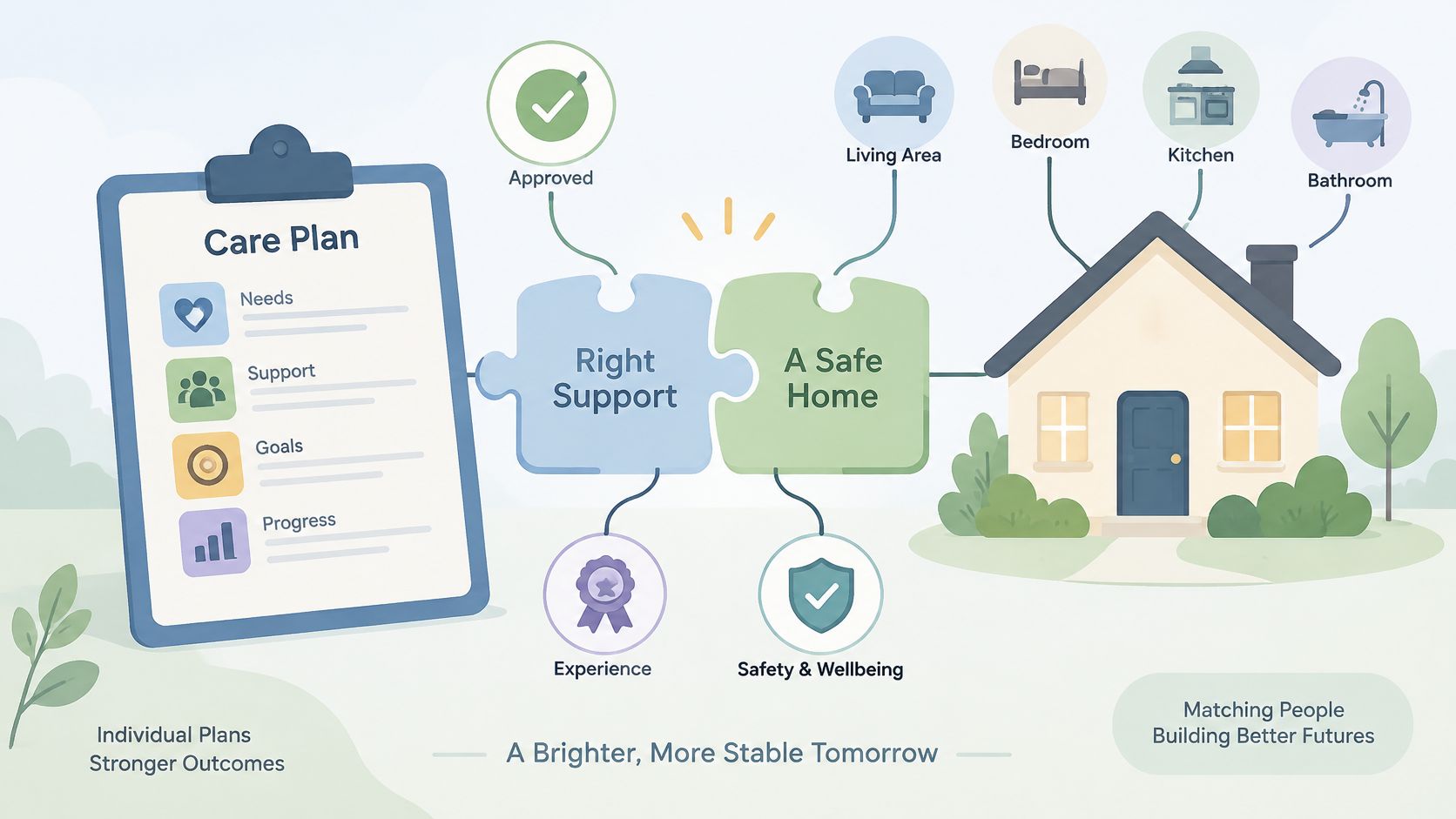
A proposed match can arrive as a handful of precise questions: could you collect an eight-year-old from a school across town every weekday, and could her Friday visits to her grandmother's mosque continue from your home? Matching exists to answer questions like these before a child moves in, by comparing a child's care plan and known needs with what a fostering household can safely provide. Organic Fostering weighs the carer's approval, household, experience and ability to provide safe care. A spare room alone does not establish suitability for a particular child.
The practical questions concern the whole household. School travel must be manageable, existing children's needs must be considered, and carers need a realistic understanding of health appointments, family contact and the child's developmental needs.
Testing the fit beyond the first weeks
Treat culture, faith, language and identity as practical questions, each needing a concrete answer. How will a child maintain meaningful relationships, reach familiar community life and receive help with experiences the carer does not share?
The guide to how placement matches work explains the matching process. Before accepting a proposed placement, carers need enough information to discuss both their strengths and the areas where additional help would be necessary.
Permanence planning asks a different question from immediate compatibility: can the arrangement keep meeting the child's needs as those needs develop? A household that manages the current school journey must also consider later education, growing independence and changing family relationships.
Planning for development rather than assuming permanence
A University of York longitudinal study followed 374 children and found that, seven or more years after entry to their index foster placements, 32% remained settled in the same long-term foster placement, while 28% of placements disrupted after three or more years. Those figures describe one study. They cannot predict what will happen to an individual child.
Long duration, therefore, should not be mistaken for a guarantee. As a child enters adolescence, adults may need to renegotiate privacy, friendships, household responsibilities and independence, because expectations that suited a younger child will not carry forward unchanged.
A useful matching discussion should establish:
- The intended plan: What is the expected direction of care, and what remains undecided?
- Relationships: How will sibling connections and agreed birth-family relationships be supported?
- Changing needs: What would trigger a review of education, health or emotional support?
- Household limits: Which needs can the carers meet, and what additional provision must be agreed?
Carers should receive clear explanations of how suitability will be reviewed and how concerns will be documented. When information is missing, name the gap and agree who will find the answer and by when. A promise that everything will become clear after the child arrives answers nothing.
What Support Keeps Long-Term Placements Steady
Experience does not remove a carer's need for support. A household can manage familiar routines confidently and still need specialist advice when a child's needs change, family contact becomes difficult or the adults become exhausted. Stability over years depends on help arriving before strain becomes normal.
The government-commissioned Foster Care Practice Guide described by Foundations found that carers valued support focused on their own needs, flexible and personalised networks, and peer groups, with evidence linking effective support to improved retention and placement stability. Help should be adapted to the household as needs change, including when carers appear experienced.
Agreeing help before a difficult period
A useful support plan names the people involved and the actions available. It should address the child's needs alongside the carer's sleep, health, employment commitments and relationships, including the experiences of other children in the household.
Organic Fostering carers have a supervising social worker, preparation and ongoing learning, advice outside normal hours for approved carers, contact with other carers, and help working through education and health needs. Regular supervision and the annual approval review give planned moments to test whether the support still matches the child's age, needs and the household's capacity.
Practical preparation should cover:
- Emerging strain: How concerns such as repeated conflict, school refusal or disrupted sleep will be raised and assessed.
- Coordinated action: Who will bring school, health and social-care professionals together when separate conversations are not resolving a problem.
- Household recovery: Whether planned breaks or additional practical help are appropriate, and how the child's continuity will be protected.
- After the urgent call: What follow-up is booked, who records agreed actions and how the support plan changes from the first year onwards.
Making support usable under pressure
An urgent route needs a clear next step after the call ends. Carers should know what will be recorded overnight, who will pick the concern up the next working day and what will be reviewed in supervision once the immediate pressure settles.
The explanation of out-of-hours fostering support can help frame that conversation. Actual arrangements should be confirmed with the service rather than inferred from a general description.
Asking for help early is responsible fostering practice.
A specific request is easier to act on than a general statement that things are difficult. Describing the concern, its effect on the household and the help already attempted gives professionals a clearer basis for deciding what should happen next.
How to Start Long-Term Fostering in England
Start with an informed conversation about your household. Organic Fostering talks prospective carers through its current requirements and gives honest information before anyone applies, so the first discussion can cover availability, accommodation, existing responsibilities and your interest in long-term care. The framework below applies in England; Scotland, Wales and Northern Ireland each operate their own fostering arrangements.
From enquiry to assessment
Check the basic requirements and expect checks early. You will normally need a suitable spare bedroom, time and flexibility, the right to work in the UK and willingness to complete assessment, checks and training. Renters can apply, though secure accommodation and any permission required under the tenancy are normally needed. Assessment itself can cover identity, date of birth, address history, references and criminal-record and barred-list information, and it gives you and the service a chance to examine capacity, support networks and where preparation is needed.
Understand the assessment timetable. Under the government's statutory assessment and approval guidance, Stage 1 and Stage 2 may run concurrently, the Stage 1 decision must be made within 10 working days of receiving all required information, and the assessment timetable should enable a panel recommendation within eight months of first applying to be assessed. Stage 2 is the full suitability assessment, so use the timetable to plan while treating each stage's outcome as open until the panel makes its recommendation.
Use the process to ask questions. The foster parent process guide sets out the stages in more detail. Applicants should feel able to raise uncertainties during assessment, including the ordinary pressures their household faces, since honest discussion produces a more useful assessment than a polished one.
Transfers and financial preparation
Experienced foster carers begin with a transfer conversation. Organic Fostering assesses and approves transferring carers through its own process, with existing reports, training and experience informing that assessment. An initial conversation can happen before any resignation, and where a child is already in placement, their welfare and stability come first: the current service, Organic Fostering and the child's local authority each follow the relevant transfer process.
A separate provision applies where a fostering agency ceases its fostering-agency functions. Regulation 34 of the Fostering Services Regulations requires assessment and an approval decision within 16 weeks unless that is not reasonably practicable, with an extension for the period necessary to complete the decision. Transfers between operating agencies follow the standard assessment route.
Financial preparation runs alongside this. Foster carers receive payments for active placements, intended to meet the costs of care and sometimes including a professional fee. For tax purposes, foster carers are generally treated as self-employed and normally register with HMRC and complete Self Assessment. Organic Fostering sets out its allowances and any fee under a published payment policy, which applicants can review and discuss before applying.
A prospective or transferring carer can send an enquiry describing their circumstances and asking which assessment route applies. That gives the service a basis for a realistic discussion about responsibilities, preparation and household capacity.
Organic Fostering recruits, assesses and supports foster carers, with matching that considers a child's care plan and the household's ability to provide safe care. Prospective long-term carers and experienced carers considering a transfer can visit Organic Fostering to begin a conversation about their circumstances, the assessment route and the support needed for a lasting placement.