

Yes, for tax purposes foster carers in the UK are generally treated as self-employed, so you normally register with HMRC and complete a Self Assessment return, although this doesn't mean every fostering payment is taxable profit.
Picture a wage. Money in, tax out, a payslip at the end of the month. Fostering doesn't work like that, and the mismatch is behind a lot of unnecessary worry, plus a fair amount of unfounded confidence. The question "are foster carers self employed" gets answered with a yes that sounds simple and then causes trouble, because three separate things sit underneath it and they don't behave the same way.
One is a tax classification. The second is the money an agency pays you. The third is a relief that decides how much of that money HMRC can tax at all. Keep the three apart and the position is easy to plan around. Blur them and you get households either bracing for a tax bill that never arrives or assuming every penny is tax-free.
Table of Contents
- Foster Carers Are Usually Self-Employed for Tax
- What Fostering Payments Cover and What They Are Not
- How Qualifying Care Relief Shapes Your Tax Bill
- How to Register and File Your Tax Return
- Circumstances That Change Your Tax Position
- Check Your Tax Position Before You Enquire
Foster Carers Are Usually Self-Employed for Tax
In the UK, foster carers are generally treated as self-employed for tax and National Insurance purposes when children are placed with them by a local authority or an independent fostering provider, as HMRC's National Minimum Wage manual sets out. In practice that means registering as self-employed and reporting your fostering income on a Self Assessment return.
That classification describes a filing duty, not a business. Fostering isn't a trade you market, price and sell. Approval, matching, training, supervision and placement decisions stay with the fostering framework and the placing authority or agency. You don't win customers and you don't set your own rates.
Practical rule: your tax status follows how you're paid and who pays you, not how much you care about the child in your spare room.
What the label changes and what it leaves alone
The comparison below is the one most prospective carers find useful, because it separates the payroll habits people bring from previous jobs from what happens here.
| Aspect | Self-employed foster carer | Employee |
|---|---|---|
| Tax registration | Register as self-employed with HMRC | Employer registers you for PAYE |
| Annual return | Self Assessment return with self-employment pages | Employer reports pay and tax through PAYE, so a return isn't needed for that job alone |
| Employer National Insurance on fostering income | Normally not paid by the agency | Paid by the employer |
| Employment rights | Depends on the individual arrangement | Statutory employment rights apply |
| Fostering payments taxed as wages | No; qualifying care relief applies to qualifying receipts | Yes, through PAYE |
Self-employed tax treatment also doesn't settle every employment question. HMRC's guidance is explicit that for National Minimum Wage purposes each arrangement must be assessed separately to decide whether the carer is a worker. The tax label doesn't wipe out every possible employment-status issue, so if your situation is unusual, ask rather than assume.
Before a first placement, do three things. Keep a record of every payment you receive, know which organisation pays it, and confirm your registration and reporting position with HMRC or a qualified adviser. If you're looking after a child already known to you, check how kinship care differs from foster care too, because the approval route and the tax treatment aren't automatically the same.
What Fostering Payments Cover and What They Are Not
Money arriving in a foster household isn't one payment with one purpose. It's usually a mix, and knowing which part is which tells you what you're expected to spend it on and what the tax system does with it.
The three parts of a fostering payment
- The allowance. Money intended to cover the everyday cost of caring for a child: food, clothing, school trips, travel to contact, the bigger shop, the extra laundry. It's a reimbursement for costs you're carrying, not a reward for carrying them.
- A professional fee or reward payment. Where the agency or authority includes one, it recognises your time, skill and availability rather than the child's expenses. Not every provider pays one, and the balance between allowance and fee is worth asking about directly.
- Placement-linked money. Foster carers receive payments for active placements. A gap between placements normally means a gap in income.
That last point is where budgeting goes wrong. An allowance is not a salary, not guaranteed income, and not automatically spare cash once the week is done. A rate that looks generous on a printed card is meant to be spent on a child. Whether you get paid to foster a child unpacks that distinction further.
Agency rates and national guidance aren't the same thing
An independent agency publishes its own approved allowance, and that figure may sit above or below the national minimum allowance guidance for the nation. Don't assume a number on one provider's page applies to another, and don't assume it's the figure HMRC uses in its calculations. Compare policies directly. Organic Fostering, for example, publishes its weekly rates by age band under a written policy and gives carers a transparent explanation of allowances alongside ways to raise concerns, with the detail on its fostering allowance page.
Allowance rules and national minimum rates are set separately in England, Scotland, Wales and Northern Ireland, so check the guidance for your nation. The HMRC tax rules in this guide apply across the UK. The allowance and support framework does not.
Questions worth putting in writing
Which costs does the allowance cover, and which are extra? Is a fee included, and is it paid per child or per household? How often are payments made, and what happens to the fee between placements? What's covered for a child's birthday, school uniform or travel to contact?
None of that is idle curiosity. HMRC applies qualifying care relief to your fostering receipts, so the payment policy is also the source of the figures you'll eventually report.
How Qualifying Care Relief Shapes Your Tax Bill
Qualifying care relief is the rule that stops fostering receipts being taxed like ordinary business profit. HMRC's helpsheet on qualifying care relief explains that where the relief applies, it treats the carer as making no profit and no loss for the year when qualifying receipts don't exceed the relevant qualifying amount. You still claim the relief on the self-employment section of the return.
The qualifying amount has two parts: a household amount for the year, plus a weekly amount for each child in placement, with the weekly figure set by age band.
For the 2025 version of the relief, HMRC's foster carer helpsheet sets the household amount at £19,360 for a full tax year, plus £405 a week for each child under 11 and £485 a week for each child aged 11 or over. Those are the 2025 figures, and they're the ones older articles keep recycling. Relief amounts are reset for each tax year, so check the current GOV.UK guidance for the year you're filing instead of copying a number from a guide written before it. The agency keeps its tax and allowance page updated with the current position and links to the official sources.
Relief amounts are built for full tax years. If you start or stop fostering part-way through, check GOV.UK for how a part year is treated before you plan around it.
Two methods once receipts go over the amount
Where qualifying receipts stay within the relief amount, there's no income tax and no Class 4 National Insurance on that caring income, though the return still records the relief. Class 4 National Insurance is the contribution self-employed people pay on their taxable profits, separate from the National Insurance deducted from an employee's pay.
Cross the amount and HMRC gives you a choice of two routes.
| Situation | Tax treatment | What you still need to do |
|---|---|---|
| Qualifying receipts within the relief amount | Treated as no profit or loss; no income tax or Class 4 National Insurance on caring income | Complete the self-employment pages and claim the relief |
| Receipts above the relief amount, simplified method | Tax applies to the excess over the qualifying amount | Track receipts by tax year |
| Receipts above the relief amount, profit method | Tax applies to profit after allowable expenses and capital allowances | Keep receipts and expense records |
| Other self-employed or employment income | Taxed under the normal rules | Report it separately from fostering receipts |
The simplified method taxes the excess over the qualifying amount. The profit method deducts allowable expenses and capital allowances from your total receipts and taxes what's left. If your receipts are likely to land close to the threshold, compare both before the tax year starts and keep dated records throughout, because you can't reconstruct a year of spending from memory in January. Running the fostering allowance calculator gives a rough annual figure to hold against the qualifying amount before you commit to a method.
How to Register and File Your Tax Return
Registration isn't difficult, and the sequence matters more than the software. Most of the work happens in a browser and a spreadsheet.
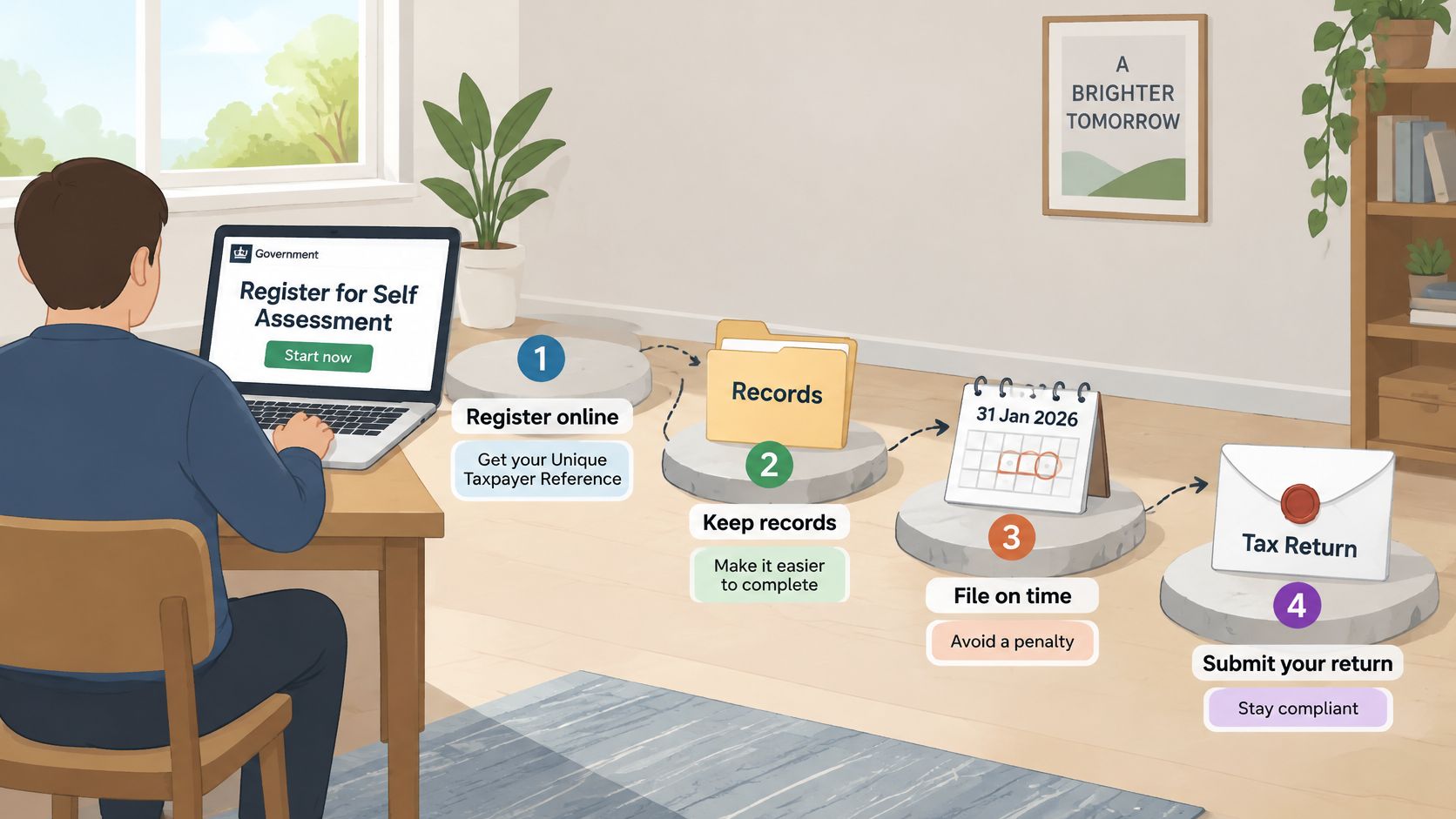
- Register as self-employed when you start fostering. Use HMRC's GOV.UK registration service as soon as you begin receiving fostering income. Do it in the tax year you're first paid, because the registration deadline is tied to that year, and confirm the current date on GOV.UK rather than working from a guide written years earlier.
- Keep your Unique Taxpayer Reference safe. HMRC issues a UTR when you register. Every return, letter and phone call needs it, and chasing a replacement costs weeks you don't want to lose near a deadline.
- Record every payment by date and type. Keep allowances, fees and reward payments apart from each other and from other income, so your totals reconcile with the agency's payment statements. If they don't match, one of you has missed something, and it's easier to find in April than in December.
- Keep receipts for costs you might claim. Expenses only change your bill under the profit method, so file them by date even in years when the simplified method makes them irrelevant. Two years of tidy records is what makes a switch between methods possible.
- Complete the self-employment pages and claim the relief each year. This happens even when no tax is due. The return is how the relief gets recorded, and a year filed without it looks like undeclared profit.
- File online by the deadline. The online return is normally due by 31 January after the tax year ends, with any tax owed payable on the same date. Check the date on GOV.UK for your year, particularly if you're filing for the first time.
- Ask before you guess. If a figure or category is unclear, contact HMRC or a qualified adviser before submitting. Amending a return is slower than asking a question.
A finished tax year has three marks: records that reconcile with the agency's statements, relief claimed where it applies, and a return filed before the deadline.
Miss one of those and nothing collapses, but the next year starts with catching up instead of planning.
Circumstances That Change Your Tax Position
Most fostering receipts are handled by the relief described above, and nothing else about them shifts. What changes your tax position is the income sitting alongside them, because everything outside the qualifying care calculation follows its ordinary rules and gets reported in its own place on the return.
| Situation | What to check | Where to get guidance |
|---|---|---|
| Other self-employed work | Reported separately and taxed under normal rules | HMRC guidance or a qualified adviser |
| Employment or pension income | Follows its own normal rules and is reported alongside fostering entries | HMRC guidance, your employer or your pension provider |
| Property or investment income | Follows its own rules, separate from fostering receipts | HMRC guidance or a qualified adviser |
| Working alongside fostering | Depends on the child's needs and your availability | Your supervising social worker and agency |
Fostering is often a full-time role in practice rather than a sideline. In England, around 60% of foster carers did not work alongside fostering in 2024, while fewer than 20% were in full-time employment, according to evidence The Fostering Network submitted to a UK Parliament committee.
If you do run another business, keep its figures apart from your fostering receipts rather than bundling everything into one self-employment entry. Employment and pension income arrives already taxed through PAYE, so it's reported alongside your fostering entries, not inside them. Property and investment income has its own rules.
Whether a carer can hold down paid work at the same time is a different conversation from the tax one. It depends on the child's needs and your availability, which is a question for your supervising social worker rather than HMRC. The practical side of combining the two is covered in working while fostering.
Where several income types overlap, general guidance runs out. A qualified adviser should look at your figures before the tax year starts, while there's still time to arrange things sensibly. And none of these tax categories decides who can foster: single people can foster, and renting isn't a bar provided you have secure accommodation, a suitable spare bedroom and any permission your tenancy requires. Tax status and eligibility are separate tests.
Check Your Tax Position Before You Enquire
Five things worth finishing before you fill in anything.
- Read the current GOV.UK pages for your tax year. Work through the foster carer tax guidance and the qualifying care relief helpsheet for the year you expect to start in, and note anything that's moved since older guides were published. Figures are reset annually, and planning on last year's number is planning on the wrong number.
- Compare expected receipts with the qualifying amount. Estimate what a full year of payments would look like and see whether it clears the relief. If it does, decide whether the simplified or profit method suits you, because that choice determines which records you keep.
- Run an estimate through an allowance calculator. Treat the output as a picture of a payment structure, not as income you can bank. It's a planning tool with a specific job.
- Put allowance questions in writing. Ask what the policy covers, whether a fee is included and how payment works between placements. Written answers are easier to check later than a remembered phone call.
- Take tax advice on your own numbers. HMRC or a qualified adviser can weigh up your household's mix of income, which no general guide can do.
Contacting an agency commits you to nothing. Organic Fostering will talk prospective carers through its current requirements when they get in touch, and submitting an enquiry doesn't create a foster carer agreement, guarantee an assessment or mean you've been approved. Carers weighing up the move can read about the support that runs alongside approval, and anyone still deciding whether fostering fits their life might start with why people become foster carers.
Organic Fostering recruits, prepares and supports foster carers across Manchester and the North West, and it publishes its allowance rates by age band under a written policy rather than leaving households to guess at the numbers. If the tax position now feels clearer but the practical next step doesn't, visit Organic Fostering to see what the agency asks of carers, how children are matched with families and what support runs from the first conversation through to approval.