

Can a relative raising a child be a foster carer, while another relative doing much the same daily parenting isn't? Yes, and that difference can affect financial support, legal authority and who helps when family life becomes difficult.
The useful starting point for kinship care vs foster care isn't which sounds better. It's the child's legal position and the arrangement being proposed. For families in Manchester and across the North West, understanding that route can prevent an urgent offer of help from becoming a commitment whose consequences nobody has properly explained.
Table of Contents
- Kinship Care and Foster Care Compared by Legal Route
- How Approval and Assessment Differ
- Allowances, Payments and Tax Treatment
- Support, Safeguarding and Carer Pressures
- Identity, Culture and Contact with Birth Family
- Frequently Asked Questions About Kinship and Foster Care
- Choosing Between Kinship and Foster Care in the North West
Kinship Care and Foster Care Compared by Legal Route
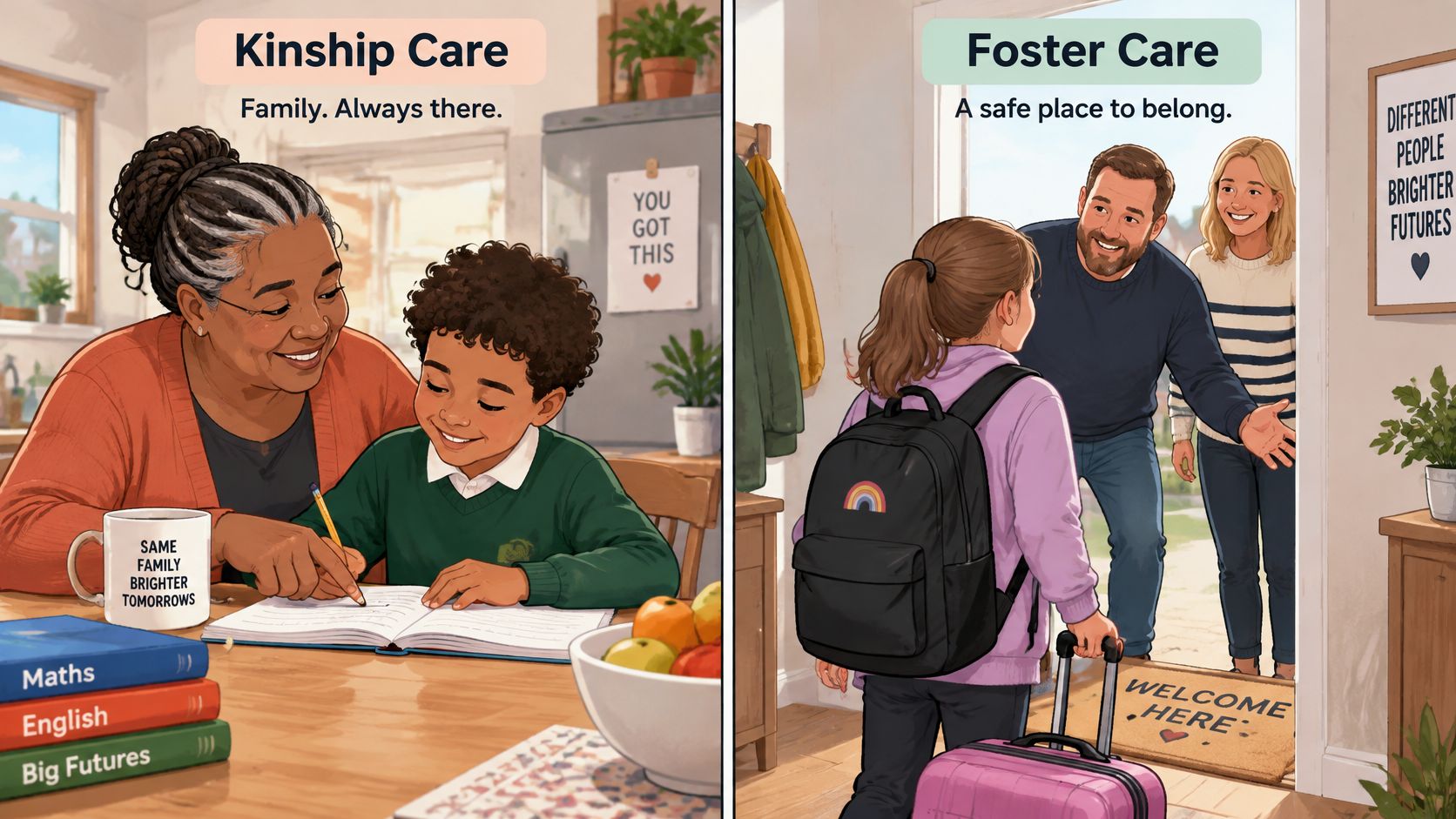
Kinship care means a relative or someone already connected to a child, such as a family friend, raising them. Foster care means an approved carer looking after a child within formal arrangements overseen by a local authority, sometimes through an independent fostering agency.
These categories overlap. Kinship fostering sits inside the care system, while other family arrangements sit outside it.
Kinship and foster care routes compared
| Route | Child looked after? | Who approves or decides | Parental responsibility | Typical support |
|---|---|---|---|---|
| Informal family arrangement | Usually no | Family, without formal fostering approval | Not automatically acquired by the relative or friend | No automatic fostering package; services may be requested |
| Kinship foster care | Yes | Local authority, for a named child | Remains with parents; the local authority also holds it under a care order. The foster carer doesn't acquire it through approval | Fostering allowance, training and supervising social worker |
| Mainstream foster care | Yes | Local authority or independent fostering agency | Remains with parents; the local authority also holds it under a care order. The foster carer doesn't acquire it through approval | Allowance, training, supervising social worker and out-of-hours advice |
| Special guardianship order | No | Court | Held by the special guardian, alongside parents, with stronger decision-making authority | Support assessment, potentially including payments and services |
| Child arrangements order | No | Court | Acquired by a carer named as someone the child lives with | Support considered under local authority policy and the family's circumstances |
Mainstream fostering isn't itself a kinship arrangement. It belongs in the comparison because it provides the alternative when a child needs an approved household without an existing family or friendship connection.
What the legal terms mean
Parental responsibility is the legal responsibility and authority associated with raising a child, including major decisions about education and medical treatment. A foster carer may have delegated authority for everyday decisions without holding parental responsibility.
Looked-after status means the local authority has duties towards the child under the relevant care arrangement. It doesn't automatically mean the authority holds parental responsibility, because that turns on the child's legal status.
The populations aren't interchangeable: Family Rights Group's Census analysis estimated approximately 164,000 children in wider kinship care across England and Wales in 2021, whereas Department for Education fostering statistics recorded 13,660 children in formal relative-or-friend foster placements in England in 2024, within 56,390 foster placements among 83,630 looked-after children.
Formal kinship carers are approved for particular children and sit within the local-authority sector, rather than independent fostering agencies, as the Department for Education's fostering methodology explains.
Routes can change. A kinship foster placement might lead towards special guardianship, but the support consequences need consideration before any order. Equally, long-term foster care describes a permanence plan, not whether the carer is related.
Before agreeing, families should ask:
- Legal status: Is the child looked after?
- Decision-making: Who holds parental responsibility now, and after any proposed order?
- Contingency planning: What happens if the arrangement becomes unsafe or cannot continue?
How Approval and Assessment Differ
Assessment isn't a judgement about whether someone loves a child enough. It examines whether the household can meet the child's needs safely, what pressures may arise and what support will make the arrangement workable.
The following sequences describe typical pathways in England. Urgent circumstances can change their order, so neither should be treated as a guaranteed timetable.
The kinship foster care pathway
- Referral or family identification. Children's services considers a relative or friend when a child needs a placement. The existing relationship helps explain why that household is being considered.
- Initial checks. Background checks, including DBS checks, health information and references, help identify risks and areas requiring closer assessment.
- Temporary approval where appropriate. An urgent placement may be considered through temporary approval. The authority should explain its legal basis, conditions and deadline rather than treating a family agreement as sufficient.
- Full assessment. A social worker explores the child's needs, the relationship, household circumstances and the carer's capacity to manage family boundaries.
- Panel consideration. The fostering panel considers the assessment and makes a recommendation.
- Local authority decision. The authority decides whether to approve the household for the named child or children.
Being a relative doesn't make approval automatic. A familiar household can still need substantial changes, additional help or a different plan.
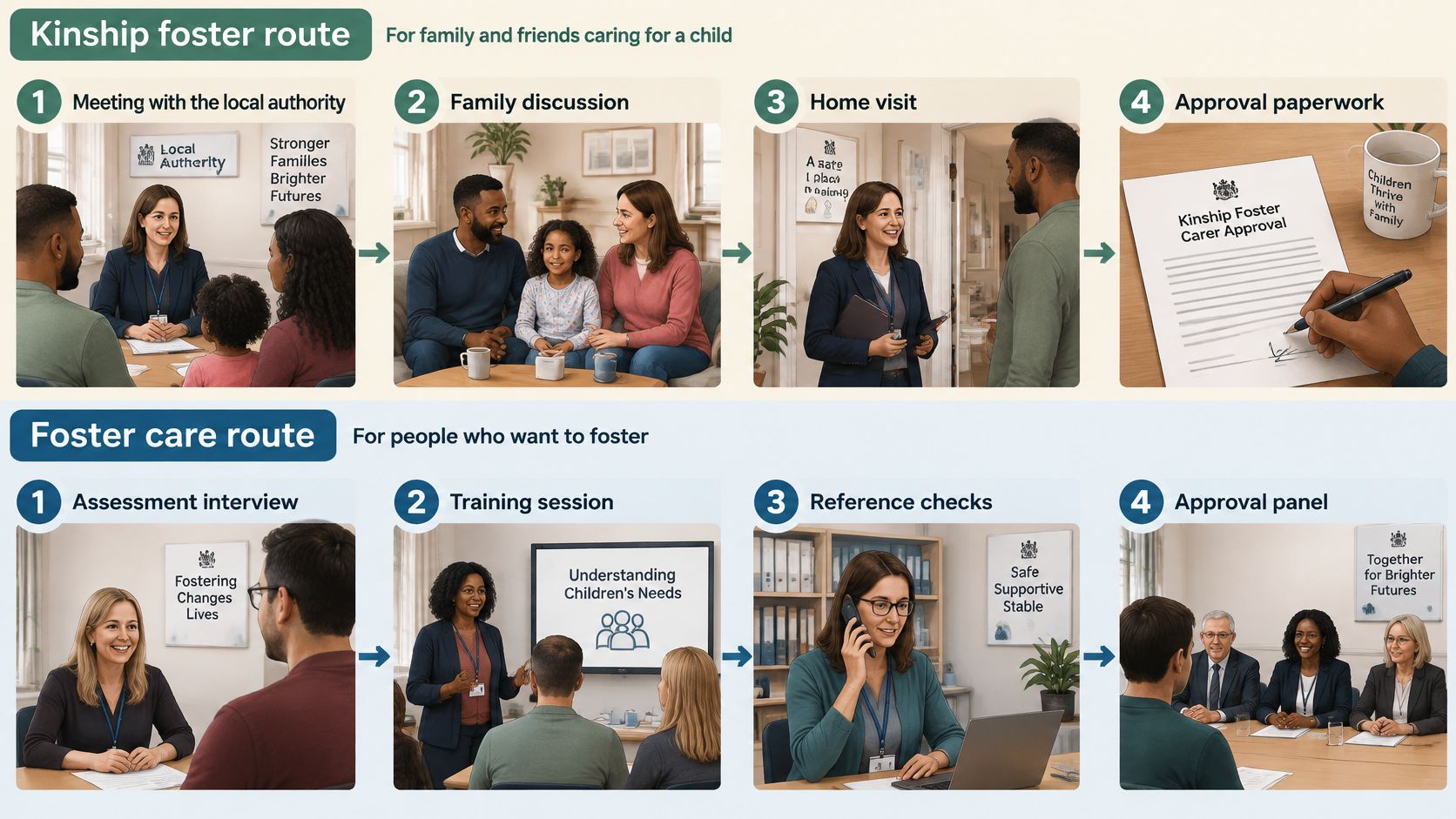
The mainstream fostering pathway
- Enquiry and informal conversation. The household explores what fostering involves before deciding whether to proceed.
- Home visit. The assessor discusses the home, sleeping space, routines and everyone affected by fostering.
- Application, checks and references. These establish the information needed for a thorough assessment.
- Preparation training. Applicants begin learning about children's experiences, safer caring and working with professionals.
- Assessment and panel. Reports explore strengths, pressures and support needs before a panel recommendation.
- Approval and matching. Following the decision, suitable referrals can be considered against the household's approval and abilities.
Both routes examine finances, health, relationships and the household's support network. Mainstream applicants should expect discussion of a suitable spare bedroom, immigration or right-to-work circumstances, and availability for training, appointments and reviews.
Practical rule: An assessment should identify the help a household needs, not simply record whether it can cope today.
Families comparing how long becoming a foster carer can take should request current indicative timescales for each stage. Missing information, household circumstances and the child's situation can all affect progress.
Allowances, Payments and Tax Treatment
Who pays the carer and how payments are set
| Route | Who pays the carer | How payments are set | General tax position |
|---|---|---|---|
| Informal family arrangement | Usually no fostering payment; family contributions or agreed support may be available | Private agreement or separately assessed assistance | Check the treatment of each payment and any benefits separately |
| Kinship foster care | Approving local authority | Authority's fostering allowance arrangements | Fostering tax rules may apply to approved arrangements; confirm eligibility |
| Mainstream foster care | Approving local authority or agency | Allowance by age band, plus any fee under the provider's policy | Qualifying care relief may apply; individual circumstances need checking |
| Special guardianship order | Local authority where financial support is agreed | Assessed support, potentially means-tested | Confirm the treatment of special guardianship payments separately from fostering income |
| Child arrangements order | Local authority where its policy provides support | Local policy and assessment | Check the particular payment; a court order alone doesn't establish fostering tax treatment |
An allowance, a fee and a support payment aren't necessarily the same thing. An allowance contributes towards caring for the child. A separate fee may recognise the fostering role under the provider's policy, while other support can address particular assessed needs.
Families comparing payments for fostering a child should request the current written policy, not rely on a headline weekly figure. The useful comparison is what remains available after the child's costs and the household's changed circumstances are understood.
Why changing route can change the budget
According to Kinship's analysis, in 2024, special guardians received an average of £40 less per child per week than kinship foster carers, while carers with a child arrangements order received around £54 less.
Those are averages, not fixed entitlements or a prediction for a particular family. A proposed change of legal route needs a fresh budget covering housing, employment, school travel and any specialist support.
Tax also needs separate attention. Families should check current GOV.UK and HMRC guidance on qualifying care relief, including whether their approval and arrangement qualify, and seek individual advice where necessary.
Before accepting a financial offer, the household should request:
- Written terms: The allowance, any fee and any additional support.
- Review arrangements: What changes trigger reassessment and when routine reviews happen.
- Means-testing details: Which payments take household income or capital into account.
- Additional costs: Whether family-contact travel, equipment and legal advice are covered.
- Changes of status: What stops, continues or requires a new application after a court order.
A verbal reassurance that support will continue isn't a substitute for a clear written plan.
Support, Safeguarding and Carer Pressures
Knowing a child well doesn't remove the effects of loss, uncertainty or trauma. A relative may become a carer suddenly while also managing difficult relationships with the child's parents.
In Kinship's 2025 survey of more than 1,900 carers, one in five said a family member had slept in unsuitable conditions during the previous year, loneliness had risen to 18%, and 66% said the children regularly displayed behaviour they found challenging to manage; the report also describes an estimated more than 141,000 children in kinship care across England and Wales.
That estimate concerns a wider population than looked-after children. It illustrates how much responsibility families carry outside formal fostering, sometimes without having planned to become carers.
Support must be practical and accessible
Approved foster carers should have a supervising social worker, training and clear advice arrangements. Specialist therapy, respite and other services still need explicit discussion rather than assumptions about automatic availability.
Relatives outside fostering may need a separate assessment or referral. A useful support plan identifies the professional responsible, how help is accessed and what happens while a service is unavailable.
Relevant support can include:
- Social-work guidance: A named contact who understands both the child and household.
- Training and safer caring: Practical help with behaviour, boundaries, online safety and responding to disclosures.
- Therapeutic services: Assessment of emotional needs, including child and adolescent mental health services where appropriate.
- Education advocacy: School liaison and, for looked-after children, relevant Virtual School involvement.
- Breaks and connection: Planned respite where agreed, peer support and dependable out-of-hours advice.
The distinction between the child's social worker and the carer's supervising worker matters. Understanding foster care social workers' roles helps families direct concerns to the right person.
Questions before a placement begins
Both formal kinship and mainstream fostering require attention to background checks, household safety and safer caring. Informal arrangements shouldn't be mistaken for arrangements that have undergone the same approval process.
A family relationship is a reason to explore a placement carefully, not a reason to leave a household unsupported.
Before accepting, carers should establish:
- Responsibility: Who supplies each agreed service?
- Urgency: Who responds if a situation becomes unsafe outside office hours?
- Availability: What help exists while referrals are pending?
- Review: How will the child's and household's changing needs be assessed?
Identity, Culture and Contact with Birth Family
A child moving to an aunt's home may recognise the food, family jokes and route to school. Yet the child may still worry about whether loving that aunt means being disloyal to a parent.
An unrelated foster household faces a different starting point. The carers may need to learn how the child practises their faith, pronounces family names or prefers their hair cared for, without expecting the child to explain everything.
Belonging needs deliberate attention
The Government's national kinship care strategy identifies benefits associated with kinship care, including stronger identity and a greater likelihood of remaining with siblings. Those findings support careful exploration of family connections, not an assumption that every relative can meet every child's needs.
Identity includes language, heritage, faith, relationships and the child's own preferences. A matching household background can help, but adults still need to listen rather than assume that shared ethnicity or religion means identical experiences.
In either household, a practical plan might protect access to community activities, familiar celebrations and meaningful relationships. Decisions about how placement matches work should consider these everyday details alongside safety and caregiving capacity.
Contact without divided loyalties
Contact arrangements should follow the child's legal and care plan, including any court directions and supervision requirements. Carers shouldn't make independent promises about visits or change arrangements without the appropriate agreement.
For a relative, the challenge may be telling another family member that an unplanned visit cannot happen. For an unrelated carer, it may involve helping a child prepare for contact while keeping personal opinions about the parents out of the conversation.
Sibling relationships also deserve attention, whether children live together or separately. The child's wishes should inform planning without making them responsible for adult decisions.
Useful questions include:
- Continuity: How will the child's heritage, language and faith remain part of daily life?
- Responsibility: Who will help the carer make that possible?
- The child's voice: What does the child want adults to understand?
Privacy and dignity apply throughout. A child's family history isn't material for casual conversation or social media.
Frequently Asked Questions About Kinship and Foster Care
Can a grandparent or other relative become a foster carer?
Yes. A relative or family friend can be assessed as a kinship foster carer for a particular child, with the local authority deciding whether approval is appropriate.
Is special guardianship the same as fostering?
No. Special guardianship gives the carer parental responsibility through a court order and sits outside the looked-after system, while kinship fostering remains a formal foster placement.
Do relatives need a spare bedroom?
Sleeping arrangements need assessment for the child and everyone else living in the home. Families should explain the actual space available and ask the authority what is acceptable for that child, rather than assume either an automatic exemption or an automatic refusal.
Is approval needed before a child moves in?
A formal foster placement requires the appropriate approval, which may be temporary in an urgent kinship situation. A private family arrangement has a different legal basis, so families should establish exactly what is being proposed before the move.
Should families get legal advice before agreeing?
Yes, particularly before accepting a court order or a change that could alter support and decision-making. An independent family solicitor or an advice organisation such as Citizens Advice can help identify the consequences and any further specialist advice needed.
These answers are general guidance for England. Eligibility isn't automatic, and the child's circumstances and proposed legal arrangement need individual consideration.
Choosing Between Kinship and Foster Care in the North West
Which route to explore first
| Situation | Route to explore first | Key question to ask |
|---|---|---|
| Relative wants to care for a child already in local authority care | Kinship foster care assessment | Will the local authority approve this household for this child? |
| Child cannot return home and needs legal certainty | Consider special guardianship alongside other permanence options | Does the support plan meet the child's and carer's needs? |
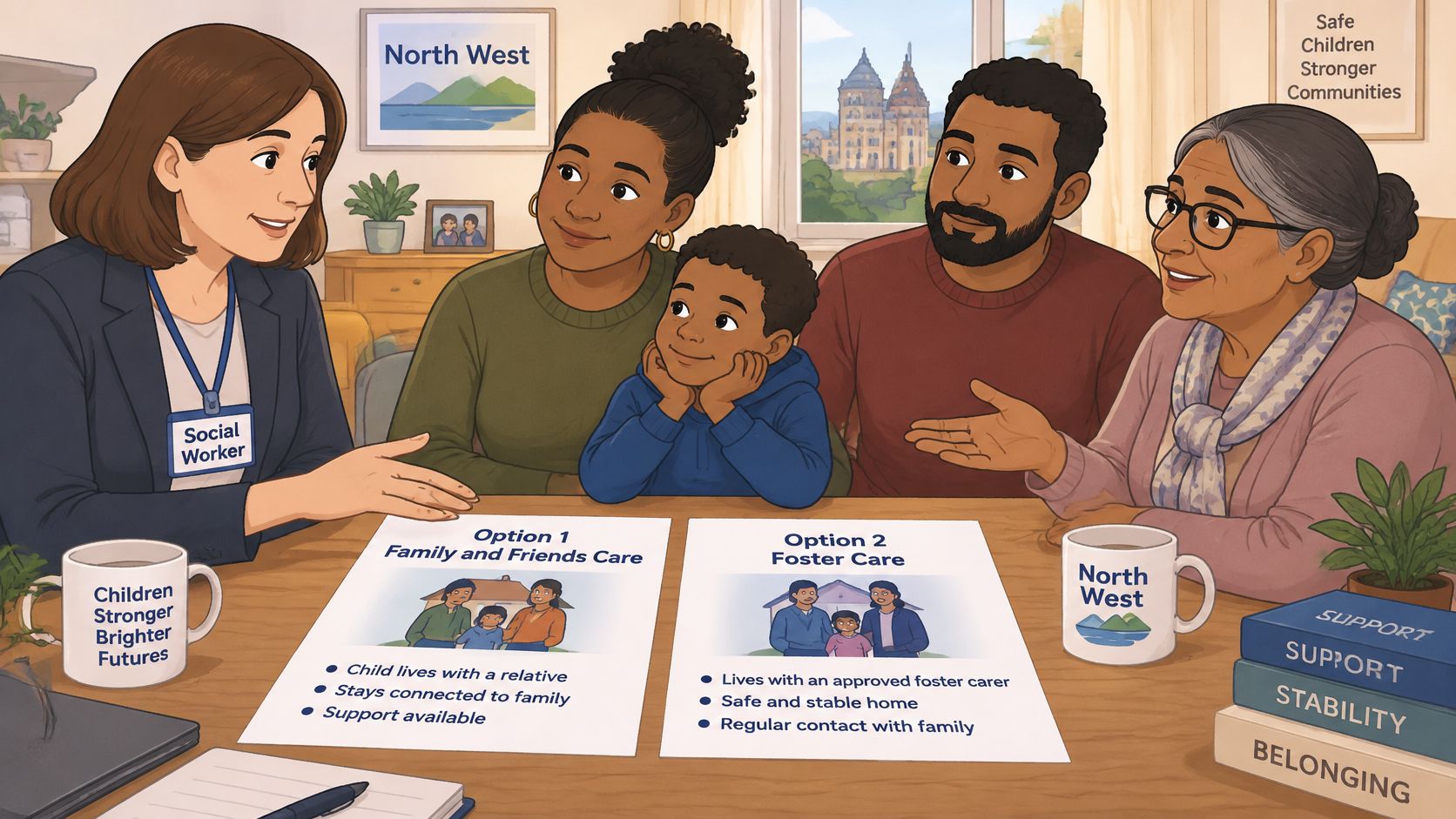
| Family wants to help without the child entering care | Private arrangement or child arrangements order, with legal advice | What support can children's services offer, and what independent advice is available? |
| Household wants to foster unrelated children | Mainstream foster care | Is the household ready for assessment, training and regular reviews? |
| Experienced foster carer considering a move | Compare agency support and allowance arrangements | How will continuity of care for current children be protected during transfer? |
The first option to explore isn't necessarily the final answer. Special guardianship, for example, shouldn't be selected just because a child needs permanence; the child's relationships, legal needs and sustainable support package must also fit.
For families in Manchester, Greater Manchester and the wider North West, early contact with the relevant children's services team can clarify responsibility. Local authorities have their own kinship and fostering arrangements, and a general guide cannot establish which local services or payments a household will receive.
Make the decision around the child and household
A useful first conversation starts with the actual situation rather than a preferred label. The household should explain whether there is already a particular child involved, whether children's services is involved and whether any court proceedings are underway.
For prospective mainstream carers, the discussion is different. It should explore the children the household could realistically support, working patterns, training needs and how matching decisions account for culture, faith, language and existing relationships.
Experienced carers considering transfer should ask how professionals will coordinate the process around children already placed. Comparing a fee alone won't establish whether the new arrangement offers the supervision and practical help the household needs.
Before committing, families should:
- Gather documents: Obtain the proposed legal arrangement, assessment information and support plan.
- Check understanding: Ask for unfamiliar terms and responsibilities to be explained plainly.
- Seek independent advice: Review legal and financial consequences before accepting an order or placement.
- Test the plan: Consider how the household would manage school difficulties, illness or changing family-contact needs.
The right route is the one that safely meets the child's needs with responsibilities and support the household understands. Family connection and professional fostering both matter, but neither should rely on carers managing alone.
Organic Fostering supports people exploring children's fostering across Manchester and the North West, including experienced carers considering an agency transfer. For an informal, no-obligation conversation about mainstream fostering, assessment, current allowances and support, visit Organic Fostering and explain whether the enquiry concerns becoming a carer or transferring agencies.