

Single parents can absolutely become foster carers in England, and in 2019–20 single-carer households made up 31% of all fostering households. The assessment focuses on a parent's capacity to provide safe, stable care, not on relationship status.
A spare bedroom can make the idea feel possible, while the school run, work rota, appointments and evening routines raise harder questions. A single adult may wonder who'll help during an emergency, whether employment must stop, or how their own child will respond to a new arrival.
Those questions deserve practical answers. Single parent foster care can work, but it needs honest planning around time, support, household boundaries, placement matching and money. The following guidance explains what the assessment considers and how a one-adult household can decide whether fostering is sustainable.
Table of Contents
- Can a Single Parent Become a Foster Carer
- What the Numbers Tell Us About Single-Carer Fostering
- Matching Placement Types to a Single-Parent Household
- Understanding Fostering Allowances and Tax Relief
- Supporting Your Own Child During a Placement
- Your Pathway from First Enquiry to Approval
- Taking the Next Step Toward Single-Parent Foster Care
Can a Single Parent Become a Foster Carer
A parent living alone may look at the spare room and think, “Could this really fit into an already full household?” The answer in England is yes. Being single isn't a bar to applying, and a parent doesn't need to be part of a couple to be considered.
The assessment asks a more useful question: can the household provide consistent, safe and nurturing care for a child who may have experienced loss, uncertainty or trauma? A social worker will consider the home, health, relationships, employment, household members, pets, previous applications and experience caring for children. For a single parent, the assessment also looks closely at the practical support available around the household.
What the assessment needs to establish
A social worker may explore:
- Time and flexibility: Can the parent attend meetings, medical appointments, school events and contact arrangements?
- Reliable support: Who can help if the parent is ill, delayed at work or needs a planned break?
- Home arrangements: Is there suitable space, privacy and safe storage for everyone's belongings?
- Emotional capacity: Can the parent manage competing needs without expecting their own child to become a young carer?
- Household stability: Are routines, finances and relationships sufficiently settled for fostering?
A parent doesn't need to present a perfect life. The important point is showing awareness of pressure points and a realistic plan for handling them. A named relative, friend or approved support person may be part of that plan, but informal goodwill alone isn't enough if nobody can reliably help at short notice.
The fostering assessment process gives applicants space to discuss these issues before approval. A thoughtful assessment protects both children, because it helps identify placements that fit the household rather than treating every spare bedroom as automatically suitable.
What the Numbers Tell Us About Single-Carer Fostering
Single-carer households aren't an unusual experiment within England's fostering system. Ofsted estimated that, at 31 March 2020, England had around 44,500 fostering households and approximately 75,300 approved foster carers caring for about 56,500 children. Single-carer households represented 31% of all fostering households, a proportion unchanged from the previous year, according to Ofsted's fostering statistics for 2019–20.
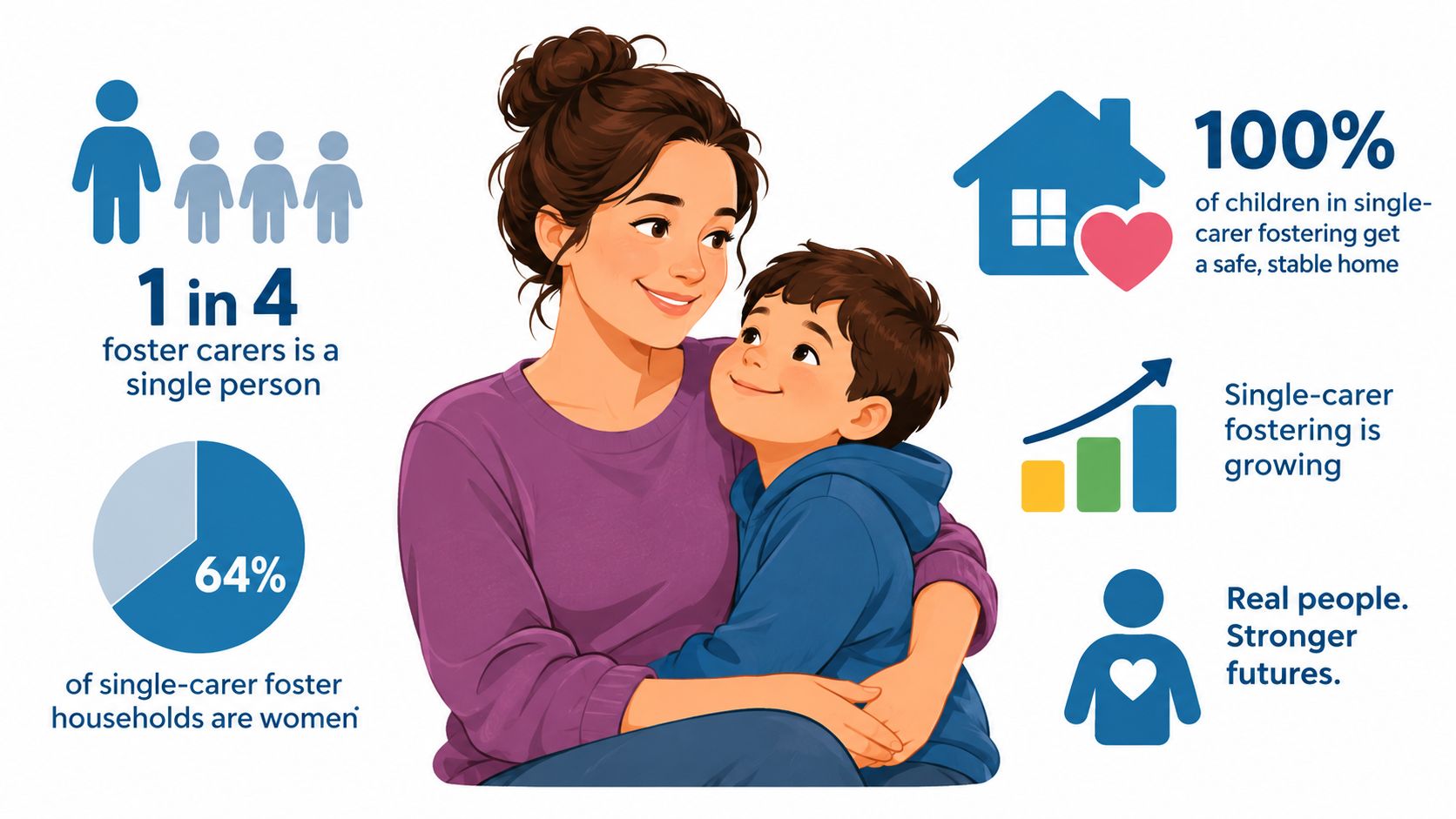
Looking at individual carers rather than households, around 13,100 approved foster carers, or 18% of the carer population, were single carers. Those carers looked after approximately 14,500 children, equivalent to about 25% of all children in foster care included in the statistics. The distinction matters: a single-carer household means one approved carer in the household, not necessarily a statement about someone's relationship history.
Why the wider picture matters
England's fostering capacity has since become more constrained. Ofsted recorded about 64,295 approved mainstream foster carers in 2019, compared with 56,345 in March 2025, a reduction of roughly 12%; the figures appear in the 2024–25 national fostering release. The same release reported that approved mainstream carers fell by 1% from the previous year, while nearly 150,000 fostering enquiries resulted in only 7,365 newly approved foster carers in 2024–25.
These figures don't mean every single parent will be approved, or that an agency can place a child in any available room. They show that single carers have long provided a meaningful part of placement capacity, while the wider system needs safe and stable households of different kinds.
For someone considering fostering around Manchester or elsewhere in the North West, the practical message is reassuring but measured. A single parent isn't applying as an exception. They're applying as an individual whose household will be assessed for suitability, preparation and support.
Matching Placement Types to a Single-Parent Household
A school run at 8 a.m., a full working day and a child's contact visit can all fall on the same calendar. The placement type must fit that reality, not just the available bedroom. A parent who cannot respond during office hours may suit a planned short-term placement, while flexible work may allow greater availability for emergency care.
| Placement type | Typical duration | Key considerations |
|---|---|---|
| Emergency | Immediate and variable | Needs rapid availability, calm decisions and a plan for late arrivals or disrupted routines. |
| Short-term | Days or weeks, sometimes longer | Contact visits, appointments and changing plans may require considerable flexibility. |
| Long-term | Extended period | Provides continuity but can alter routines, relationships and future plans. |
| Respite | Planned short breaks | May suit a household offering care for limited periods, with clear handover and support arrangements. |
| Sibling placements | Depends on the care plan | Space, transport, supervision and each child's needs must be considered together. |
| Teenage placements | Depends on the care plan | Requires clear boundaries, privacy, communication and attention to education, independence and contact. |
Duration alone does not determine whether a placement will work. A child may need supervised contact, therapeutic appointments, school transport, personal care or help managing strong emotions. A teenager may need less hands-on help in some areas, yet require patient work around trust, boundaries and independence.
For one-adult households, the timetable is the practical test. Who can take a child to school if a meeting overruns? How will contact travel fit alongside work? Can the parent's own child sleep, study and feel secure when routines change? These questions help turn a general interest in fostering into a realistic household plan.
Check the match before accepting
A prospective carer can ask the supervising social worker:
- What are the child's immediate needs, routines and known triggers?
- How often will birth-family contact take place, and who will organise transport?
- What support is available outside ordinary working hours?
- Could the arrangement affect the parent's own child's sleep, privacy or safety?
- Is the household being asked to care for one child, siblings or a child needing additional supervision?
- What changes might be expected at short notice?
A good match does not promise easy days. It means the child's needs and the household's capacity have been examined together, with practical support identified before the placement begins. Parents can discuss placement referrals and matching rather than assuming approval requires accepting every referral.
Practical rule: Judge the placement by the whole day. School runs, contact travel, work commitments and your own child's needs matter as much as the bedroom.
Understanding Fostering Allowances and Tax Relief
Fostering payments need careful budgeting, particularly where one adult manages the household income. A fostering allowance is intended primarily to help cover the cost of caring for a child. It isn't a universal salary, and the amount depends on factors including age, location, fostering service, the child's needs and the carer's skills and experience.
For England's 2026–27 minimum rates, the “rest of England” figures, which include Manchester in the national table, are:
- Ages 0–2: £176 a week
- Ages 3–4: £182 a week
- Ages 5–10: £201 a week
- Ages 11–15: £227 a week
- Ages 16–17: £267 a week
These figures come from GOV.UK guidance on help with the cost of fostering. An agency or local authority may pay more under its own policy, so a prospective carer should confirm the actual allowance, any fee and what happens during planned breaks or gaps between placements.
Treat the allowance as child-related money
The allowance may contribute towards food, clothing, travel, activities, bedroom equipment and other costs. It shouldn't automatically be treated as disposable income or used to fill a gap in the parent's ordinary household budget.
A sensible budget should separate:
- Existing household costs, such as rent, utilities, food and travel.
- Placement-related spending, such as clothing, school needs and activities.
- Irregular costs, including equipment, birthdays, travel and changes between placements.
- Income changes, including employment decisions, benefits and periods when no child is placed.
Foster households can use Qualifying Care Relief for tax. Under the published 2026–27 figures, this includes a fixed tax exemption of up to £20,440, plus weekly tax relief of £435 for a child under 11 and £515 for a child aged 11 or over, as explained in GOV.UK's tax arrangements for foster carers.
Foster carers generally register as self-employed and file tax returns. Employment or investment income remains subject to normal tax rules, so records should keep fostering payments, placement dates and other income separate. The guide to tax allowances for foster carers can help a parent prepare questions, but personal tax advice should come from the fostering service or a qualified adviser.
Supporting Your Own Child During a Placement
Your child may be doing homework at the kitchen table when a foster child arrives upset after school. The evening then has to hold dinner, reassurance, bedtime and perhaps a difficult phone call about contact. A single parent can care greatly for both children and still find the competing needs tiring. Planning helps the household feel predictable.
Before accepting a placement, explain what may change in language your child can understand. A foster child might need extra supervision, arrive with little notice or struggle with sleep. Your child may feel jealous, worried about losing your attention or unsure whether ordinary behaviour could cause problems. These reactions are signals to listen to, not evidence of unkindness.
Discuss the practical details together:
- Bedroom and privacy arrangements: Each child needs suitable sleeping space, personal belongings and clear rules about entering rooms.
- Devices and possessions: Agree what may be shared and what stays private. This includes phones, toys, clothes and school materials.
- Household routines: Explain how meals, school runs, bathing and bedtimes may work when one child needs additional support.
- Individual attention: Protect regular time with your own child, such as a walk, shared meal or short conversation after bedtime.
- Getting help: Make sure your child knows which adult they can approach if something feels uncomfortable or confusing.
Foster children may have experienced trauma, disrupted relationships or difficult contact. Their behaviour can affect the atmosphere at home, especially during the first weeks. Careful matching and calm explanations of household rules reduce avoidable pressure, although no plan removes every difficulty.
Your child must not become a babysitter, counsellor or physical restrainer. They can take part in ordinary family life at an age-appropriate level, while the adult remains responsible for care and supervision. Give your child private opportunities to share worries. Their views and vulnerabilities should form part of the assessment before a placement begins.
Support remains important after approval. A supervising social worker, out-of-hours advice and planned respite can help a single parent respond early when routines become strained. Knowing how to access support for foster carers gives the household a clear route for advice rather than leaving one adult to solve every problem alone.
A workable arrangement gives both children belonging, privacy and time with the parent. Review the plan when circumstances change, because the right support for one placement may not suit the next.
Your Pathway from First Enquiry to Approval
A single parent may begin with a short conversation after the school run, asking whether work hours, bedroom space and existing family routines could accommodate fostering. That first enquiry carries no obligation to apply. It is a chance to discuss support, placement types, allowances and the practical demands of caring for another child.
If the parent chooses to proceed, a social worker leads the assessment. Relationship status does not prevent an application, but every applicant must complete an assessment before fostering starts, according to GOV.UK's fostering assessment guidance. For one-adult households, the assessment examines how work, school arrangements, illness, appointments and dependable support would fit around the parent's own children.
The assessment is like checking whether the household's daily timetable has enough safe margin. It may take place in two stages, separately or at the same time, and usually covers:
- Initial information and checks: discussion of the applicant's circumstances, household and reasons for fostering.
- Home assessment: consideration of safety, space, pets, routines and the effect on everyone living there.
- References and health information: normally a GP medical statement and at least two referees for the applicant and each adult in the household.
- Training and preparation: learning about trauma, safeguarding, identity, behaviour, contact and fostering responsibilities.
- Assessment report and decision: the evidence is gathered for consideration before approval.
The social worker needs an accurate picture, not rehearsed perfection. Explain what works, where pressure could arise and how help would be arranged. For example, recognising that a placement during a demanding work period may require planned cover shows practical judgement. Fostering is shared responsibility, even when only one adult is the approved carer.
Approval does not end the process. A supervising social worker provides supervision, training and placement discussions, while the journey to becoming a foster carer should leave space for questions, reflection and a decision to wait if the timing is unsuitable.
Taking the Next Step Toward Single-Parent Foster Care
Single parent foster care is both eligible and valuable, but it isn't a shortcut around the demands of fostering. A single adult must be able to provide safe, dependable care while protecting the wellbeing of their own child, maintaining appropriate boundaries and responding to the practical work around a placement.
The strongest preparation is specific. A prospective carer can map the school day, identify who can help during illness, ask an employer about flexibility, consider which placement types fit the household and build a budget that doesn't depend on treating the allowance as ordinary disposable income.
Cultural identity, faith, language and existing relationships also matter when a child is matched with a household. A parent should feel able to discuss what the household can offer and what it can't, including the ages, needs and experiences that would be realistic alongside existing family responsibilities.
For experienced carers considering a transfer, the same questions apply alongside a careful discussion about continuity, support and the child's welfare. An agency should explain its assessment, training, payment policy, matching approach and out-of-hours arrangements clearly, without pressuring a household to make a decision before it's ready.
A first conversation can test the practical fit. Questions about work, support, bedroom space, allowances or a child's likely needs are valid from the outset, and an honest answer is more useful than reassurance that ignores the daily reality.
Organic Fostering offers informal conversations, fostering assessments, preparation training, placement matching and ongoing professional support for households across Manchester and the North West. Adults considering fostering alone, or experienced carers thinking about transferring, can visit Organic Fostering for a no-obligation conversation about their circumstances and possible next steps.