

Fostering in Blackpool is day-to-day family care for a child the local authority already looks after, planned with that child's social worker, school and health staff. The local rate of care is far higher than the English average, so a spare room and goodwill are only a starting point. Households need the official counts, a realistic approval route, and a clear split between the council's service and an independent agency that should name the town only when it can assess and support carers there.
Table of Contents
- Fostering in Blackpool and the Local Need
- Who Can Apply and What a Home Needs
- How Approval Works in England
- Placement Types That Suit Different Households
- What Keeps a Placement Steady
- Allowances for the 2026 to 2027 Tax Year
- Check Which Service Can Support You
Fostering in Blackpool and the Local Need
Analysis reported by ITV News from the Child of the North All-Party Parliamentary Group in April 2024 found that approximately one in every 52 children in Blackpool was in care, compared with about one in 140 across England. That is roughly 1.9% of Blackpool's child population and about 0.7% nationally, so the local rate is approximately 2.7 times the English average. The same analysis found the North of England held 28% of England's child population and 36% of children in care.
| Comparison | Blackpool | England |
|---|---|---|
| Children in care, April 2024 analysis | About 1 in 52 | About 1 in 140 |
| Share of the child population | About 1.9% | About 0.7% |
| Rate against the English average | About 2.7 times | Baseline |
| Ofsted looked-after count and rate | 531 children; 184 per 10,000 | 67 per 10,000 |
| DfE 2023 looked-after count and rate | 539 children; 191 per 10,000 | Not stated as a rate in that local table |
| JSNA at 31 March 2023 | 539 looked-after children | Not a national count in that note |
| Regional share | North of England: 28% of children and 36% of children in care | England as a whole |
Ofsted's local-authority profile records 531 children looked after in Blackpool, 184 per 10,000, against 67 per 10,000 in England. The Department for Education's 2023 local-authority table recorded 539 looked-after children and a rate of 191 per 10,000. Blackpool's Joint Strategic Needs Assessment records 539 looked-after children and young people at 31 March 2023. These counts describe need. They aren't a vacancy list, and they don't promise that any particular household will be matched.
What the national pattern adds
For the year from 1 April 2023 to 31 March 2024, the Department for Education's fostering statistics show around 84,000 children looked after in England, including approximately 57,000 placed in foster care. In that period, 45% of looked-after children, about 37,520, lived outside their home local authority, compared with 41% in 2020. Where the local rate is already high, distance from school, relatives and health services becomes a practical problem, not a background statistic.
Read the table as need, not a job advert. A high rate tells you why family homes matter. It doesn't tell you that a bedroom is empty, or that your household is the right one.
Blackpool Council recruits and supports foster carers for children it is responsible for. Organic Fostering is an Ofsted-registered independent fostering agency supporting foster families across Manchester and the North West. It publishes an area only after confirming it is recruiting foster carers there and can provide the assessment, supervision and continuing support that follows. Living outside that recruitment area doesn't mean an applicant is unsuitable, but another service may be better placed to support them locally. The April 2024 analysis linked the northern pattern to deep social inequalities and economic pressure, which is why useful homes include carers for teenagers, siblings and children who need to stay near their own community.
Who Can Apply and What a Home Needs
A useful first filter for fostering with Organic Fostering is practical, and it isn't an offer of approval. You normally need a suitable spare bedroom, time and flexibility, the right to work in the UK, and a willingness to complete assessment, checks and training. People sometimes assume a caring manner is the whole test. The household still has to show it can offer a safe, steady base while professionals stay involved.
The bedroom rule, in plain terms
The National Minimum Standards for Fostering Services state that every child over three should normally have their own bedroom. Sharing is possible only where the responsible authority agrees, each child has their own designated space, and the fostering service has considered risks including bullying, previous abuse or abusive behaviour, the children's wishes and all other relevant circumstances. The agreement and the decision must be recorded in writing. England's fostering standards are the framework here. They aren't identical in every nation of the UK.
Before an initial conversation, write down the rooms, usual work hours, school runs and who else sleeps in the home. That list is more useful than a general statement that you have space.
- Renting: You may be able to foster if you rent, but you will normally need secure accommodation, a suitable spare bedroom and any permission your tenancy requires.
- Children already at home: You can foster if you already have children. Their views, ages, needs and the likely effect on family life form part of the assessment.
- Adults in the household: The same standards require identity, relationship-status, health, personal-reference and enhanced criminal-record checks for prospective foster carers and adult household members.
A rented flat with a lockable front door, a genuine spare room and a landlord who has agreed in writing is a clearer starting point than a large house where the spare room is also a home office three nights a week. Neither example decides approval. Assessment does that.
Five early questions are set out in who can foster. Use them to test time, space and household agreement before you treat fostering as a settled plan. If the spare room only works by moving a teenager onto a sofa, or if work travel leaves nobody home on weeknights, say so at the start. That honesty saves a long assessment that was never going to fit.
How Approval Works in England
Timescales differ from household to household, so none of the stages below is a guaranteed number of weeks. The route has five steps, and each one has a job.
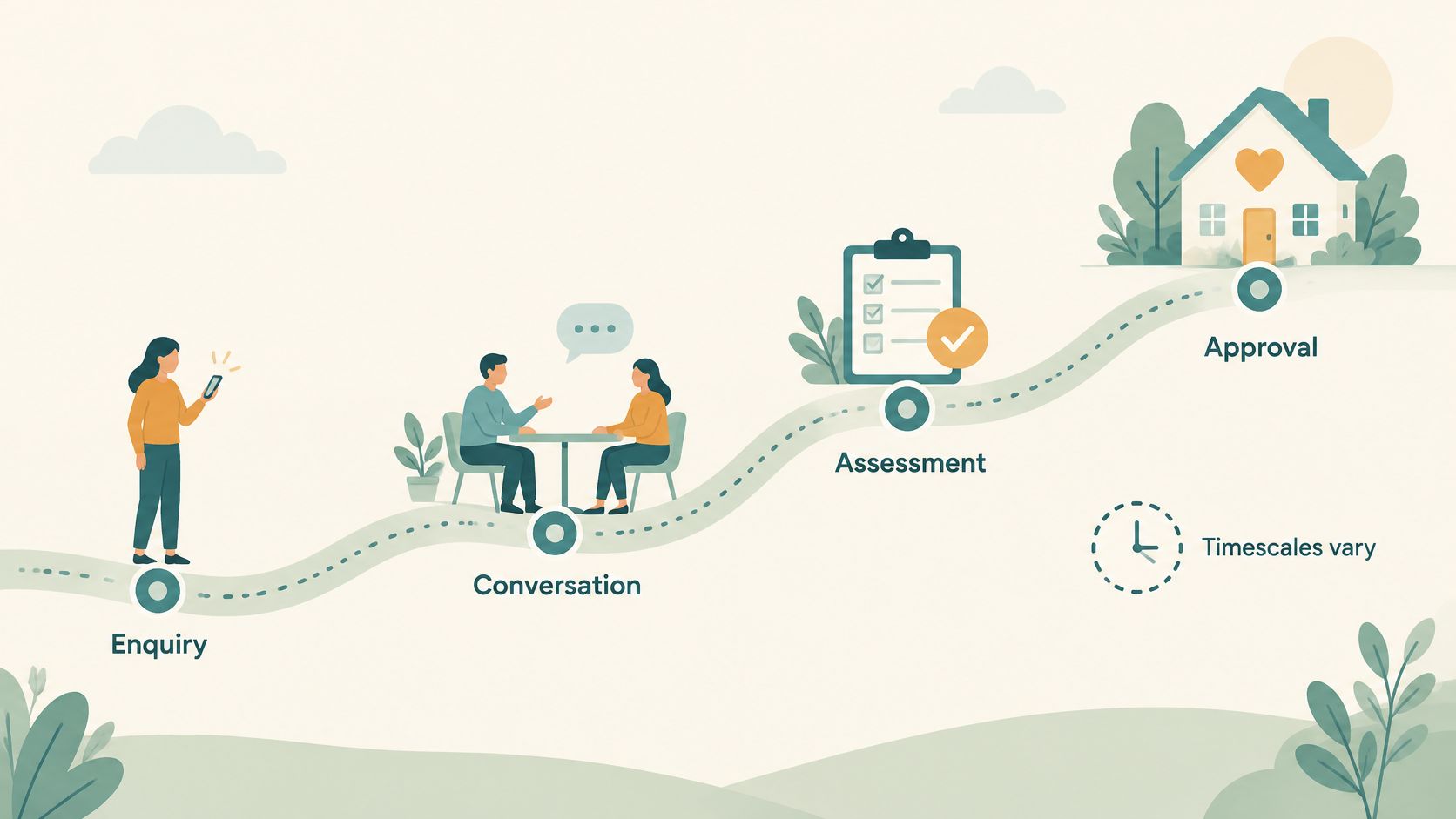
- Start a conversation. Phone or email and ask whether the service currently recruits where you live. If the area isn't confirmed, the rest of the process shouldn't begin there.
- Initial home visit. If the location and initial requirements appear suitable, Organic Fostering may arrange an initial visit. The purpose is to talk through the household, motivation and practical space, not to approve you on the day.
- Apply and train. Preparation training works better when you use real examples from family life, such as how you handle a broken routine, rather than rehearsed model answers.
- Assessment. Recruitment and assessment can include identity, date of birth, address history, references, and criminal-record and barred-list information for the relevant adults. The assessing social worker is trying to understand how the household thinks and adapts when a child's needs are unfamiliar.
- Panel and approval. A panel considers a recommendation, and an approval decision follows through the agency's process. Approval is a status to care, not a date when a child will arrive.
What the assessor is actually listening for
A polished sentence about wanting to help is less informative than a plain account of a hard week. Say a relative's stay overlapped with school exams and someone in the house was unwell. The useful detail is who changed their hours, who spoke to the school, and what you would do differently. That is evidence of judgement. It isn't a performance.
The same five stages apply to someone exploring fostering for the first time. An experienced foster carer moving from another service needs the agency's transfer route, so the child's continuity is planned, rather than a second copy of this explanation. How long each stage takes is covered on the fostering assessment timescales page. Read that for the shape of the wait, and treat any personal timetable as something to confirm with the service, not as a promise.
A careful "not yet" at panel is safer than a rushed yes that unravels after a child has moved in.
Placement Types That Suit Different Households
A placement that suits one household may strain another. Short-term fostering gives a child a safe home while the next steps are planned; long-term fostering offers continuity when a child needs a lasting home. The right fit depends on the child's needs and what the household can sustain.
| Placement type | What it is for | Question for the household |
|---|---|---|
| Short-term | A safe home while the next steps are planned | Can you manage an end date that is not fixed? |
| Long-term | Continuity when a child needs a lasting home | Can you stay involved through changes at school and in teenage years? |
| Emergency | A child who needs a home quickly | Can you be flexible at short notice? |
| Respite | Planned, time-limited stays | Can you offer reliable short periods of care? |
| Siblings | Brothers and sisters, together only when that is right for each child | Do you have the space, time and agreement for more than one child? |
| Teenagers | Young people needing support with education, identity and independence | Can your routines flex as a young person grows? |
The practical differences matter. Emergency care can involve little notice; respite calls for dependable availability over agreed short periods. A sibling placement may mean coordinating more than one child's routines, while fostering a teenager can involve supporting growing independence.
Fostering can affect work patterns, privacy, transport, school routines and family time. Approval does not guarantee that a placement will follow, and a narrow preference may not match the child who needs a home.
Before expressing a preference, consider the household's actual capacity. Could your work schedule absorb an unexpected school run? Could everyone manage if a short stay lasted longer than expected? For a sibling placement, think about space and the impact on each child, not only whether another bed is available.
Matching also considers age, sibling relationships, culture, faith, language, education and travel. The different types of foster care offer more detail. Be clear about what you can reliably provide, such as weekday respite but not an unplanned weekend. Clear limits help identify a placement the household can sustain.
What Keeps a Placement Steady
Blackpool Council reported that 59% of children in care had remained in the same home for two years by early 2025, up from 54% in December 2023. The share who had stayed in one home for the previous 12 months rose from 75% to 84% over the same period, according to the council's children's social care update. The same update reported around 544 children and young people in care, with some awaiting foster homes. These figures show why finding a household is only part of the task. The placement also needs the conditions and support to last.
A steady placement is built through everyday decisions: keeping routines predictable, communicating changes promptly and asking for help before strain becomes a crisis. Foster carers may also need to coordinate with professionals around school, health needs and contact with birth relatives. When plans change, clear communication helps the child and household understand what happens next.
For Organic Fostering carers, a supervising social worker, ongoing learning, contact with other carers, and help with a child's education and health needs form part of the support. Approved carers can also get advice outside normal hours. The agency's out-of-hours support for foster carers explains how that help can be accessed.
Notice patterns early. A single missed school day may have a simple explanation; repeated absence calls for a conversation. The same applies when contact arrangements change repeatedly, a carer feels their patience wearing thin, or a request for professional advice has gone unanswered.
For example, if the school has called twice in a fortnight and a contact visit has been rearranged without warning, tell the child's social worker and supervising social worker what has happened. Raising the concern early gives the adults involved a chance to agree practical next steps while the child remains in the home.
Allowances for the 2026 to 2027 Tax Year
For current and upcoming placements, the UK Government's national minimum fostering allowances are set by age band for the tax year running from 6 April 2026 to 5 April 2027. Blackpool falls under the rest of England rates.
| Child's age | Minimum weekly allowance |
|---|---|
| 0–2 | £176 |
| 3–4 | £182 |
| 5–10 | £201 |
| 11–15 | £227 |
| 16–17 | £267 |
The GOV.UK guidance on fostering costs gives the legal minimums: £176 for ages 0–2, £182 for ages 3–4, £201 for ages 5–10, £227 for ages 11–15 and £267 for ages 16–17. A fostering service may pay more, depending on its policy, the child's needs, the number of children placed, and the carer's skills and experience. Check the current published rates before budgeting.
Keep the payments distinct
Foster carers receive payments for active placements. A weekly figure is therefore not a guaranteed annual income, and tax treatment depends on HMRC rules for the relevant tax year.
- National minimum: the legal floor for the rest of England during this tax year.
- Service allowance: the amount approved by the fostering service, which may be above the national minimum.
- Fee: a separate payment under the service's own policy, distinct from the allowance for a child's day-to-day costs.
- Tax: the treatment of fostering income under HMRC rules. A weekly rate alone does not establish that payments are tax-free.
The fostering allowance calculator can help estimate payments from published age bands. When comparing services, ask which tax year their figures use, how allowance and any fee are separated, and what happens to payments if a placement ends. For example, using the minimum for a child aged 5–10 as a budget estimate may leave a gap if the service's actual payment differs.
Check Which Service Can Support You
Decide on geography before you choose a process. Organic Fostering's public office is Beaumont House, Office 4, 455 Chester Road, Manchester M16 9HA, in Old Trafford. That address shows where the independent agency is based. It isn't proof that Blackpool is a current recruitment area. The team can tell prospective foster carers which areas it currently recruits in.
Call 0161 241 1332 or email info@organicfostering.co.uk and ask two direct questions. Is Blackpool currently confirmed for recruitment, assessment and continuing support? Do the household's spare room, availability and right to work make an initial visit appropriate? If either answer is no, don't send an application to a service that can't supervise the home.
If Blackpool isn't confirmed
The practical next step is Blackpool Council's own fostering service, which is responsible for local children and for local supervision. That route deserves the same careful look as an agency route. Ask the council how supervision works, which placement shapes it needs, and what preparation it expects. A household that is well suited to fostering shouldn't stall because the first organisation it called doesn't cover the town.
If you are already an approved foster carer elsewhere, and the area is confirmed, use the agency's transfer pages so the child's continuity is considered before any move. Don't treat a transfer as a fresh application that ignores the child already in your home.
After those answers, use the published journey, support, allowance and enquiry pages only for the question you still have. An informed conversation is the right ending. An application sent to a service that cannot support the household isn't.
Organic Fostering assesses and supports foster carers where it can provide supervision, and it treats fostering in Blackpool as a local question of need, fit and a confirmed area rather than a general invitation. If you are weighing a spare room, a move from another service, or whether the council is the better route, start with that geography check. Visit Organic Fostering when you want the published route, support and allowance explanations beside that conversation.