
You're waiting for the first call, the first knock at the door, or the first night a child needs a bed in a home that is still learning their routines. Short term fostering asks a lot of a household in that moment, not because the stay is long, but because the first hours matter so much. It is a role built around welcome, steadiness and a clear plan for how a child moves on safely, not just how they arrive.
Table of Contents
- What Short Term Fostering Really Means
- Where Short Term Fostering Sits in the Care System
- How Long Short Term Placements Actually Last
- Who You Might Be Caring For
- What the First 72 Hours Look Like in Practice
- Planning the End of a Short Term Placement
- Comparing Short Term Fostering With Other Placement Types
- Support, Training and Allowances for Short Term Carers
What Short Term Fostering Really Means
A first short-term placement often begins with small, practical questions. Where will the child sleep, what do they eat, who answers the next phone call, and what happens if they arrive with little information? Those questions are the heart of short term fostering, because the task is not only to host a child, but to help them settle quickly while professionals work out the next step.
GOV.UK explains that short-term fostering can be as brief as one night, while other placements may last for many years or until a young person becomes an adult, so prospective carers should discuss the level of availability and flexibility needed before applying. foster care types
How it differs from other fostering arrangements
Short-term care is distinct from long-term fostering, where the expectation is a much more settled arrangement. It also differs from emergency fostering, which can begin with very little notice, and from respite care, which gives another carer or family a planned break.
That distinction matters because the placement purpose shapes everyday life. A short-term carer needs to be ready to support a child through transition, uncertainty and change, even when the placement itself is not meant to last long.
Practical rule: if the household can manage change well, short-term fostering may fit. If it needs long, predictable routines before feeling comfortable, the type of placement needs careful thought.
The language can sound similar at first, but the job is different. Short-term fostering is best understood as a bridge, not a holding pattern, and that bridge needs structure on both sides.
Where Short Term Fostering Sits in the Care System
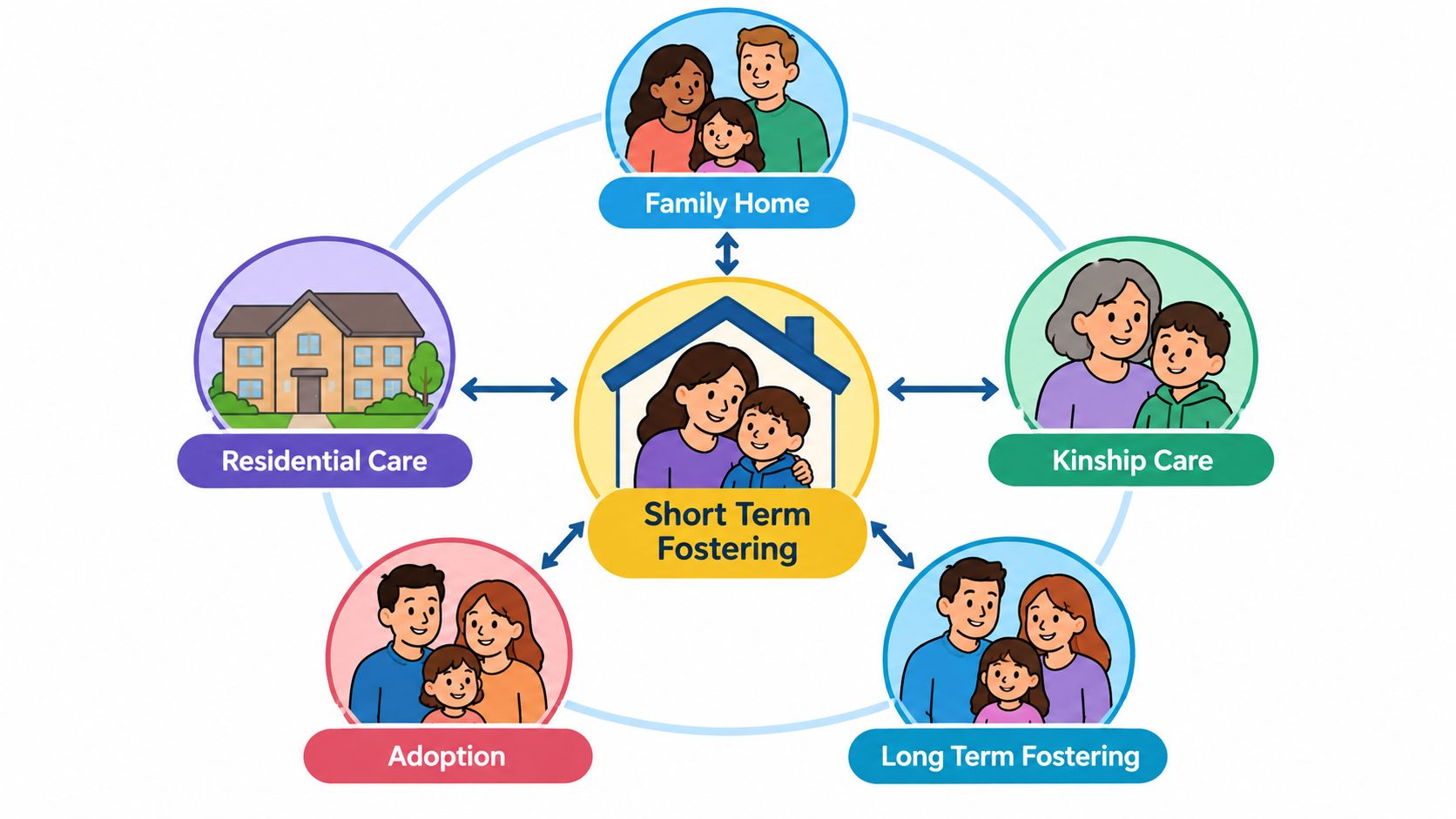
A child can arrive in short-term foster care while adults around them are still working out what happens next. That makes the placement part of the care system's holding structure, giving a child day-to-day stability while plans are tested and decisions are made. At 31 March 2024, 83,840 children were looked after in England, including 56,390 children in foster placements, which represented 67% of all children in care. The same figures show the number of children in foster care rose from 51,570 in 2015 to a peak of 57,190 in 2022 before easing to 56,390 in 2024. children looked after in England
That scale matters because foster homes carry most of the everyday care. Short-term fostering is not a side route. It is part of the main way children are looked after when they need family life, routines, and close attention while professionals plan the next step.
Why agency matching matters
A child may be placed through a local authority or an independent fostering agency. The matching process should look at practical needs first, then the child's relationships, location, identity, culture, faith, and language. A bed alone is never enough.
Short-term foster care sits alongside other forms of permanence and transition. If you want to compare it with a more settled arrangement, see what long-term foster care involves. Organic Fostering works in this space, coordinating placements around the child's wider needs and the support already in place.
A placement only works if the child can live there safely and keep enough continuity to breathe.
For carers in Manchester and the North West, that often means holding school links, sibling contact, familiar foods, language needs, or faith practices while the next plan is being built. The aim is steadiness, not just a roof over the child's head.
How Long Short Term Placements Actually Last
Short-term fostering does not mean one fixed length of stay. In England, 51% of foster placements that ended in the year to March 2020 had lasted fewer than six months. Of those, 12% lasted less than one week and 11% lasted between one week and one month. placement duration data
A simple way to think about duration
| Length of placement | Share of placements that ended |
|---|---|
| Less than one week | 12% |
| One week to one month | 11% |
| Less than six months overall | 51% |
That spread tells a clear story. Some children need a bed for only days, some need weeks of care while plans are tested, and some stay longer than anyone expected because court timetables, family finding or permanence decisions take time.
A household offering short-term care has to be ready for all three. The arrival may feel sudden, but the ending can be just as uncertain, which is why the rhythm of the placement matters as much as the label.
Short-term care also tests a carer's ability to reset. A child may leave, a room may need to be turned over quickly, and another referral may follow after a quiet gap or with almost no pause at all.
Useful mindset: plan for a stay that is shorter than expected and prepare emotionally for one that stretches a little longer.
That flexibility is not about being endlessly available. It is about being able to make a child feel secure even when the timetable is still moving.
Who You Might Be Caring For
Short-term fostering can involve very different children. One placement may be a young child arriving after a family crisis. Another may be a teenager waiting for a longer-term plan, or siblings who need to stay together while adults sort out next steps.

Matching is about more than space
Government statistics show that, at 31 March 2024, 52% of children looked after outside their local-authority boundary were placed with foster carers who were not relatives or friends, and matching decisions can therefore need to consider location, existing relationships and the child's wider identity and support needs. placement location data
That is why short-term fostering is never just about having an empty bedroom. A child's age, school, language, faith, cultural background and family links can all shape where they go and how they are settled.
For teenagers, the first contact can feel especially sensitive. teens in foster care Older young people often notice whether adults speak plainly, respect privacy and explain what happens next without drifting into vague reassurance.
The first 72 hours need a calm structure. Carers usually need delegated authority details, contact arrangements, health information and transport plans ready to use, because a child may arrive with partial information and still need decisions made quickly. Arrival should be treated as a defined operation, not improvisation.
If the child arrives with a bag and a lot of unknowns, the carer's job is to make the unknowns smaller, one decision at a time.
What the First 72 Hours Look Like in Practice
The first day is rarely about settling into a routine. It is usually about immediate comfort, practical safety and getting the basic facts in the right hands. That can mean medication questions, school transport, bedtime anxieties, and a contact plan that helps everyone know who speaks to whom.
The core tasks that can't wait
A short-term carer often needs to check four things quickly.
- Health and medication: what the child takes, when they take it and who holds the records.
- Delegated authority: what the carer can decide without calling for approval every time.
- Contact with family: when it happens, how it is managed and what the child has been told.
- Daily movement: school transport, nursery runs, packed bags and anything the child needs for the next morning.
Those first decisions matter because frequent moves are a real risk. Government stability statistics define high placement instability as a child experiencing three or more placements in the year ending 31 March, or three or more over the preceding two-year period, and 23% of children looked after experienced three or more placements across the previous two years in 2024. stability measures
A good first 72 hours reduces the chance of confusion becoming disruption. If school knows the right pickup, if the child knows where their things are, and if professionals have a clear chronology, the placement starts from a safer place.
Matching also has to respect identity. A child may need their language, faith, sibling contact or community ties protected while the plan for their future is still taking shape, especially when the placement is outside the local area.
Planning the End of a Short Term Placement
A short-term placement should be judged by the quality of the ending, not just the speed of the move. That sounds counterintuitive at first, but the evidence makes the point clearly. Stability data show that 14% of children looked after for less than 12 months experienced three or more placements in the year, compared with 9% of children looked after for longer, which shows why endings need planning from day one. children looked after in England
What a planned ending usually includes
Good exit planning usually covers the following:
- Introductions: how the next carer, family member or returning parent will be introduced.
- Contact: what happens to calls, visits and familiar relationships.
- Belongings: where clothes, toys, documents and keepsakes will go.
- School continuity: who tells the school, who updates transport and who handles the handover of information.
- Contingency planning: what happens if reunification or permanence is delayed.
Those details matter because endings can drift. A plan that looked clear at the start may slow down later, and the child should not be left in limbo while adults negotiate next steps.
The most useful questions at the start are often simple. Who makes the decision if the plan changes? What should happen if the placement is extended? Which records need to move with the child? Who is responsible for explaining the next step in age-appropriate language?
A carer does not have to solve the plan, but should know how the plan will be held if circumstances change.
A well-managed ending protects the child's memory of the placement as safe, not abrupt.
Comparing Short Term Fostering With Other Placement Types
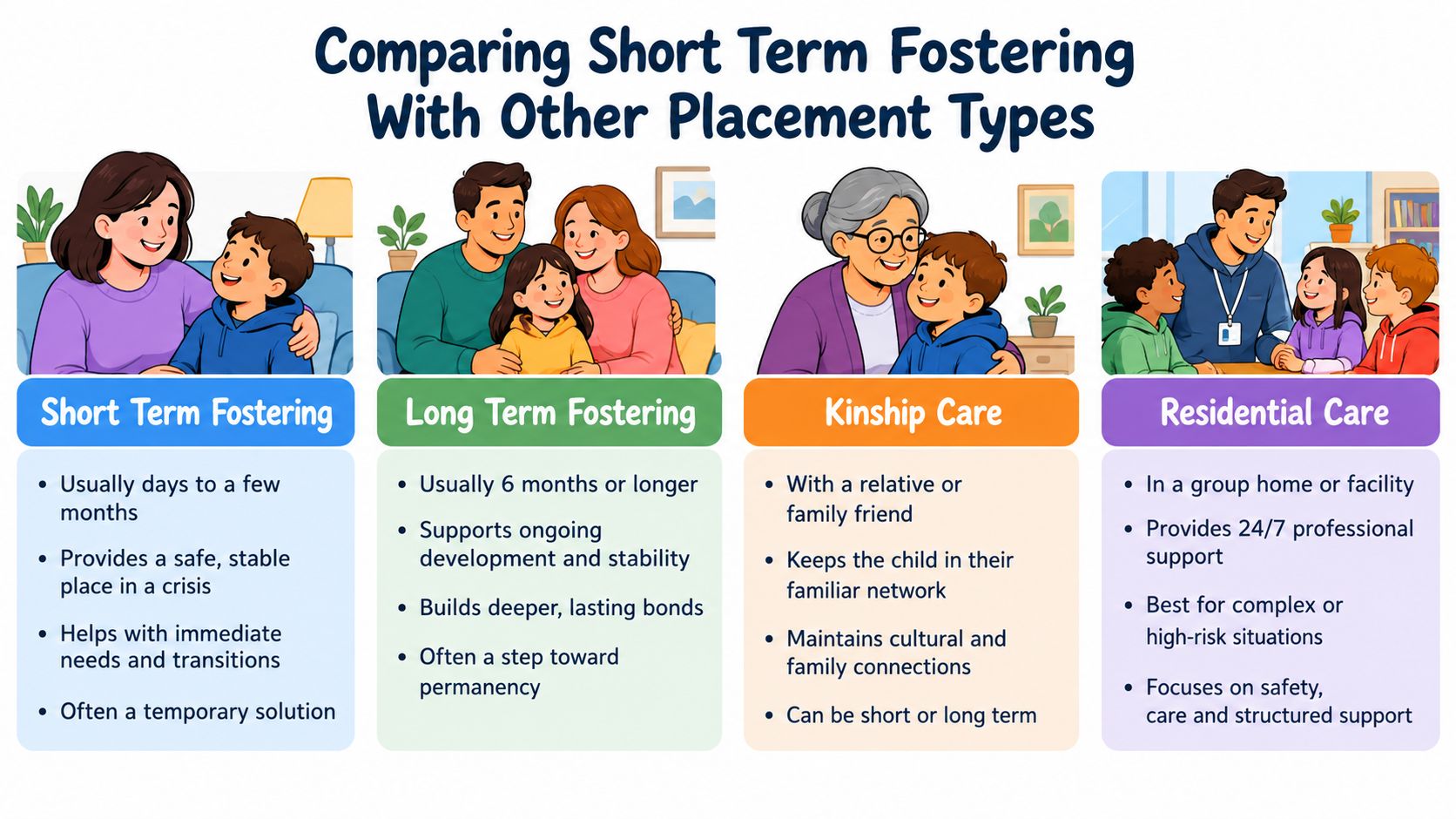
Short-term fostering suits some households better than others. Compared with long-term care, it asks less for permanence and more for readiness. Compared with kinship care, it usually involves a wider formal matching process. Compared with residential care, it places the child in a family home, which can feel more intimate and more changeable at the same time.
A practical self-check
A household may handle short-term care well if it can usually cope with:
- Unpredictable notice: being ready when a call comes.
- Variable routines: school, bedtime and contact changing quickly.
- Emotional endings: helping a child leave without making the goodbye harder.
- Household flexibility: rearranging work, childcare or transport when needed.
Government figures also show why the need is persistent. During the 2024 to 2025 reporting period, 1,765 approved household places were used exclusively for short breaks, equivalent to 3% of all approved mainstream fostering places, and the number of short-break places increased by 41% compared with 2021. fostering in England 2024 to 2025
That demand doesn't mean every household should say yes to every placement. It means carers need to know what kind of uncertainty they can absorb safely, and where they need clearer limits.
Short-term fostering can suit new carers, experienced carers and transfer carers, but only when the household can tolerate change without losing the basics of warmth, consistency and calm.
Support, Training and Allowances for Short Term Carers
A child can arrive with little notice, and the first days often feel like setting up a house while someone is already living in it. Short-term fostering works best when carers have training, supervision and clear financial support before that call comes. Fostering services have a formal duty to provide the training they judge necessary for children placed with carers, and Ofsted's fostering standards require each placement to promote children's safety and welfare. Services are also expected to encourage foster-carer associations or self-help groups, because carers do better when they are not left to make sense of complex placements alone. Ofsted fostering standards
What carers should expect in practice
Training should continue after approval. A short-term carer may need refreshers on safeguarding, behaviour, contact, education, recording, identity and attachment, especially when a placement moves quickly and the child's situation changes from day to day.
Support also has to be practical. That usually means a supervising social worker who can answer placement questions, guidance on allowances and costs, and a clear route for help when a child arrives with missing information or the plan changes at short notice.
Organic Fostering sets out its approach to recruitment, assessments, matching, supervision, allowance information and transfer support, so prospective carers in Manchester and the North West can compare the wider England framework with one agency's process. Its published pages explain the route from first enquiry through approval and ongoing support, which helps households judge whether the arrangement fits their circumstances.
Short-term fostering is often described as flexible. Flexibility only works when the carer knows where the support line is. Good support lowers the strain of uncertainty, and a clear allowance policy helps the household plan for transport, food, clothing and routine expenses without guessing.
For anyone considering a first placement or a transfer from another agency, the next step is usually a calm conversation rather than a promise. A short, informal discussion can clarify eligibility, the kind of placement that fits the household, and how short-term care would work day to day.