

Can foster carers claim Child Benefit? Generally no, when a local authority places a child with them and pays toward that child's accommodation or maintenance. The exception sits with the carer's own children, because a birth, adopted or permanently cared-for child in the household can still be claimed for under the normal rules.
Many people assume a benefit follows a child into a home. Child Benefit doesn't work that way. It follows the money, which means two households with identical children, identical bedrooms and identical approval certificates can end up with completely different answers depending on who signs the placement payment. That's the gap worth closing before a claim form goes anywhere near HMRC.
Table of Contents
- Can Foster Carers Claim Child Benefit for a Fostered Child
- Why Child Benefit and Fostering Allowance Are Separate
- Claiming Child Benefit for Your Own Children
- How Fostering Affects Other Benefits and Credits
- What to Report and Mistakes That Cause Overpayments
- Confirm Your Child Benefit Position Before You Claim
Can Foster Carers Claim Child Benefit for a Fostered Child
The question is really about payment, not permission. The GOV.UK Child Benefit eligibility rules state that a person fostering a child can receive Child Benefit only where the local council is not paying anything toward that child's accommodation or maintenance. Nothing in that sentence turns on whether the carer is approved, experienced, working through an agency or fostering for the first time.
The test asks two things. Who pays for the child's care, and what does that payment cover?
For conventional local-authority placements the answer is usually straightforward, because those placements normally involve public payments intended to cover the child's care costs. Agency involvement changes the administration, not the underlying test. If the placing authority is meeting the child's maintenance, the exclusion applies.
| Situation | Child Benefit for the fostered child | Why it matters | Check first |
|---|---|---|---|
| Local authority places a child and pays toward accommodation or maintenance | Generally no | The exclusion applies where the authority pays toward the child's care | Who pays and what the payment covers |
| Placement arranged through an agency but funded by a local authority | Generally no, where the authority pays toward maintenance | The funding source decides the test, not the agency name | The placing authority's payment arrangements |
| Own birth, adopted or permanently cared-for child living in the household | Can usually be claimed under normal rules | The placement rule applies to the placed child only | Whether another adult already claims for that child |
| Child with no council payment toward accommodation or maintenance | Decided by the individual arrangement | Entitlement turns on individual circumstances | Ask HMRC or the council before claiming |
Treat the caveat beside that table as part of the table. An incorrect claim can result in overpayment recovery, so the check happens before the claim, not after it. Money paid under an award the household wasn't entitled to gets clawed back, and that lands hardest in the first months of a placement when costs are already unpredictable.
One rule, four nations
The restriction is UK-wide in scope, although the detailed statutory references differ between Great Britain and Northern Ireland. England's regulations are cited in guidance for illustration. Carers in Scotland, Wales and Northern Ireland should read the rules for their own nation on GOV.UK before relying on any summary, including this one.
Before making a claim, write down three things. Who pays, what each payment covers, and whether the placement is formally arranged under the relevant looked-after-children legislation. Those three notes answer most of the question on their own.
Why Child Benefit and Fostering Allowance Are Separate
Picture two doors in the same hallway. Child Benefit goes through one, the fostering allowance goes through the other, and each has its own lock. A key that opens one tells you nothing about the second.
Child Benefit is a payment for an eligible child, assessed child by child under HMRC rules. The fostering allowance meets the cost of caring for a placed child, set under the fostering service's policy and the placing authority's arrangements. Foster carers receive payments for active placements, and that phrase does real work: the payment is tied to a child being in the home.
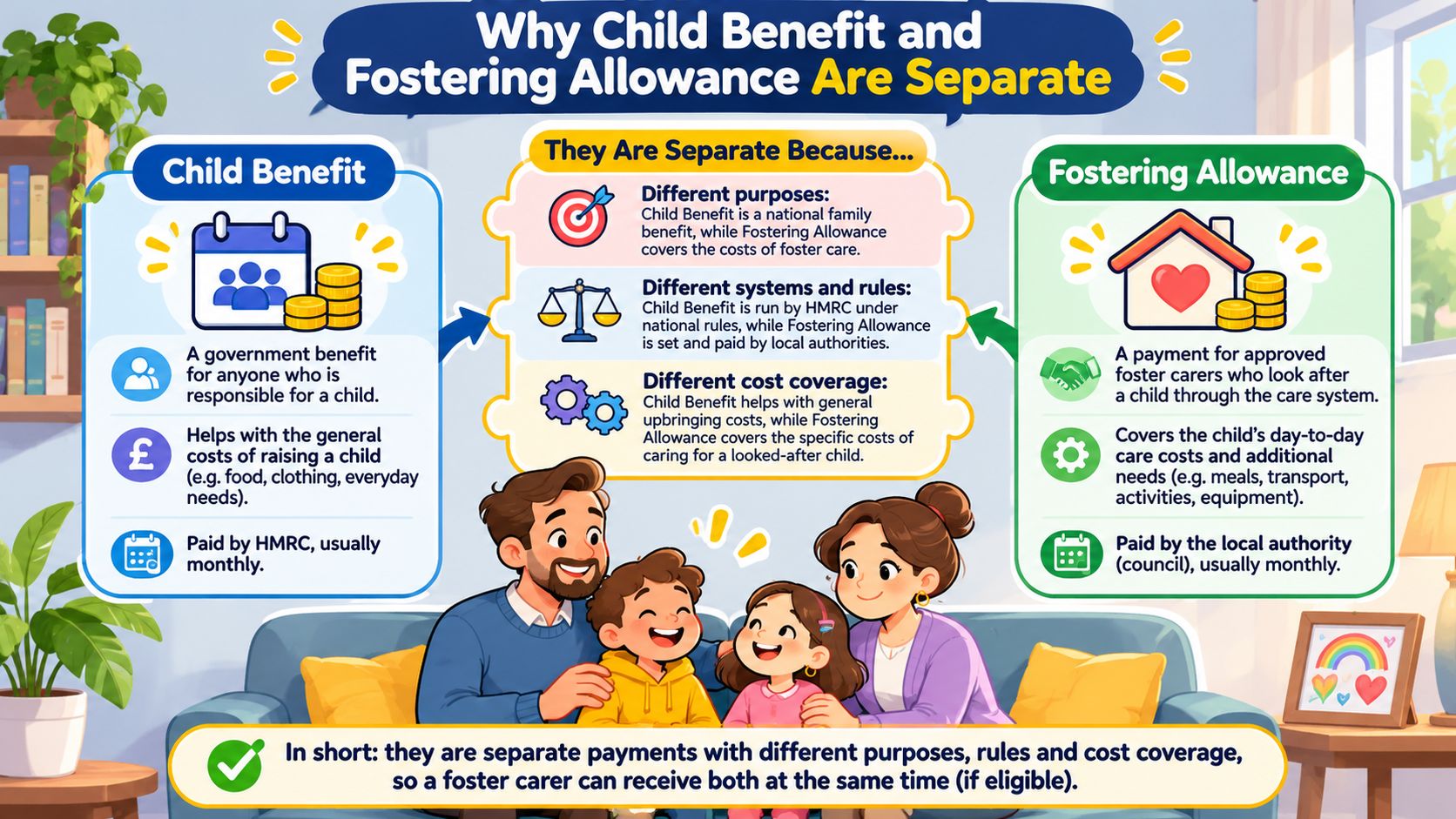
| Feature | Child Benefit | Fostering allowance |
|---|---|---|
| Purpose | Support for raising an eligible child | Meets the cost of caring for a placed child |
| Basis for entitlement | Assessed child by child under eligibility rules | Set for each active placement under the fostering service's policy |
| Who pays | HM Revenue and Customs | The fostering service or placing authority, under its published policy |
| How the rate is set | Government rates for each tax year | National minimum rates by location and age, plus any agency allowance or fee |
| What must be reported | Changes in the child's care arrangement | The allowance must be disclosed to the organisation paying other benefits |
The national minimum depends on where the household is and how old the child is. GOV.UK's guidance on help with the cost of fostering sets the published minimum for the rest of England in 2026–27 at £176 a week for a child aged 0 to 2 and £267 a week for a young person aged 16 to 17. An agency may pay its own approved allowance, extras or a professional fee on top, and those elements should be kept apart when budgeting rather than bundled into one figure.
HMRC's technical position is narrow and specific: the exclusion applies to the carer with whom the child is placed, and it is linked to placements under England's Care Planning, Placement and Case Review Regulations 2010 and the Fostering Services Regulations 2011, as set out in the Child Benefit technical manual.
Practical rule: the allowance is not a substitute for Child Benefit, and the two shouldn't be added together without checking the rules that apply to each.
The takeaway is a list, not a calculation. For every child in the household, note each payment received, the body paying it, and the test that payment passed. Understanding how the allowance itself is structured is worth a separate read at understanding the fostering allowance.
Claiming Child Benefit for Your Own Children
Yes, in most cases. The exclusion attaches to the placed child, not to the household, so fostering does not cancel a claim for your own birth, adopted or permanently cared-for children living with you. Child Benefit follows who the child is and who is responsible for their maintenance, not whether the home also fosters. Each child is assessed separately, and one child's exclusion never drags down another's award.
Only one person can generally be paid Child Benefit for a particular child. Before starting a claim, check whether another adult already receives it, because a duplicate claim will be closed. Some families also care for a relative's or friend's child, and those arrangements sit in a different position in the rules: kinship care versus foster care explains where the boundary falls.
The rate structure works by birth order: one rate for the eldest or only child, a lower rate for each additional child. Rates have risen steadily over three decades, from £9.65 and £7.80 a week in April 1992 to £26.05 and £17.25 a week in 2025–26.
| Tax year | Eldest or only child (weekly) | Each additional child (weekly) |
|---|---|---|
| April 1992 | £9.65 | £7.80 |
| 2019–20 | £20.70 | £13.70 |
| 2023–24 | £24.00 | £15.90 |
| 2024–25 | £25.60 | £16.95 |
| 2025–26 | £26.05 | £17.25 |
| 2026–27 | Check GOV.UK for the confirmed rate | Check GOV.UK for the confirmed rate |
The weekly figures for each tax year are published on GOV.UK's Child Benefit rates page, which is also where the confirmed 2026–27 amounts will appear once set.
A table like this answers exactly one question: how much. Whether each child in the household qualifies is a separate question, settled by the eligibility rules rather than by the size of the payment, so look up the amount only after you know which children the claim covers.
Three checks before submitting. Count the eligible children in the household. Confirm which rate applies to each. Then confirm that no fostered child has been included in that claim, since the exclusion applies child by child and the allowance a placement attracts is a separate payment with its own rules.
How Fostering Affects Other Benefits and Credits
Child Benefit is one line in a household budget, not the whole ledger. GOV.UK's guidance for foster carers on claiming benefits is clear that fostering can affect benefits, that carers must tell the organisation paying their benefit about the fostering allowance, and that a foster child may qualify separately for disability benefits where the eligibility criteria are met.
That produces the position that confuses people most. A carer may be unable to claim Child Benefit for a council-funded child while still having to disclose the fostering allowance when a means-tested benefit is assessed. Both statements are true at once, because they answer different questions.
Here's the checklist, with the timing that matters for each.
- Universal Credit. Report the allowance and any placement start, change or end. Report at the point the change happens, not at the next annual review.
- Housing Benefit. Notify the council that assesses it, since it runs its own income assessment separate from HMRC's.
- Legacy tax credits. Notify HMRC if the household still has an open tax credit award.
- Disability benefits. A foster child may qualify separately where the criteria are met, so check the child's own circumstances rather than assuming the placement rules settle it.
- National Insurance credits. These can be built up through a Child Benefit claim. Check the current conditions on GOV.UK, because they attach to the claimant and the child's circumstances.
Scheduled rate changes for 2026–27 don't automatically reach a foster placement. Eligibility decides first, and the amount only matters once eligibility is settled. Use an official benefits calculator and read the current GOV.UK rates before comparing two options on paper.
The official guidance doesn't give a worked example for every household shape, and the interaction between an allowance intended to cover a child's costs and a benefit system that assesses income and household circumstances differently is especially awkward. Where the position is complex, a benefits adviser earns their keep. Tax treatment is a separate question again, covered in foster carer tax.
What to Report and Mistakes That Cause Overpayments
The most expensive error in this whole area is the unreported change. A carer starts a placement, says nothing, and an existing award keeps paying. Overpayment recovery follows, sometimes months later, and the household has already spent the money.
The sequence below works like a paper trail you build as events happen, rather than a pile of evidence you reconstruct afterwards. Work through it in order.
- Note the placement start date and who makes each payment. The date is the evidence that circumstances changed, and it's the first thing anyone will ask for.
- Tell HMRC if a council or agency pays you to look after another child, including through fostering. GOV.UK's guidance on looking after someone else's child gives that instruction directly, so it isn't optional paperwork.
- Check whether an existing claim for another child needs changing. A claim that continues after the rules stop applying is exactly how overpayments start.
- Tell every organisation paying you a benefit about the fostering allowance. Fostering can affect wider benefits, and each paying body needs the information.
- Keep dated records of placement starts, ends and allowance payments. A dated note settles disputes that memory can't.
- Review the position at approval, at any placement change, on reunification or adoption, and whenever payment arrangements change. Those are the natural checkpoints, and missing one is how a stale award survives.
How an overpayment builds in practice: a placement starts in spring and the carer means to report it, but the form waits for a quiet evening that never comes. By autumn an award has paid for months against circumstances that no longer exist, and the full amount is recoverable even though it was spent on the household in good faith.
Six mistakes and their corrections
Assuming a placement ending tidies up the paperwork by itself. The fostering payment stops with the placement because it is tied to an active placement, but no benefits office learns that the placement has ended unless someone reports it. Report endings with the same care as starts.
Assuming an existing claim continues automatically after a placement starts. Report the change and let HMRC confirm the position in writing.
Treating the allowance as salary or guaranteed income. It covers the cost of care and is tied to an active placement, so it stops when the placement does.
Adding Child Benefit and the allowance together to estimate income. List each payment separately and test each against its own rules. The allowance exists to meet the costs of care, while Child Benefit entitlement turns on who is responsible for the child and who pays for their maintenance, so the two never belong in one pot.
Telling one organisation and assuming the rest know. HMRC, the council and every other paying body keep separate records, and entries do not copy across. A disclosure only counts with the organisation that received it.
Delaying disclosure to a benefits office. Notify the paying organisation when the allowance begins, not after the first review letter arrives.
Tax is where carers often assume the wrong thing. For tax purposes, foster carers are generally treated as self-employed and normally register with HMRC and complete Self Assessment. That is a different framework from the Child Benefit test, which asks who pays for the child's maintenance rather than how the carer is taxed, and tax allowances for foster carers sets out how the two fit together.
Confirm Your Child Benefit Position Before You Claim
Five actions turn this from a guess into a documented position.
- Write down, for each child in the household, who pays for their care, what each payment covers and when it started. One page, one row per child.
- Read the GOV.UK eligibility rules and compare them with that list. The situation table earlier in this article is the short version.
- Ask the council or agency to confirm in writing what the placement payment covers and whether the placement is arranged under looked-after-children legislation. A written answer is worth more than a phone recollection.
- Check the claim with HMRC through GOV.UK before submitting it, and keep a dated record of what you were told.
- If you already foster, ask your fostering service or supervising social worker to help with benefit questions. They see these situations regularly.
For anyone considering fostering, the sensible first move is a conversation rather than a form. Organic Fostering will talk prospective carers through its current requirements when they get in touch, and carers approved with the agency get a supervising social worker, preparation and ongoing learning, advice outside normal hours for approved carers, contact with other foster carers, and help navigating a child's education and health needs. The agency also gives carers a transparent explanation of allowances and opportunities to give feedback and raise concerns.
Start with how payments are structured on the fostering allowance page, use the fostering allowance calculator for a rough weekly and annual picture, and read the tax allowance guidance for the tax side. Exact figures depend on the current policy and the financial year, so confirm them before building a budget around them.
Checking early protects the household budget and avoids a correction later.
Working out whether Child Benefit applies is easier when the payment structure is clear from day one, and that's the conversation Organic Fostering has with prospective carers before anything is signed. The agency explains its current allowance policy, how placement payments are made and what carers need to report, so the benefit questions have a factual starting point. If you're weighing up fostering in Greater Manchester or the North West, get in touch and ask how the numbers would work for your household.